QUESTION IMAGE
Question
period: answer to the nea
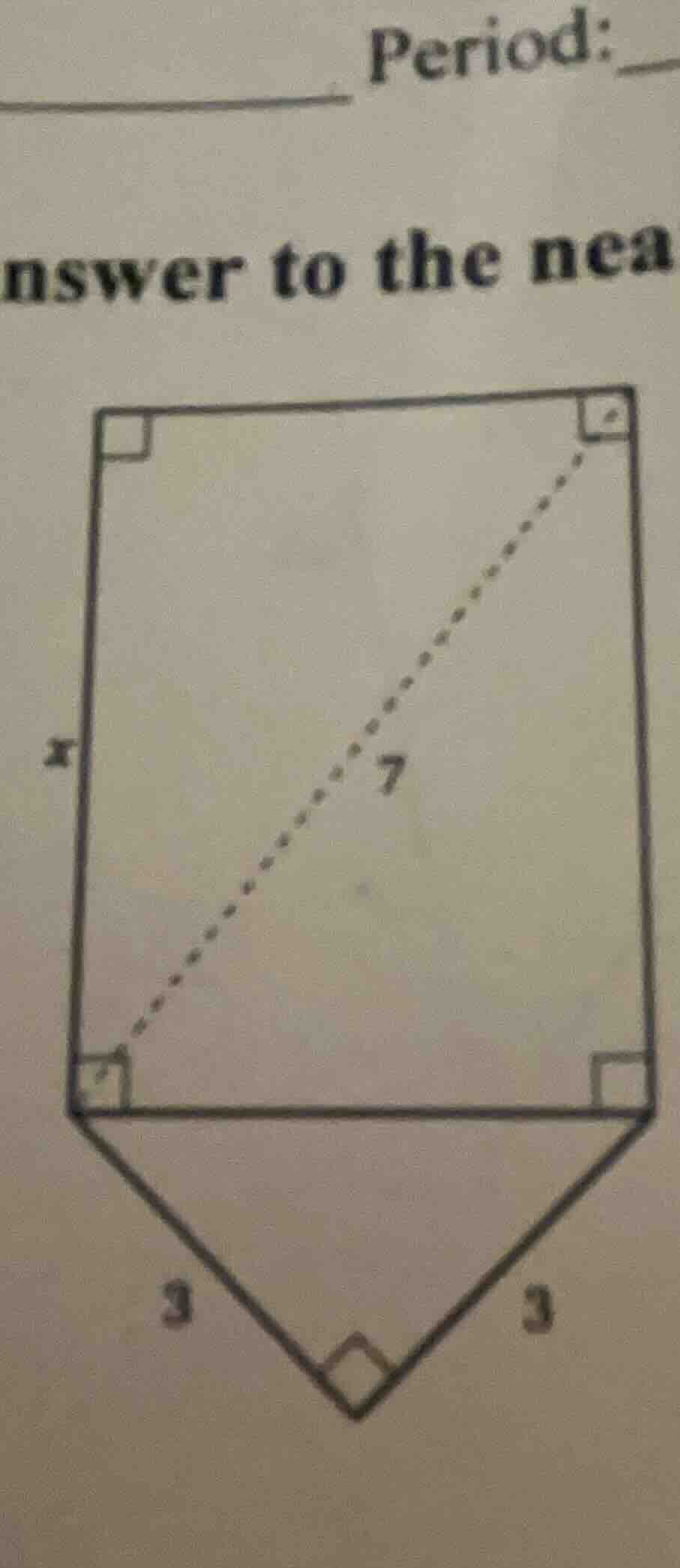
Step1: Identify the right triangle
The dashed line (length 7) and the side \( x \) and the base of the right - angled triangle (from the bottom - left right angle to the bottom - right right angle) form a right triangle. First, we need to find the length of the base of this right triangle. The bottom part is a right - angled isosceles triangle with legs of length 3. The base of the larger right triangle (the one with hypotenuse 7) is equal to the length of the side opposite the right angle in the bottom isosceles right triangle? Wait, no. Wait, the figure: the bottom is a right - angled triangle with legs 3 and 3, so the hypotenuse of the bottom triangle (the side that is the base of the larger right triangle) can be found using the Pythagorean theorem. For the bottom right - angled triangle with legs \( a = 3 \) and \( b = 3 \), the hypotenuse \( c \) is \( c=\sqrt{3^{2}+3^{2}}=\sqrt{9 + 9}=\sqrt{18}=3\sqrt{2}\)? Wait, no, wait the figure: looking at the angles, the bottom is a right - angled triangle (the small one) with a right angle, and the two legs are 3. But the larger figure: the left side is \( x \), the bottom left is a right angle, the bottom side (the base of the rectangle - like part) and the dashed line (7) form a right triangle. Wait, maybe I misread. Wait, the figure has four right angles in the upper part? Wait, no, the left side is \( x \), bottom left is a right angle, bottom right is a right angle, top left is a right angle, top right is a right angle, and the bottom is a triangle with two 3s and a right angle. So the length of the base of the rectangle (the horizontal side between the two bottom right angles) is equal to the length of the side opposite the right angle in the bottom right - angled triangle. Wait, the bottom triangle is a right - angled triangle with legs 3 and 3, so its hypotenuse is \( \sqrt{3^{2}+3^{2}}=\sqrt{18}=3\sqrt{2}\)? No, wait, no, if the bottom triangle is a right - angled triangle with legs 3 and 3, then the hypotenuse is \( \sqrt{3^{2}+3^{2}}=\sqrt{18}=3\sqrt{2}\approx4.24 \). But then the larger right triangle has hypotenuse 7 and one leg equal to the hypotenuse of the bottom triangle? No, wait, maybe the bottom triangle is a right - angled triangle, and the side adjacent to \( x \) in the larger right triangle is \( x \), and the other leg is the length of the base, which is equal to the length of the side of the bottom triangle's hypotenuse? Wait, no, let's re - examine. The figure: the left side is \( x \), the dashed line is 7, and the base of the right triangle (the horizontal leg) is equal to the length of the side of the bottom right - angled triangle's hypotenuse? Wait, no, maybe the bottom triangle is a right - angled triangle, and the length of the base (the horizontal side) is 3? No, the two sides of the bottom triangle are 3, and it's a right - angled triangle, so the hypotenuse is \( \sqrt{3^{2}+3^{2}} = 3\sqrt{2}\approx4.24 \). Then, in the larger right triangle (with hypotenuse 7 and one leg \( x \) and the other leg equal to the hypotenuse of the bottom triangle), we can use the Pythagorean theorem. Wait, no, maybe I made a mistake. Wait, the figure: the left side is \( x \), the bottom left is a right angle, the bottom side (the horizontal side) is equal to the length of the side of the bottom triangle's hypotenuse? Wait, no, the bottom triangle is attached to the rectangle. The rectangle has length \( x \) (vertical) and width equal to the hypotenuse of the bottom triangle. Then the diagonal of the rectangle is 7. So the rectangle has length \( x \) and width \(…

Snap & solve any problem in the app
Get step-by-step solutions on Sovi AI
Photo-based solutions with guided steps
Explore more problems and detailed explanations
\( \approx5.6 \)