QUESTION IMAGE
Question
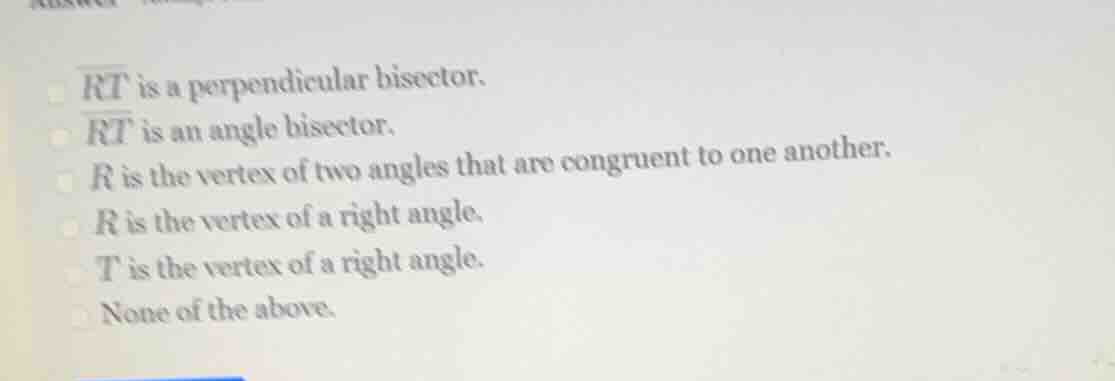
$\overline{rt}$ is a perpendicular bisector.
$\overline{rt}$ is an angle bisector.
$r$ is the vertex of two angles that are congruent to one another.
$r$ is the vertex of a right angle.
$t$ is the vertex of a right angle.
none of the above.
To solve this, we analyze each statement:
- “\(\overline{RT}\) is a perpendicular bisector”: A perpendicular bisector intersects a segment at 90° and divides it into two equal parts. Without a diagram, we can’t confirm this, but even so, this is not necessarily implied by the other statements.
- “\(\overline{RT}\) is an angle bisector”: An angle bisector splits an angle into two equal angles. Again, no diagram means we can’t confirm, and this isn’t directly tied to the other angle/right - angle claims.
- “\(R\) is the vertex of two congruent angles”: If \(\overline{RT}\) were an angle bisector (not confirmed here), this could be true, but we don’t have enough info.
- “\(R\) is the vertex of a right angle”: A right angle is 90°. If \(\overline{RT}\) is a perpendicular bisector or forms a right angle at \(R\), this could be true, but we lack a diagram.
- “\(T\) is the vertex of a right angle”: Similar to \(R\), we need a diagram to confirm if \(T\) forms a 90° angle.
Since we don’t have a diagram or additional context to verify any of these statements, the most logical choice is:
Without a diagram or additional context, none of the statements about \(\overline{RT}\) (perpendicular bisector, angle bisector) or the vertices \(R\) and \(T\) (congruent angles, right angles) can be confirmed. Thus, "None of the above" is the appropriate choice.

Snap & solve any problem in the app
Get step-by-step solutions on Sovi AI
Photo-based solutions with guided steps
Explore more problems and detailed explanations
None of the above.