QUESTION IMAGE
Question
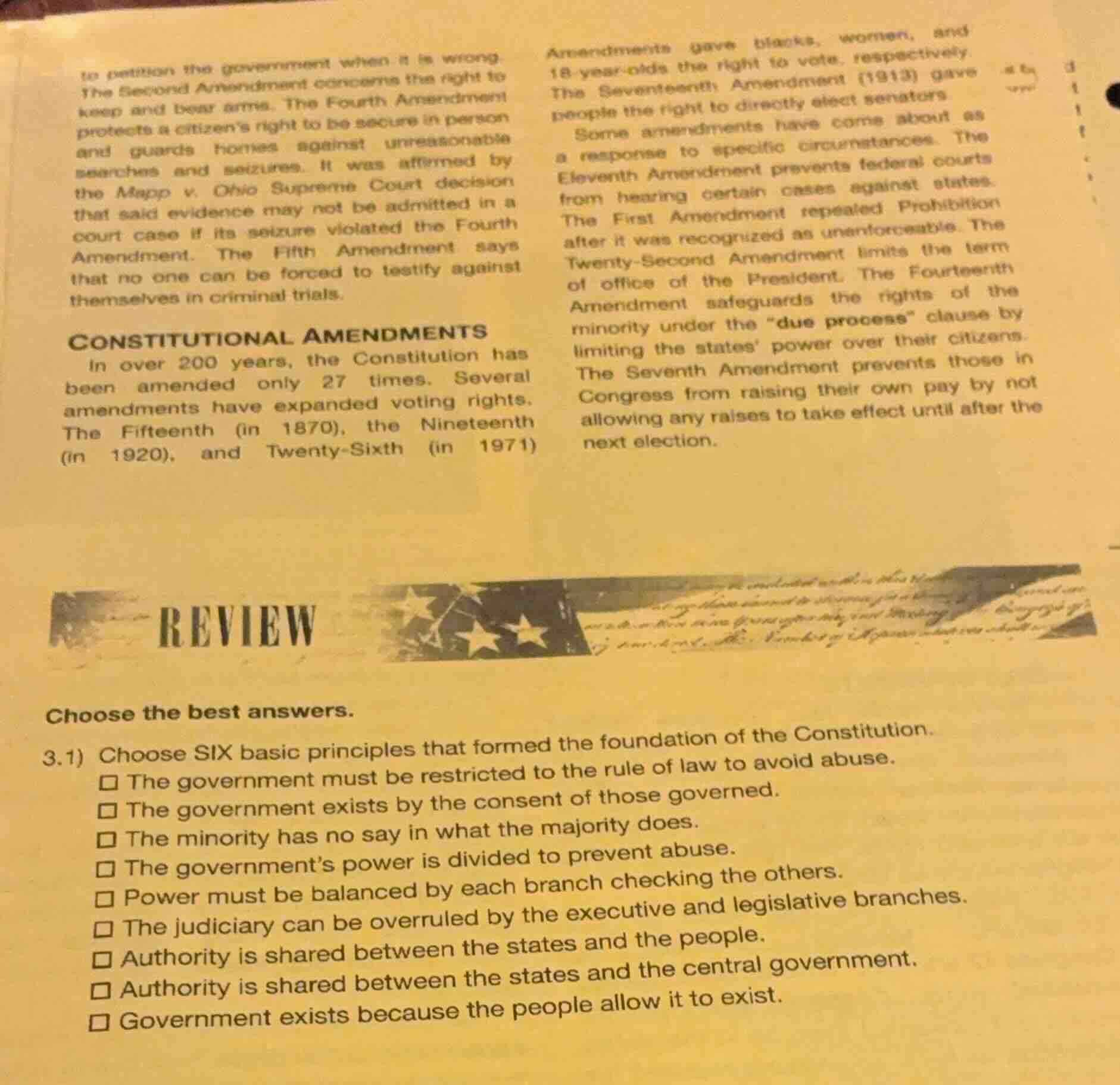
to petition the government when it is wrong. the second amendment concerns the right to keep and bear arms. the fourth amendment protects a citizens right to be secure in person and guards homes against unreasonable searches and seizures. it was affirmed by the mapp v. ohio supreme court decision that said evidence may not be admitted in a court case if its seizure violated the fourth amendment. the fifth amendment says that no one can be forced to testify against themselves in criminal trials.
constitutional amendments
in over 200 years, the constitution has been amended only 27 times. several amendments have expanded voting rights. the fifteenth (in 1870), the nineteenth (in 1920), and twenty - sixth (in 1971) amendments gave blacks, women, and 18 - year - olds the right to vote, respectively. the seventeenth amendment (1913) gave people the right to directly elect senators
some amendments have come about as a response to specific circumstances. the eleventh amendment prevents federal courts from hearing certain cases against states. the first amendment repealed prohibition after it was recognized as unenforceable. the twenty - second amendment limits the term of office of the president. the fourteenth amendment safeguards the rights of the minority under the “due process” clause by limiting the states power over their citizens. the seventh amendment prevents those in congress from raising their own pay by not allowing any raises to take effect until after the next election.
review
choose the best answers.
3.1) choose six basic principles that formed the foundation of the constitution.
□ the government must be restricted to the rule of law to avoid abuse.
□ the government exists by the consent of those governed.
□ the minority has no say in what the majority does.
□ the government’s power is divided to prevent abuse.
□ power must be balanced by each branch checking the others.
□ the judiciary can be overruled by the executive and legislative branches.
□ authority is shared between the states and the people.
□ authority is shared between the states and the central government.
□ government exists because the people allow it to exist.
Each selected option aligns with a core U.S. Constitutional principle:
- "The government must be restricted to the rule of law to avoid abuse." aligns with the Rule of Law principle.
- "The government exists by the consent of those governed." aligns with Popular Sovereignty.
- "The government’s power is divided to prevent abuse." aligns with Separation of Powers.
- "Power must be balanced by each branch checking the others." aligns with Checks and Balances.
- "Authority is shared between the states and the central government." aligns with Federalism.
- "Government exists because the people allow it to exist." aligns with Popular Sovereignty (a restatement of the consent principle).
Incorrect options: The minority has protected rights under the Constitution, the judiciary (via judicial review) cannot be overruled by the other branches on constitutional matters, and authority is not shared between states and people as a core structural principle.

Snap & solve any problem in the app
Get step-by-step solutions on Sovi AI
Photo-based solutions with guided steps
Explore more problems and detailed explanations
- The government must be restricted to the rule of law to avoid abuse.
- The government exists by the consent of those governed.
- The government’s power is divided to prevent abuse.
- Power must be balanced by each branch checking the others.
- Authority is shared between the states and the central government.
- Government exists because the people allow it to exist.