QUESTION IMAGE
Question
the philadelphia convention
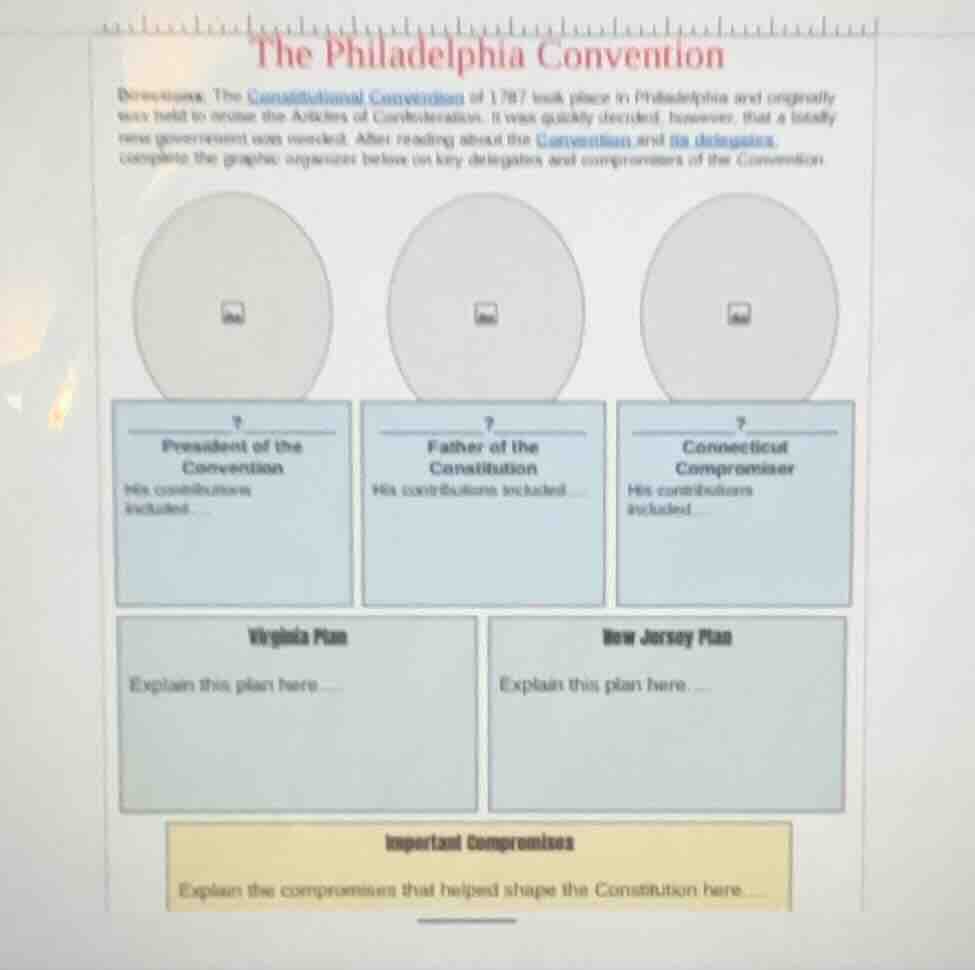
directions: the constitutional convention of 1787 took place in philadelphia and originally was held to revise the articles of confederation. it was quickly decided, however, that a totally new government was needed. after reading about the convention and its delegates, complete the graphic organizer below on key delegates and compromises of the convention
?
president of the
convention
his contributions
included...
?
father of the
constitution
his contributions included...
?
connecticut
compromiser
his contributions
included...
virginia plan
explain this plan here...
new jersey plan
explain this plan here...
important compromises
explain the compromises that helped shape the constitution here...
President of the Convention:
This refers to George Washington, who presided over the 1787 Philadelphia Convention, lending his authority and credibility to the proceedings to maintain order and build trust among delegates.
Father of the Constitution:
This title belongs to James Madison, who drafted the Virginia Plan, took detailed notes of the convention debates, and was a key advocate for the final Constitution, shaping much of its structure.
Connecticut Compromiser:
Roger Sherman (and Oliver Ellsworth) are associated with this; Sherman proposed the compromise that resolved the representation dispute between large and small states.
Virginia Plan:
A proposal from large states that called for a bicameral legislature where representation in both houses was based on a state's population or wealth, giving more power to populous states.
New Jersey Plan:
A proposal from small states that called for a unicameral legislature with equal representation for all states, preserving the equal state power structure from the Articles of Confederation.
Important Compromises:
- Great (Connecticut) Compromise: Created a bicameral legislature with the House of Representatives (representation based on population) and the Senate (equal representation for each state, 2 senators per state).
- Three-Fifths Compromise: Counted enslaved people as three-fifths of a person for the purposes of both representation in Congress and direct taxation, resolving a dispute between slaveholding and non-slaveholding states.
- Commerce Compromise: Allowed Congress to regulate interstate and foreign commerce, but prohibited it from taxing exports or banning the slave trade until 1808.

Snap & solve any problem in the app
Get step-by-step solutions on Sovi AI
Photo-based solutions with guided steps
Explore more problems and detailed explanations
President of the Convention
Name: George Washington
His contributions included: Presiding over the convention, providing a unifying, authoritative presence to guide debates and ensure the process remained focused.
Father of the Constitution
Name: James Madison
His contributions included: Drafting the Virginia Plan, recording detailed convention debates, advocating for the Constitution, and shaping its structural framework.
Connecticut Compromiser
Name: Roger Sherman
His contributions included: Proposing the Great Compromise that resolved the state representation conflict.
Virginia Plan
Explain this plan here: A large-state proposal for a bicameral legislature, with representation in both chambers based on state population/wealth, giving more power to populous states.
New Jersey Plan
Explain this plan here: A small-state proposal for a unicameral legislature, with equal representation for every state to protect the power of smaller states.
Important Compromises
Explain the compromises that helped shape the Constitution here:
- Great (Connecticut) Compromise: Established a bicameral Congress: House of Representatives (population-based representation) and Senate (2 senators per state, equal representation).
- Three-Fifths Compromise: Enslaved people were counted as $\frac{3}{5}$ of a person for congressional representation and federal taxation calculations.
- Commerce Compromise: Congress gained power to regulate interstate/foreign commerce, but could not tax U.S. exports or ban the slave trade until 1808.