QUESTION IMAGE
Question
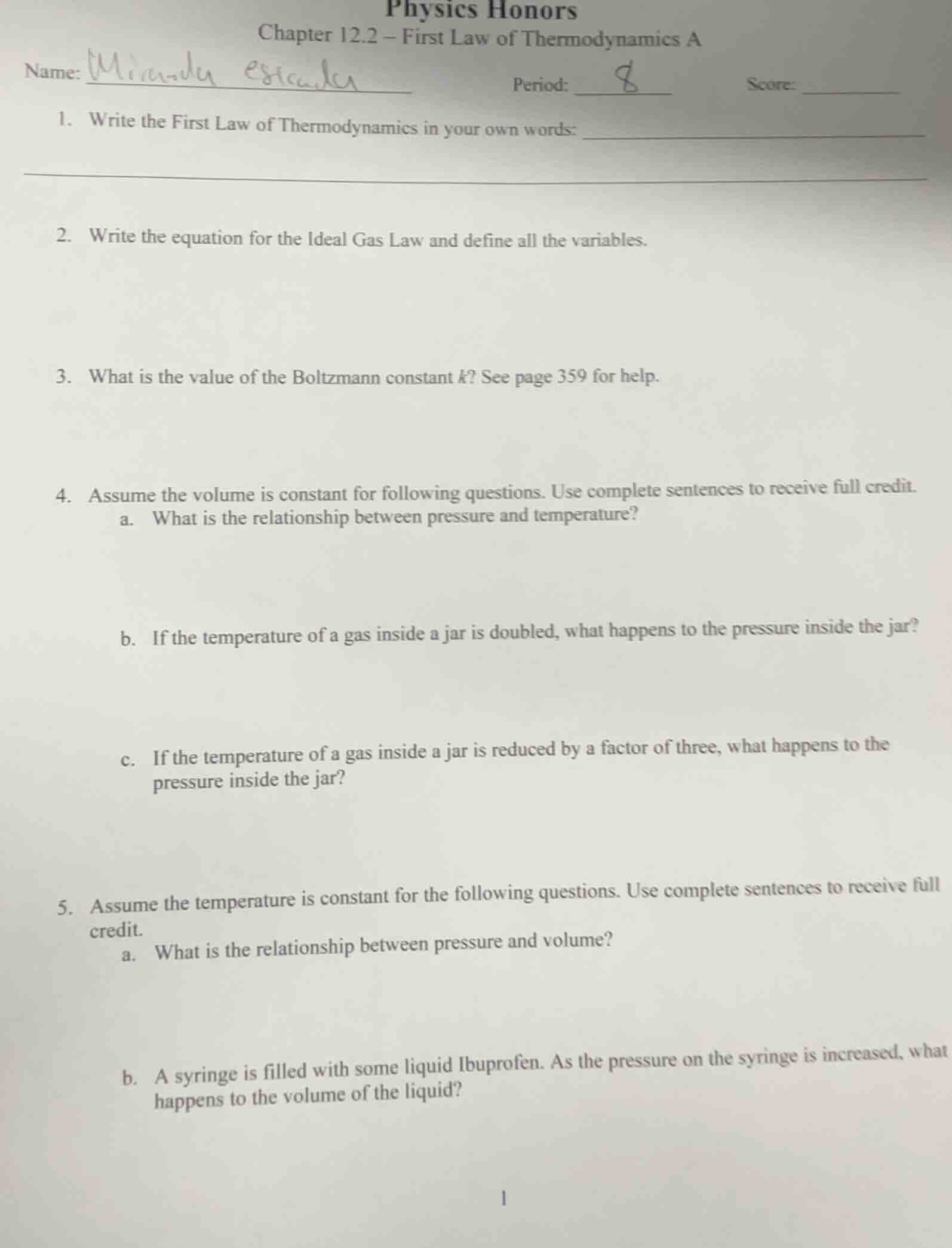
physics honors
chapter 12.2 – first law of thermodynamics a
name: miranda estrada
period: 8
score:
- write the first law of thermodynamics in your own words:
- write the equation for the ideal gas law and define all the variables.
- what is the value of the boltzmann constant k? see page 359 for help.
- assume the volume is constant for following questions. use complete sentences to receive full credit.
a. what is the relationship between pressure and temperature?
b. if the temperature of a gas inside a jar is doubled, what happens to the pressure inside the jar?
c. if the temperature of a gas inside a jar is reduced by a factor of three, what happens to the pressure inside the jar?
- assume the temperature is constant for the following questions. use complete sentences to receive full credit.
a. what is the relationship between pressure and volume?
b. a syringe is filled with some liquid ibuprofen. as the pressure on the syringe is increased, what happens to the volume of the liquid?
- Restates the first law of thermodynamics in plain language, focusing on energy conservation for a system.
- Provides the ideal gas law equation and standard variable definitions.
- Gives the accepted standard value of the Boltzmann constant.
- Uses Gay-Lussac's Law (constant volume) to address pressure-temperature relationships and changes.
- Uses Boyle's Law (constant temperature) for gas pressure-volume relationships, and notes liquids are nearly incompressible.

Snap & solve any problem in the app
Get step-by-step solutions on Sovi AI
Photo-based solutions with guided steps
Explore more problems and detailed explanations
- The change in a system's internal energy equals the heat added to the system minus the work the system does on its surroundings.
- Ideal Gas Law equation: $PV = nRT$
- $P$: Absolute pressure of the gas
- $V$: Volume occupied by the gas
- $n$: Amount of gas in moles
- $R$: Ideal gas constant ($8.314 \frac{\text{J}}{\text{mol·K}}$ or $0.0821 \frac{\text{L·atm}}{\text{mol·K}}$)
- $T$: Absolute temperature of the gas in Kelvin
- The Boltzmann constant $k = 1.380649 \times 10^{-23} \frac{\text{J}}{\text{K}}$
- a. At constant volume, pressure and absolute temperature are directly proportional (as one increases, the other increases by the same factor, and vice versa).
b. At constant volume, if the absolute temperature of the gas is doubled, the pressure inside the jar will also double.
c. At constant volume, if the absolute temperature of the gas is reduced by a factor of three, the pressure inside the jar will also be reduced by a factor of three.
- a. At constant temperature, pressure and volume of a gas are inversely proportional (as one increases, the other decreases by the same factor, and vice versa).
b. Since liquids are nearly incompressible, increasing the pressure on the syringe filled with liquid Ibuprofen will cause essentially no change to the volume of the liquid.