QUESTION IMAGE
Question
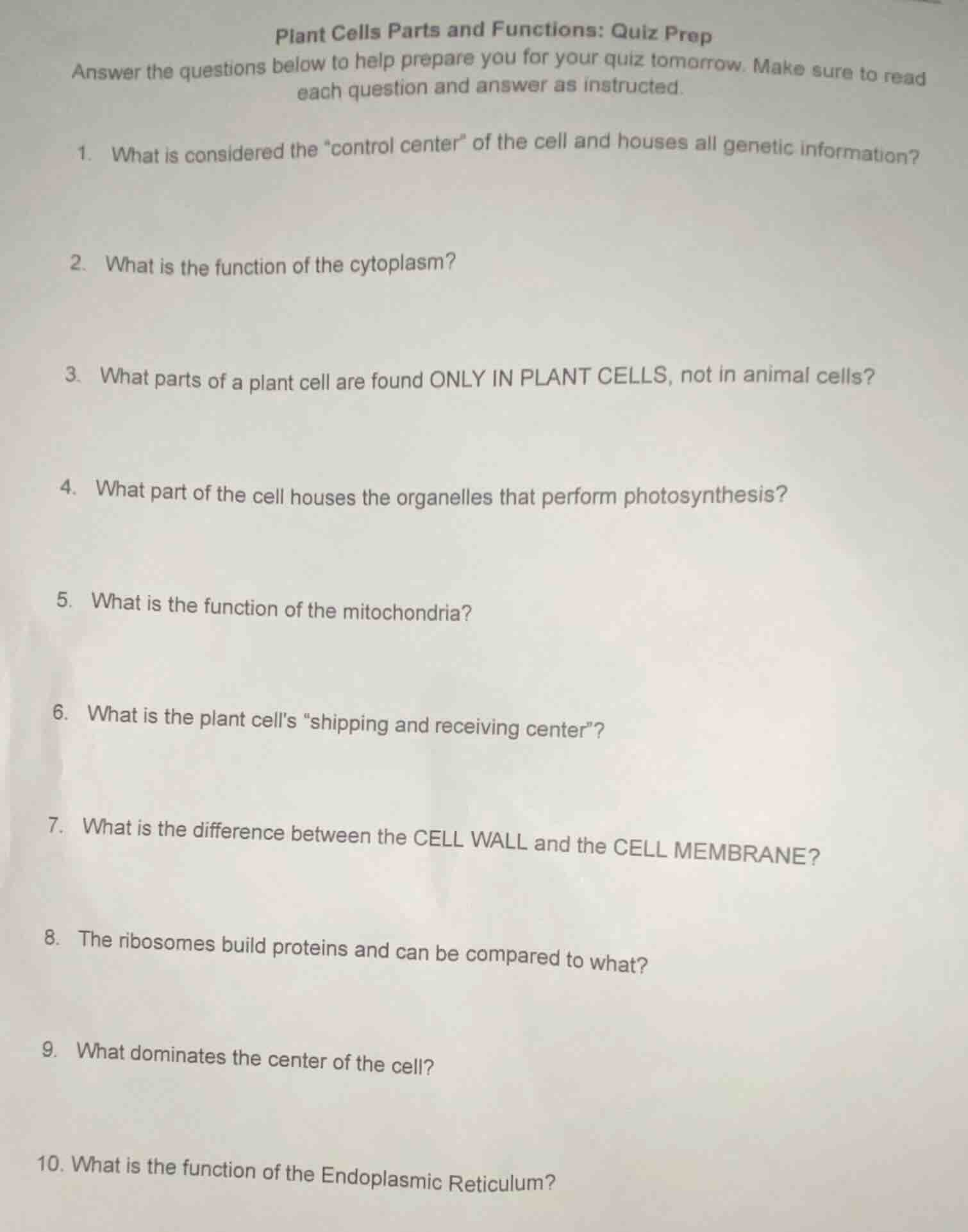
plant cells parts and functions: quiz prep
answer the questions below to help prepare you for your quiz tomorrow. make sure to read
each question and answer as instructed.
- what is considered the \control center\ of the cell and houses all genetic information?
- what is the function of the cytoplasm?
- what parts of a plant cell are found only in plant cells, not in animal cells?
- what part of the cell houses the organelles that perform photosynthesis?
- what is the function of the mitochondria?
- what is the plant cells \shipping and receiving center\?
- what is the difference between the cell wall and the cell membrane?
- the ribosomes build proteins and can be compared to what?
- what dominates the center of the cell?
- what is the function of the endoplasmic reticulum?
Brief Explanations
- Identifies the cell's genetic control hub.
- Describes the cytoplasm's core role in cell function.
- Lists structures unique to plant cells.
- Names the organelle for photosynthesis.
- States the mitochondria's key energy role.
- Identifies the cell's transport and processing organelle.
- Contrasts the two structures' traits and roles.
- Provides a common analogy for ribosomes.
- Names the large central plant cell structure.
- Covers the ER's two main functional roles.

Snap & solve any problem in the app
Get step-by-step solutions on Sovi AI
Photo-based solutions with guided steps
Explore more problems and detailed explanations
- The nucleus
- It is a gel-like substance that fills the cell, suspends organelles, and serves as the site for many cellular chemical reactions.
- Cell wall, chloroplasts, and large central vacuole
- Chloroplasts
- It is the powerhouse of the cell, responsible for producing energy (ATP) through cellular respiration.
- The Golgi apparatus (or Golgi body)
- The cell wall is a rigid, non-living structure made of cellulose that surrounds the cell membrane, providing structural support and shape to plant cells; the cell membrane is a flexible, living lipid bilayer that controls the movement of substances in and out of all cells.
- A factory (or a chef, as they assemble proteins like a factory/chef assembles products/food)
- The large central vacuole (in mature plant cells)
- There are two types: rough ER (with ribosomes) synthesizes and transports proteins, while smooth ER synthesizes lipids, detoxifies substances, and stores calcium ions.