QUESTION IMAGE
Question
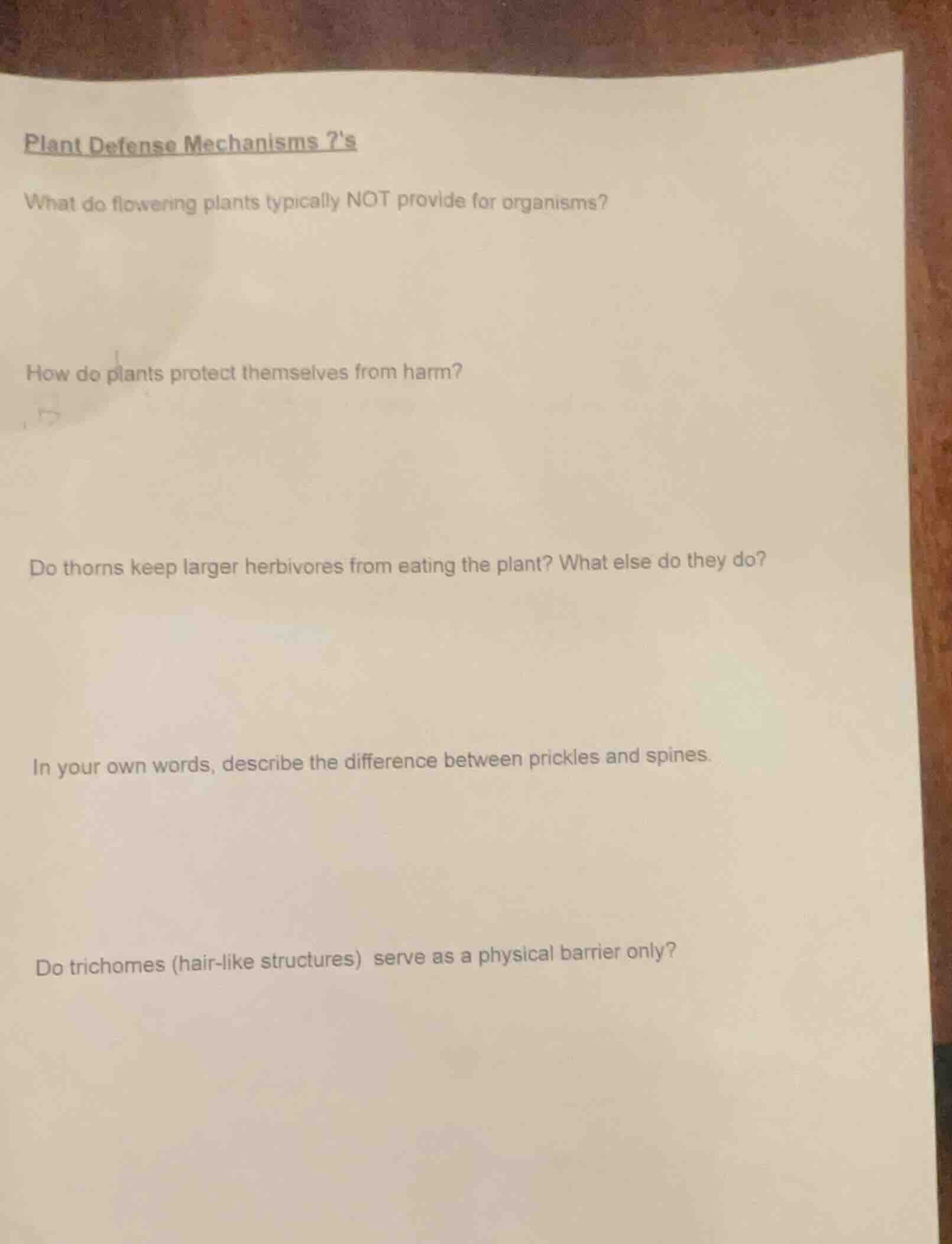
plant defense mechanisms ?s
what do flowering plants typically not provide for organisms?
how do plants protect themselves from harm?
do thorns keep larger herbivores from eating the plant? what else do they do?
in your own words, describe the difference between prickles and spines.
do trichomes (hair-like structures) serve as a physical barrier only?
Brief Explanations
- For the first question: Flowering plants provide food, shelter, oxygen, and reproductive support; they do not typically provide mobility or locomotion assistance for other organisms.
- For the second question: Plants use physical barriers (like thorns, waxy cuticles) and chemical defenses (toxins, repellents) to avoid harm.
- For the third question: Thorns deter some larger herbivores; they also can help plants cling to surfaces for support, and reduce water loss by breaking wind flow.
- For the fourth question: Spines are modified leaves or leaf parts, while prickles are outgrowths of the plant's outer skin (epidermis) that can be easily broken off.
- For the fifth question: Trichomes do not only act as physical barriers; some secrete toxic or sticky chemicals to repel herbivores, or reflect light to reduce water loss.

Snap & solve any problem in the app
Get step-by-step solutions on Sovi AI
Photo-based solutions with guided steps
Explore more problems and detailed explanations
- Flowering plants typically do NOT provide locomotion/mobility for organisms.
- Plants protect themselves via physical structures (thorns, waxy cuticles) and chemical defenses (toxic compounds, repellents).
- Yes, thorns can deter larger herbivores; they also aid in structural support for climbing plants and reduce water loss by disrupting air flow around the plant.
- Spines are modified leaves/leaf components, while prickles are small, easily detached outgrowths of the plant's outer epidermal layer.
- No, trichomes do not serve only as a physical barrier. Some secrete toxic, sticky, or foul-smelling chemicals to repel herbivores, and others can reflect sunlight to reduce water loss.