QUESTION IMAGE
Question
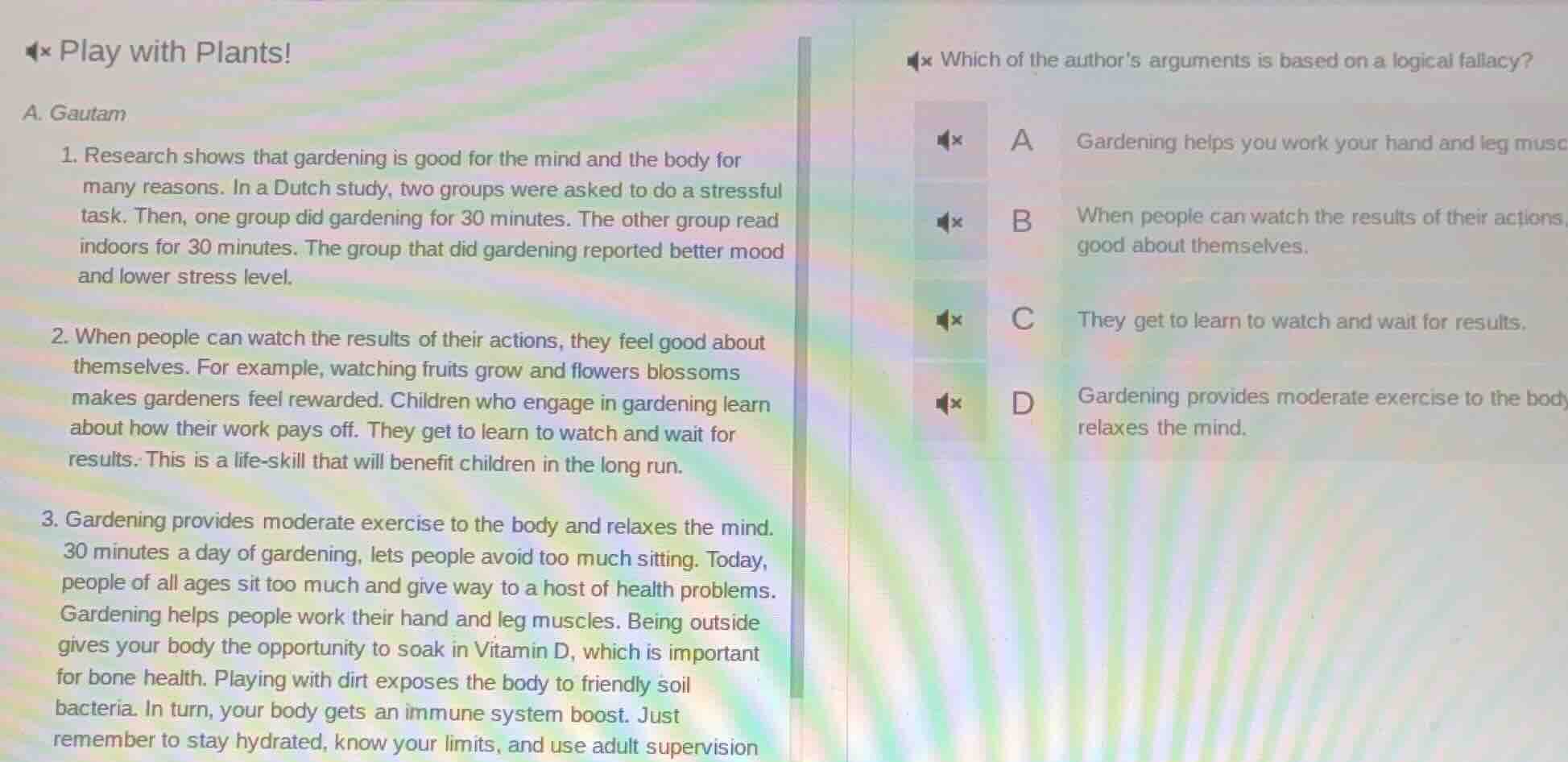
play with plants!
a. gautam
- research shows that gardening is good for the mind and the body for many reasons. in a dutch study, two groups were asked to do a stressful task. then, one group did gardening for 30 minutes. the other group read indoors for 30 minutes. the group that did gardening reported better mood and lower stress level.
- when people can watch the results of their actions, they feel good about themselves. for example, watching fruits grow and flowers blossoms makes gardeners feel rewarded. children who engage in gardening learn about how their work pays off. they get to learn to watch and wait for results. this is a life - skill that will benefit children in the long run.
- gardening provides moderate exercise to the body and relaxes the mind. 30 minutes a day of gardening, lets people avoid too much sitting. today, people of all ages sit too much and give way to a host of health problems. gardening helps people work their hand and leg muscles. being outside gives your body the opportunity to soak in vitamin d, which is important for bone health. playing with dirt exposes the body to friendly soil bacteria. in turn, your body gets an immune system boost. just remember to stay hydrated, know your limits, and use adult supervision
which of the authors arguments is based on a logical fallacy?
a gardening helps you work your hand and leg musc
b when people can watch the results of their actions, good about themselves.
c they get to learn to watch and wait for results.
d gardening provides moderate exercise to the body relaxes the mind.
To determine the logical fallacy, we analyze each option:
- Option A: Gardening helping work hand and leg muscles is supported by the text (point 3: "Gardening helps people work their hand and leg muscles").
- Option B: The text states "When people can watch the results of their actions, they feel good about themselves" (point 2) and gives an example with gardening, so this is a valid argument.
- Option C: The text says "Children who engage in gardening learn about how their work pays off. They get to learn to watch and wait for results" (point 2), so this is supported.
- Option D: Wait, let's re - check. Wait, actually, looking at the options again, maybe there was a mis - reading. Wait, no, the key is to find the fallacy. Wait, maybe the original problem's option C (the one in the right - hand side) "They get to learn to watch and wait for results" – but in the left - hand text, it's about children in gardening learning to wait for results. Wait, no, maybe the fallacy is in option C? Wait, no, let's re - evaluate. Wait, the argument in option C: "They get to learn to watch and wait for results" – but is there a fallacy here? Wait, maybe the intended answer is C? Wait, no, let's think again. Wait, the left - hand text's point 2: "Children who engage in gardening learn about how their work pays off. They get to learn to watch and wait for results." So that's a valid point. Wait, maybe the options were mis - transcribed. Wait, assuming that the correct answer is C (but maybe I made a mistake). Wait, no, let's check the logical fallacies. A logical fallacy is an error in reasoning. Let's see:
- Option A: Supported by text.
- Option B: Supported by text (point 2).
- Option C: The statement "They get to learn to watch and wait for results" – but who is "they"? If it's referring to gardeners in general, but the text only says children in gardening learn this. So maybe it's a hasty generalization? So the argument in option C might be a fallacy as it generalizes from children in gardening to "they" (a broader group) without proper support.
- Option D: Supported by text (point 3: "Gardening provides moderate exercise...").
So the argument in option C is based on a logical fallacy (hasty generalization, maybe) as it extends the learning of children in gardening to a broader "they" without sufficient evidence.

Snap & solve any problem in the app
Get step-by-step solutions on Sovi AI
Photo-based solutions with guided steps
Explore more problems and detailed explanations
C. They get to learn to watch and wait for results.