QUESTION IMAGE
Question
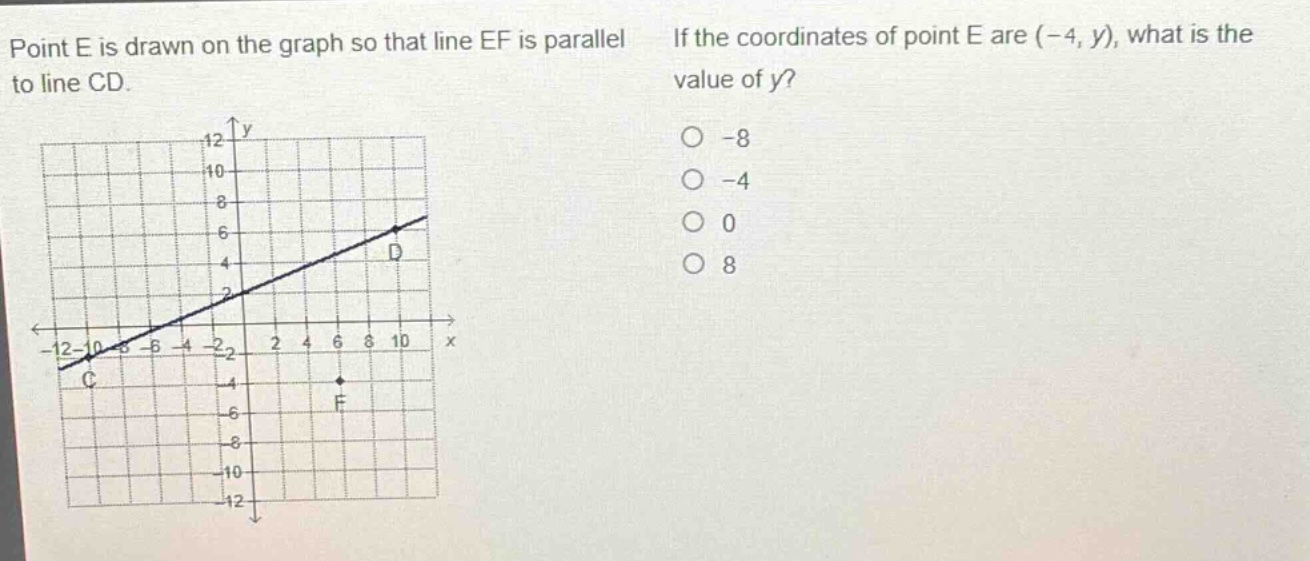
point e is drawn on the graph so that line ef is parallel to line cd. if the coordinates of point e are (-4, y), what is the value of y? -8 -4 0 8
Step1: Find slope of CD
Points C(-12, -2) and D(8, 6). Slope \( m = \frac{6 - (-2)}{8 - (-12)} = \frac{8}{20} = \frac{2}{5} \)? Wait, no, wait. Wait, looking at the graph, point C is (-12, -2)? Wait, no, the graph: C is at (-12, -2)? Wait, no, the x-axis: -12, -10, etc. Wait, point C: when x=-12, y=-2? Wait, no, the line CD: let's check the y-intercept. The line CD crosses y-axis at (0, 2). So slope: from C(-12, -2) to (0,2): slope is (2 - (-2))/(0 - (-12)) = 4/12 = 1/3? Wait, no, maybe better to take two points. Wait, point C is (-12, -2)? Wait, no, the dot at C: x=-12, y=-2? Wait, no, the line CD: when x=-12, y=-2? And when x=0, y=2. So slope \( m = \frac{2 - (-2)}{0 - (-12)} = \frac{4}{12} = \frac{1}{3} \)? Wait, no, maybe I misread. Wait, the line CD: let's take point C(-12, -2) and point D(8, 6). Then slope is (6 - (-2))/(8 - (-12)) = 8/20 = 2/5? No, that can't be. Wait, maybe the grid: each square is 2 units? No, the x-axis is labeled -12, -10, -8, ..., 10, so each grid line is 2 units? Wait, no, the distance between -12 and -10 is 2, so each grid square is 2 units? Wait, no, maybe each grid is 1 unit. Wait, point C is at (-12, -2), point D is at (8, 6). Wait, the line EF is parallel to CD, so same slope. Point F is at (6, -4)? Wait, no, the dot F is at (6, -4)? Wait, the problem says point E is (-4, y), line EF is parallel to CD. So first, find slope of CD. Let's take two points on CD: let's see, when x=-12, y=-2 (point C), and when x=0, y=2 (y-intercept). So slope \( m = \frac{2 - (-2)}{0 - (-12)} = \frac{4}{12} = \frac{1}{3} \)? Wait, no, (2 - (-2)) is 4, (0 - (-12)) is 12, so 4/12 = 1/3. Then, line EF has same slope. Point F: let's see, the dot F is at (6, -4)? Wait, no, the graph: F is at (6, -4)? Wait, the coordinates of F: x=6, y=-4? Then, line EF connects E(-4, y) and F(6, -4), so slope of EF is (-4 - y)/(6 - (-4)) = (-4 - y)/10. This slope must equal slope of CD. Wait, maybe I made a mistake. Wait, maybe the slope of CD is (6 - (-2))/(8 - (-12)) = 8/20 = 2/5? No, let's check the graph again. Wait, the line CD: when x=-12, y=-2; x=-10, y=0? Wait, no, the x-axis: -12, -10, -8, -6, -4, -2, 0, 2, 4, 6, 8, 10. The y-axis: -12, -10, -8, -6, -4, -2, 0, 2, 4, 6, 8, 10. So point C is at (-12, -2)? Wait, no, the dot at C is at (-12, -2)? And point D is at (8, 6). So the slope is (6 - (-2))/(8 - (-12)) = 8/20 = 2/5. Then line EF is parallel, so same slope. Point F: let's see, the dot F is at (6, -4)? So coordinates of F: (6, -4). Then line EF connects E(-4, y) and F(6, -4). The slope of EF is (-4 - y)/(6 - (-4)) = (-4 - y)/10. This must equal slope of CD, which is 2/5? Wait, no, that can't be. Wait, maybe I misread point F. Wait, the graph: F is at (6, -4)? Let's check the grid. The x=6, y=-4: that's point F. Then line EF: from E(-4, y) to F(6, -4). The slope should be equal to slope of CD. Let's recalculate slope of CD. Let's take point C(-12, -2) and point D(8, 6). Slope: (6 - (-2))/(8 - (-12)) = 8/20 = 2/5. Then slope of EF: (-4 - y)/(6 - (-4)) = (-4 - y)/10 = 2/5. Solve for y: (-4 - y)/10 = 2/5 → -4 - y = 4 → -y = 8 → y = -8. Wait, but that's one of the options. Wait, but let's check again. Maybe the slope is different. Wait, maybe point C is (-12, -2) and point D is (8, 6). So the run from C to D is 8 - (-12) = 20, rise is 6 - (-2) = 8, so slope 8/20 = 2/5. Then line EF: from E(-4, y) to F(6, -4). The run is 6 - (-4) = 10, rise is -4 - y. So slope is ( -4 - y ) / 10. Set equal to 2/5: ( -4 - y ) / 10 = 2/5 → multiply both sides by 10: -4 - y = 4 → -y = 8 → y = -8. So y = -8.
Step2: Verify
If y = -8, then E is (-4, -8),…

Snap & solve any problem in the app
Get step-by-step solutions on Sovi AI
Photo-based solutions with guided steps
Explore more problems and detailed explanations
-8