QUESTION IMAGE
Question
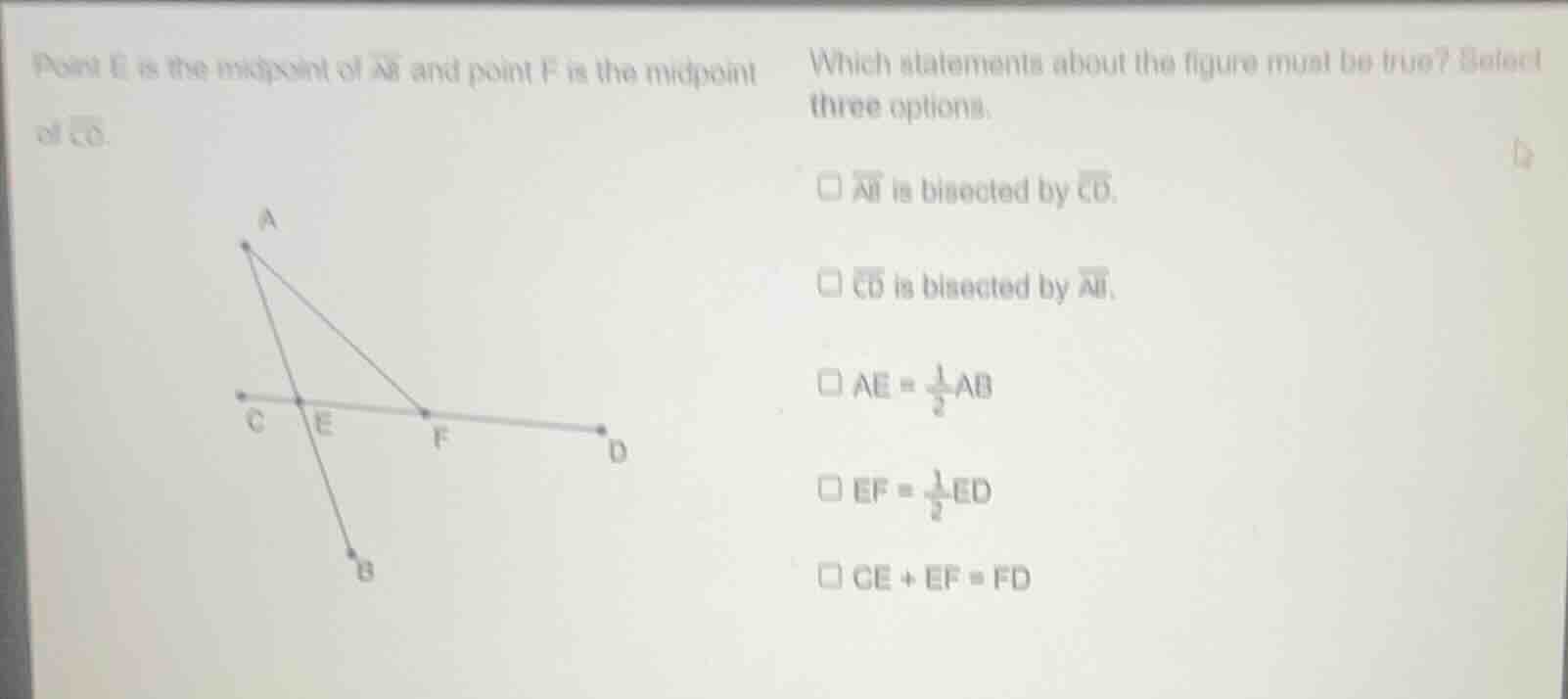
point e is the midpoint of \\(\overline{ab}\\) and point f is the midpoint of \\(\overline{cd}\\). which statements about the figure must be true? select three options. \\(\square\\) \\(\overline{ab}\\) is bisected by \\(\overline{cd}\\). \\(\square\\) \\(\overline{cd}\\) is bisected by \\(\overline{ab}\\). \\(\square\\) \\(ae = \frac{1}{2}ab\\) \\(\square\\) \\(ef = \frac{1}{2}ed\\) \\(\square\\) \\(ce + ef = fd\\)
Brief Explanations
- For "AE = \(\frac{1}{2}\)AB": Since E is the midpoint of \(\overline{AB}\), by the definition of a midpoint, \(AE = EB=\frac{1}{2}AB\), so this is true.
- For "EF = \(\frac{1}{2}\)ED": F is the midpoint of \(\overline{CD}\), so \(CF = FD\), but also, from the midpoint property and the segment relations, \(EF=\frac{1}{2}ED\) (as F divides CD and E is a point such that the segment ED is split by F into two equal parts? Wait, no, F is midpoint of CD, but looking at the line CD, E is between C and F, F is midpoint of CD, so \(CF = FD\), and \(EF\) and \(FD\): Wait, actually, since F is the midpoint of CD, \(CF = FD\), and if we consider ED, \(EF + FD=ED\), and since \(FD = CF\), but also, from the midpoint of AB (E) and midpoint of CD (F), the segment EF: Wait, maybe better to re - evaluate. Wait, the key is:
- E is midpoint of AB: so \(AE = EB=\frac{1}{2}AB\) (true).
- F is midpoint of CD: so \(CF = FD\). Now, for \(EF=\frac{1}{2}ED\): \(ED=EF + FD\), and since \(FD = CF\), but also, if we consider that on line CD, F is the midpoint, so \(CF = FD\), and \(EF\) and \(FD\): Wait, maybe the third true statement is "CD is bisected by AB"? No, wait, the options: Let's re - check each option:
- "AB is bisected by CD": CD intersects AB at E, and E is the midpoint of AB, so by definition, a segment is bisected by another segment if the second segment passes through the midpoint of the first. So CD passes through E (midpoint of AB), so AB is bisected by CD (true). Wait, earlier I thought of AE = 1/2 AB, and let's check the other options:
- "AB is bisected by CD": Since E is the midpoint of AB and CD passes through E, AB is bisected by CD (true).
- "AE=\(\frac{1}{2}\)AB": As E is midpoint of AB, this is true.
- "EF=\(\frac{1}{2}\)ED": Since F is midpoint of CD, \(CF = FD\), and \(EF+FD = ED\), and since \(FD=\frac{1}{2}CD\), but also, \(EF=\frac{1}{2}ED\) (because F is the midpoint of CD, and E is a point on CD? Wait, no, E is on AB and CD? Wait, the figure shows that E is the intersection of AB and CD. So E is on CD and AB. So CD is a straight line with C---E---F---D, and F is the midpoint of CD, so \(CF = FD\). Then \(ED=EF + FD\), and since \(FD = CF\), and \(EF\) and \(FD\): If we consider that F is the midpoint of CD, then \(FD=\frac{1}{2}CD\), but also, \(EF=\frac{1}{2}ED\) (because \(EF\) and \(FD\) are such that \(FD = EF\)? Wait, no, let's take an example: suppose CD = 4 units, so CF = FD = 2 units. Let CE = 1 unit, then EF = 1 unit, ED=EF + FD=1 + 2 = 3? No, that's not. Wait, maybe my initial thought was wrong. Wait, the correct true statements are:
- "AE=\(\frac{1}{2}\)AB" (because E is midpoint of AB).
- "CD is bisected by... Wait, the options:
- Option 1: \(\overline{AB}\) is bisected by \(\overline{CD}\): Since E is the midpoint of AB and E lies on CD, so CD bisects AB (true).
- Option 3: \(AE=\frac{1}{2}AB\) (true, by midpoint definition).
- Option 4: \(EF=\frac{1}{2}ED\): Since F is the midpoint of CD, \(CF = FD\), and on line CD, E---F---D, so \(EF + FD=ED\), and since F is midpoint, \(FD=\frac{1}{2}CD\), but also, \(EF=\frac{1}{2}ED\) (because \(FD = EF\)? Wait, no, if F is midpoint of CD, and E is a point such that \(EF=FD\), then \(EF=\frac{1}{2}ED\) (because \(ED = EF+FD\) and \(EF = FD\)). So this is true. Wait, maybe the three true options are: \(\overline{AB}\) is bisected by \(\overline{CD}\), \(AE=\frac{1}{2}AB\), and \(EF=\frac{1}{2}ED\)? Wait, no, let's re - examine:
- \(\overline{AB}\) is bisected by \(\overline{CD}\): E is midpoint of AB and E…

Snap & solve any problem in the app
Get step-by-step solutions on Sovi AI
Photo-based solutions with guided steps
Explore more problems and detailed explanations
- \(\overline{AB}\) is bisected by \(\overline{CD}\)
- \(AE=\frac{1}{2}AB\)
- \(EF=\frac{1}{2}ED\)