QUESTION IMAGE
Question
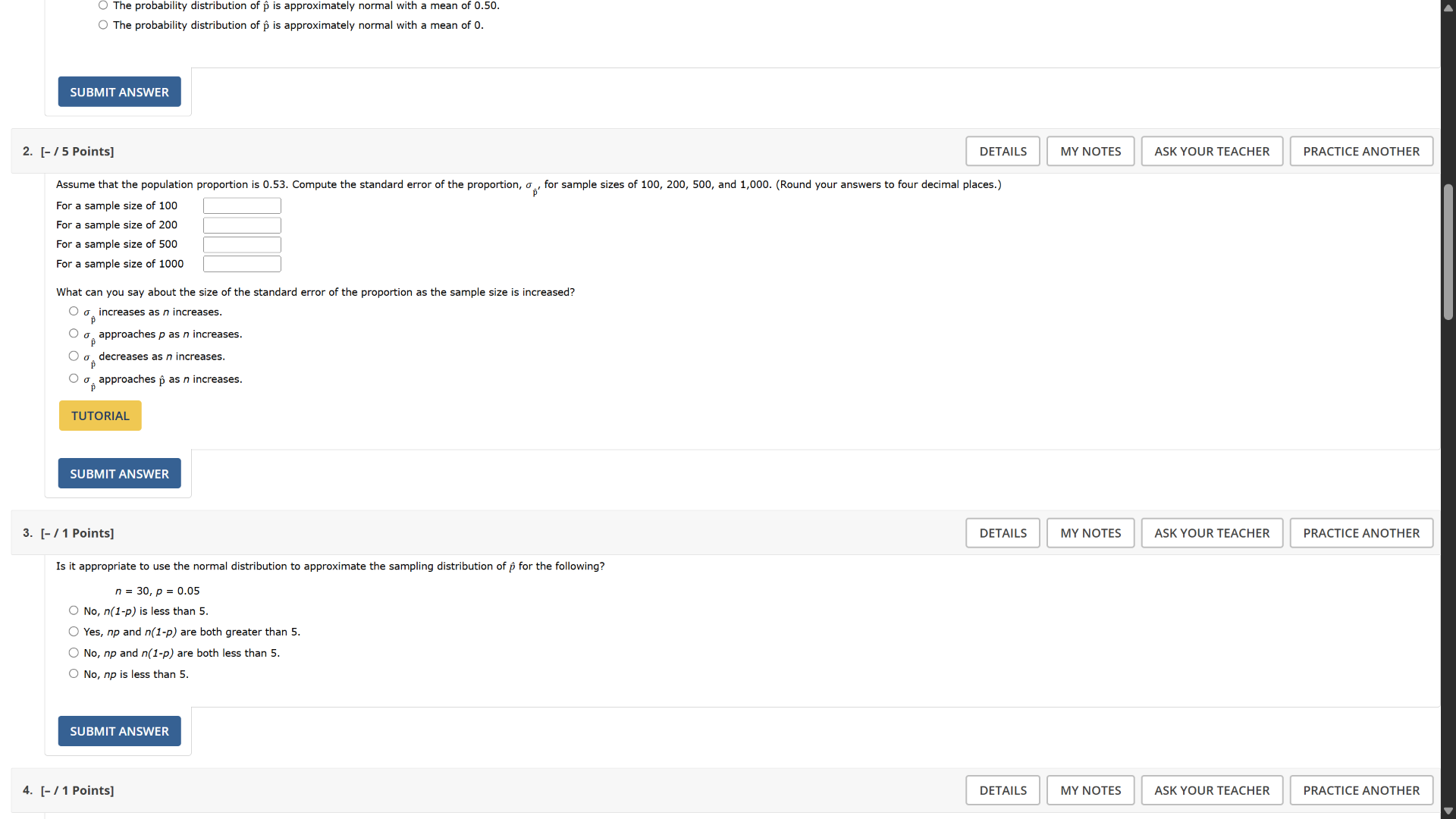
- - / 5 points assume that the population proportion is 0.53. compute the standard error of the proportion, \\(\sigma_{\hat{p}}\\), for sample sizes of 100, 200, 500, and 1,000. (round your answers to four decimal places.) for a sample size of 100 for a sample size of 200 for a sample size of 500 for a sample size of 1000 what can you say about the size of the standard error of the proportion as the sample size is increased? \\(\sigma_{\hat{p}}\\) increases as \\(n\\) increases. \\(\sigma_{\hat{p}}\\) approaches \\(p\\) as \\(n\\) increases. \\(\sigma_{\hat{p}}\\) decreases as \\(n\\) increases. \\(\sigma_{\hat{p}}\\) approaches \\(\hat{p}\\) as \\(n\\) increases. 3. - / 1 points is it appropriate to use the normal distribution to approximate the sampling distribution of \\(\hat{p}\\) for the following? \\(n = 30, p = 0.05\\) no, \\(n(1 - p)\\) is less than 5. yes, \\(np\\) and \\(n(1 - p)\\) are both greater than 5. no, \\(np\\) and \\(n(1 - p)\\) are both less than 5. no, \\(np\\) is less than 5. 4. - / 1 points
Problem 2
The formula for the standard error of the proportion ($\sigma_{\hat{p}}$) is $\sigma_{\hat{p}} = \sqrt{\frac{p(1 - p)}{n}}$, where $p$ is the population proportion and $n$ is the sample size. Given $p = 0.53$, we calculate for each sample size:
Step 1: Sample size $n = 100$
We substitute $p = 0.53$ and $n = 100$ into the formula:
$\sigma_{\hat{p}} = \sqrt{\frac{0.53(1 - 0.53)}{100}} = \sqrt{\frac{0.53 \times 0.47}{100}} = \sqrt{\frac{0.2491}{100}} = \sqrt{0.002491} \approx 0.0499$
Step 2: Sample size $n = 200$
Substitute $p = 0.53$ and $n = 200$:
$\sigma_{\hat{p}} = \sqrt{\frac{0.53 \times 0.47}{200}} = \sqrt{\frac{0.2491}{200}} = \sqrt{0.0012455} \approx 0.0353$
Step 3: Sample size $n = 500$
Substitute $p = 0.53$ and $n = 500$:
$\sigma_{\hat{p}} = \sqrt{\frac{0.53 \times 0.47}{500}} = \sqrt{\frac{0.2491}{500}} = \sqrt{0.0004982} \approx 0.0223$
Step 4: Sample size $n = 1000$
Substitute $p = 0.53$ and $n = 1000$:
$\sigma_{\hat{p}} = \sqrt{\frac{0.53 \times 0.47}{1000}} = \sqrt{\frac{0.2491}{1000}} = \sqrt{0.0002491} \approx 0.0158$
For the second part, as the sample size $n$ increases, the denominator in the formula $\frac{p(1 - p)}{n}$ increases, so the value under the square root decreases, hence $\sigma_{\hat{p}}$ decreases. So the correct option is "$\sigma_{\hat{p}}$ decreases as $n$ increases."
To determine if we can use the normal distribution to approximate the sampling distribution of $\hat{p}$, we check if $np \geq 5$ and $n(1 - p) \geq 5$. For $n = 30$ and $p = 0.05$:
- $np = 30 \times 0.05 = 1.5$ (which is less than 5)
- $n(1 - p) = 30 \times 0.95 = 28.5$ (which is greater than 5)
Since $np < 5$, we cannot use the normal approximation. So the correct option is "No, $np$ is less than 5."

Snap & solve any problem in the app
Get step-by-step solutions on Sovi AI
Photo-based solutions with guided steps
Explore more problems and detailed explanations
For a sample size of 100: $\boldsymbol{0.0499}$
For a sample size of 200: $\boldsymbol{0.0353}$
For a sample size of 500: $\boldsymbol{0.0223}$
For a sample size of 1000: $\boldsymbol{0.0158}$
The standard error of the proportion: $\boldsymbol{\sigma_{\hat{p}}}$ decreases as $n$ increases.