QUESTION IMAGE
Question
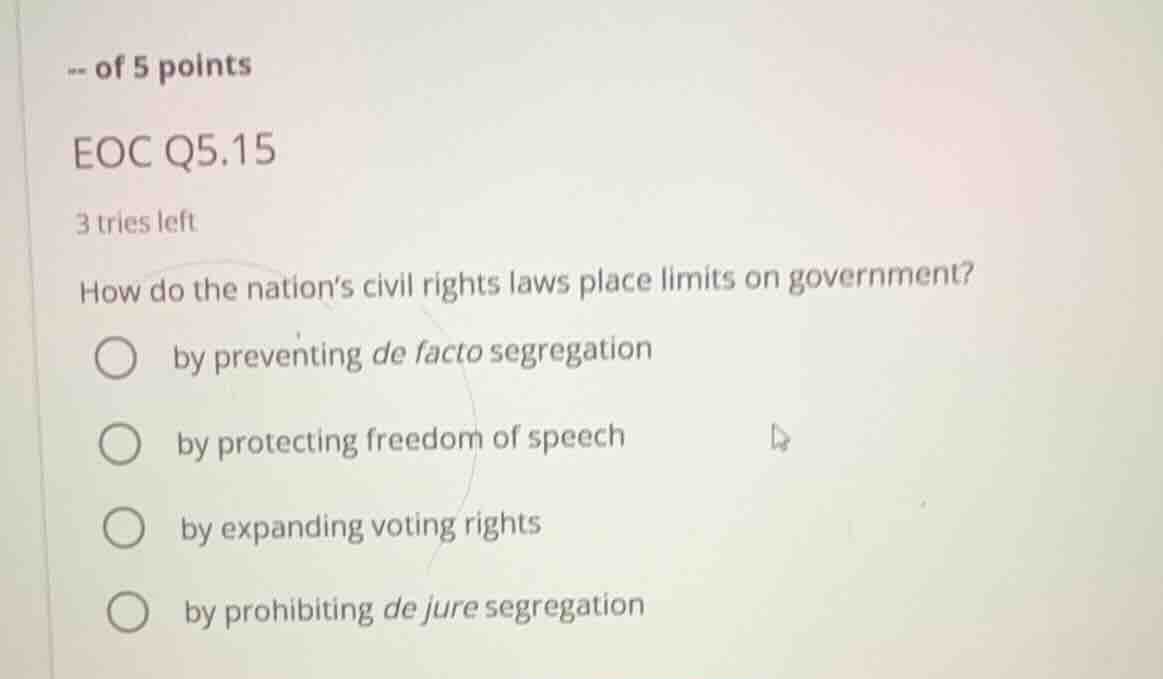
of 5 points eoc q5.15 3 tries left how do the nation’s civil rights laws place limits on government? by preventing de facto segregation by protecting freedom of speech by expanding voting rights by prohibiting de jure segregation
Brief Explanations
- Analyze each option:
- Option "by preventing de facto segregation": De facto segregation is often due to social/cultural factors, and civil rights laws focus more on legal (de jure) segregation. So this is incorrect.
- Option "by protecting freedom of speech": Freedom of speech is protected by the First Amendment, not directly related to civil rights laws' limit on government in terms of segregation or equal treatment in the context of civil rights (like racial, gender - based equal rights). So this is incorrect.
- Option "by expanding voting rights": While civil rights laws do expand voting rights, the main way they limit government in the context of civil rights (especially regarding segregation) is by prohibiting de jure segregation. Expanding voting rights is more about political participation rather than limiting government's ability to impose segregated policies.
- Option "by prohibiting de jure segregation": De jure segregation is segregation imposed by law (by the government). Civil rights laws like the Civil Rights Act of 1964 prohibit the government from enacting or enforcing laws that segregate people based on race, color, religion, sex, or national origin. This directly limits the government's power to create or maintain segregated systems through legal means.

Snap & solve any problem in the app
Get step-by-step solutions on Sovi AI
Photo-based solutions with guided steps
Explore more problems and detailed explanations
D. by prohibiting de jure segregation