QUESTION IMAGE
Question
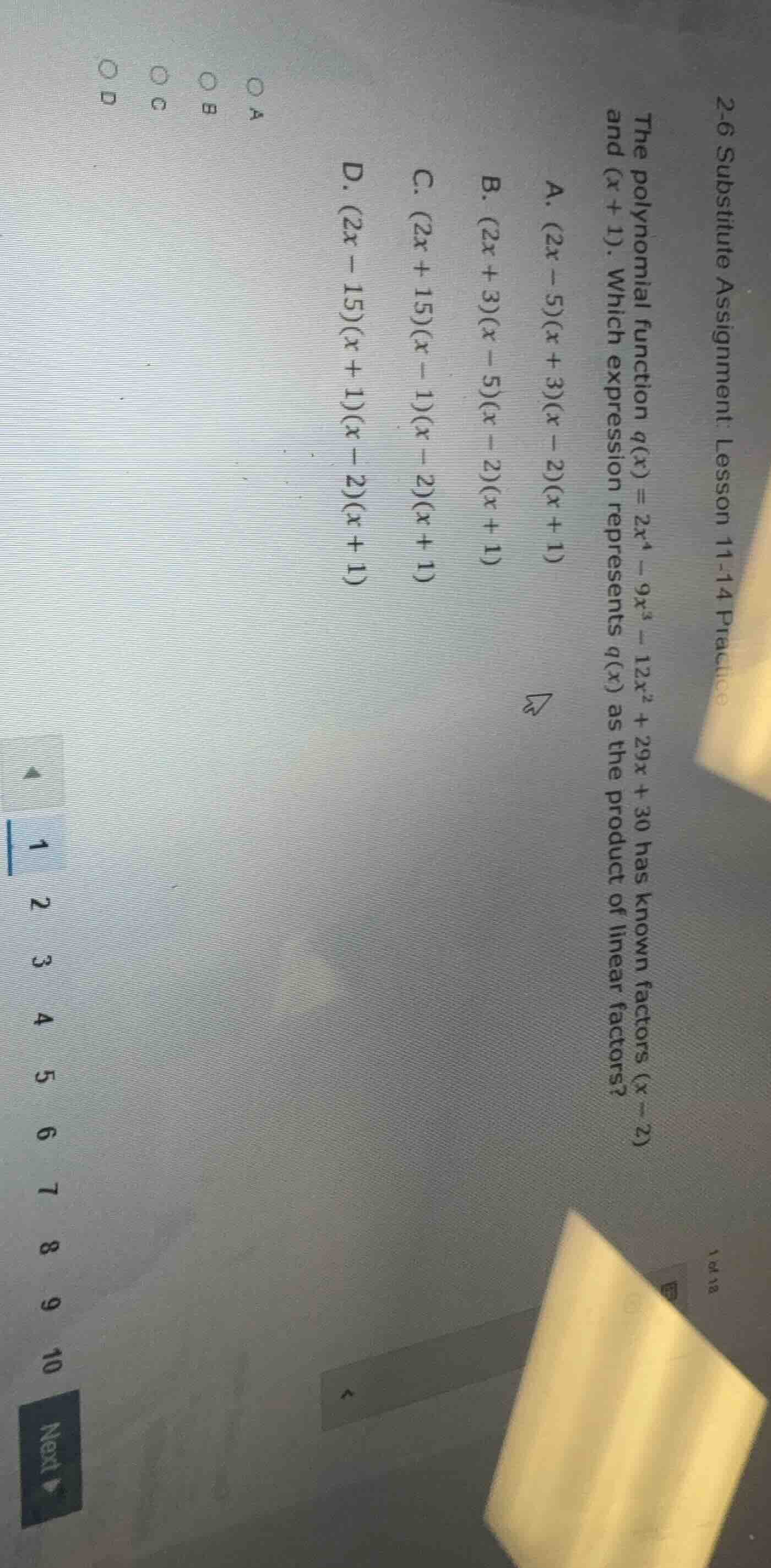
the polynomial function ( q(x) = 2x^4 - 9x^3 - 12x^2 + 29x + 30 ) has known factors ( (x - 2) ) and ( (x + 1) ). which expression represents ( q(x) ) as the product of linear factors?
a. ( (2x - 5)(x + 3)(x - 2)(x + 1) )
b. ( (2x + 3)(x - 5)(x - 2)(x + 1) )
c. ( (2x + 15)(x - 1)(x - 2)(x + 1) )
d. ( (2x - 15)(x + 1)(x - 2)(x + 1) )
Step1: Use polynomial division or factor theorem
We know that \(q(x)\) has factors \((x - 2)\) and \((x + 1)\). Let's first perform polynomial division or use synthetic division to factor out these known factors. But maybe a better way is to expand each option and see which one matches \(q(x)=2x^{4}-9x^{3}-12x^{2}+29x + 30\).
Step2: Expand Option B: \((2x + 3)(x - 5)(x - 2)(x + 1)\)
First, multiply \((2x + 3)(x - 5)\):
\[
\]
Then multiply \((x - 2)(x + 1)\):
\[
\]
Now multiply the two quadratics: \((2x^{2}-7x - 15)(x^{2}-x - 2)\)
\[
\]
Which matches the given polynomial \(q(x)\). Let's just check one more option to be sure.
Step3: Expand Option A: \((2x - 5)(x + 3)(x - 2)(x + 1)\)
Multiply \((2x - 5)(x + 3)\):
\[
\]
Multiply \((x - 2)(x + 1)=x^{2}-x - 2\) (from before)
Now multiply \((2x^{2}+x - 15)(x^{2}-x - 2)\)
\[
\]
This does not match \(q(x)\), so Option A is wrong.
We can see that Option B expands to the given polynomial.

Snap & solve any problem in the app
Get step-by-step solutions on Sovi AI
Photo-based solutions with guided steps
Explore more problems and detailed explanations
B. \((2x + 3)(x - 5)(x - 2)(x + 1)\)