QUESTION IMAGE
Question
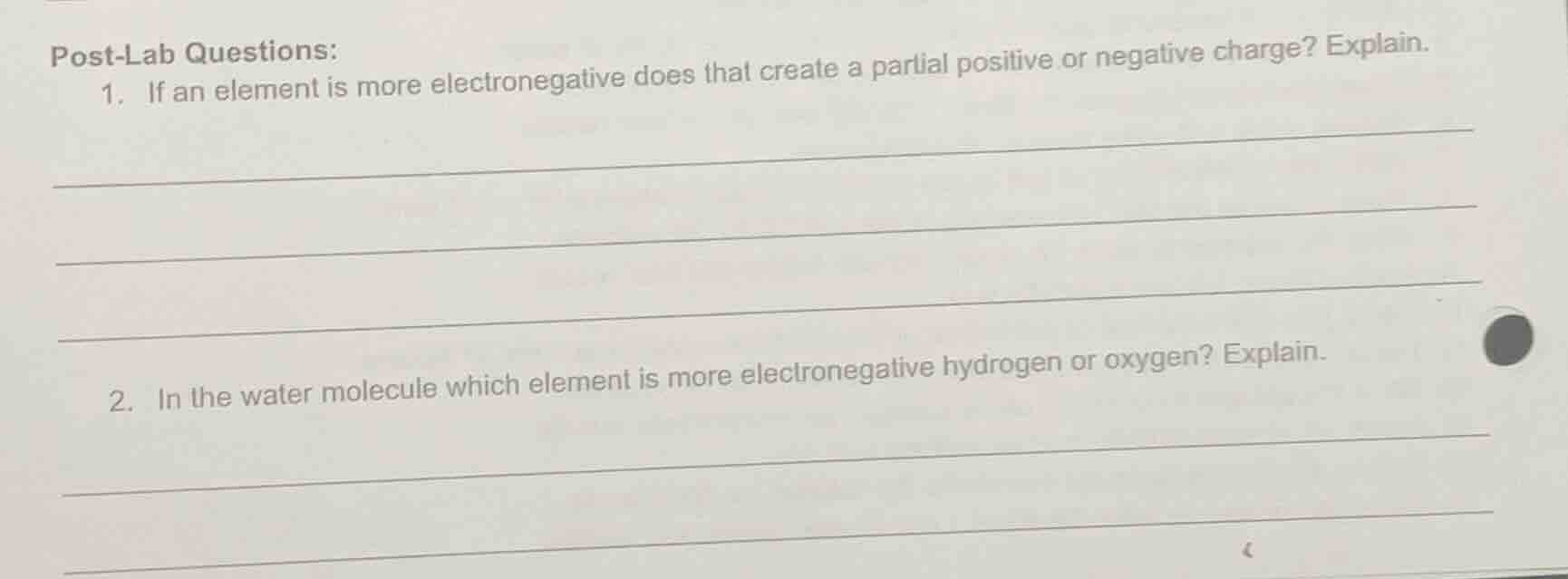
post-lab questions:
- if an element is more electronegative does that create a partial positive or negative charge? explain.
- in the water molecule which element is more electronegative hydrogen or oxygen? explain.
Brief Explanations
- Electronegativity is the ability of an atom to attract shared electrons in a covalent bond. A more electronegative atom pulls electron density toward itself, creating a partial negative charge, while the less electronegative atom has reduced electron density, forming a partial positive charge.
- Oxygen has a higher electronegativity than hydrogen. Oxygen has 8 protons in its nucleus (vs. 1 for hydrogen) and a smaller atomic radius, giving it a stronger pull on shared electrons in the H-O bonds of a water molecule.

Snap & solve any problem in the app
Get step-by-step solutions on Sovi AI
Photo-based solutions with guided steps
Explore more problems and detailed explanations
- A more electronegative element creates a partial negative charge. This is because it strongly attracts the shared electrons in a bond, concentrating electron density around itself.
- Oxygen is more electronegative than hydrogen. Oxygen has a greater nuclear charge and smaller atomic radius, so it exerts a stronger pull on the shared electrons in the water molecule's covalent bonds.