QUESTION IMAGE
Question
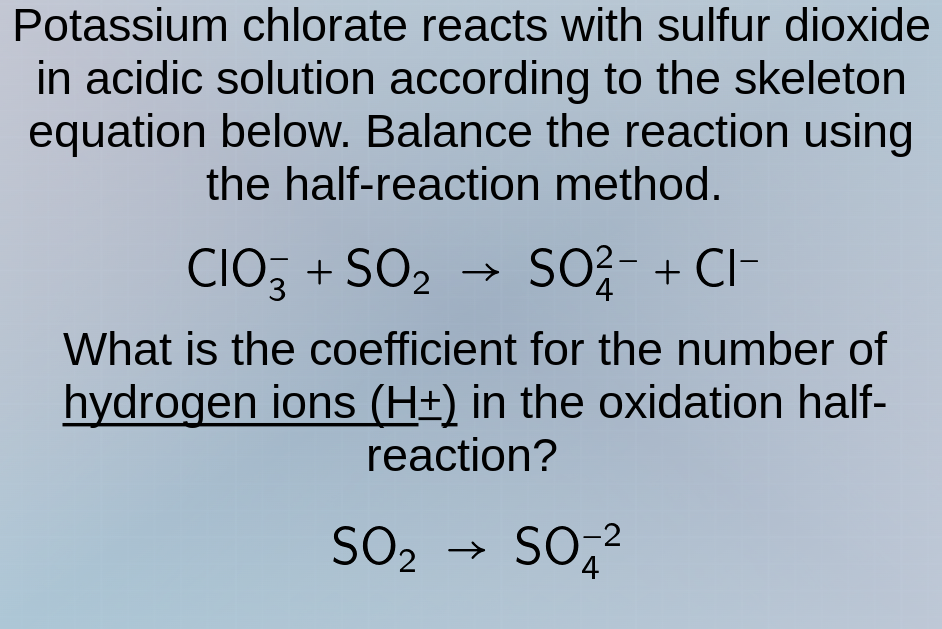
potassium chlorate reacts with sulfur dioxide in acidic solution according to the skeleton equation below. balance the reaction using the half-reaction method.\\(\ce{clo^-_{3} + so_{2} \
ightarrow so^{2-}_{4} + cl^-}\\)\
what is the coefficient for the number of hydrogen ions (h+) in the oxidation half-reaction?\\(\ce{so_{2} \
ightarrow so^{-2}_{4}}\\)
Step1: Balance Oxygens with Water
In the oxidation half - reaction \(SO_2
ightarrow SO_4^{2 - }\), we first balance the oxygen atoms. There are 2 O in \(SO_2\) and 4 O in \(SO_4^{2 - }\). So we add 2 \(H_2O\) to the left - hand side to balance the O:
\(SO_2 + 2H_2O
ightarrow SO_4^{2 - }\)
Step2: Balance Hydrogens with \(H^+\)
Now, we balance the hydrogen atoms. On the left - hand side, from \(2H_2O\), we have 4 H atoms. So we add \(4H^+\) to the right - hand side to balance the H:
\(SO_2+2H_2O
ightarrow SO_4^{2 - } + 4H^+\)
Step3: Balance Charges (Optional for Finding \(H^+\) Coefficient)
We can also check the charge balance. The oxidation state of S in \(SO_2\) is +4, and in \(SO_4^{2 - }\) is +6. The change in oxidation state is +2 (oxidation). But for the purpose of finding the coefficient of \(H^+\), we already found from balancing H that the coefficient of \(H^+\) is 4.

Snap & solve any problem in the app
Get step-by-step solutions on Sovi AI
Photo-based solutions with guided steps
Explore more problems and detailed explanations
4