QUESTION IMAGE
Question
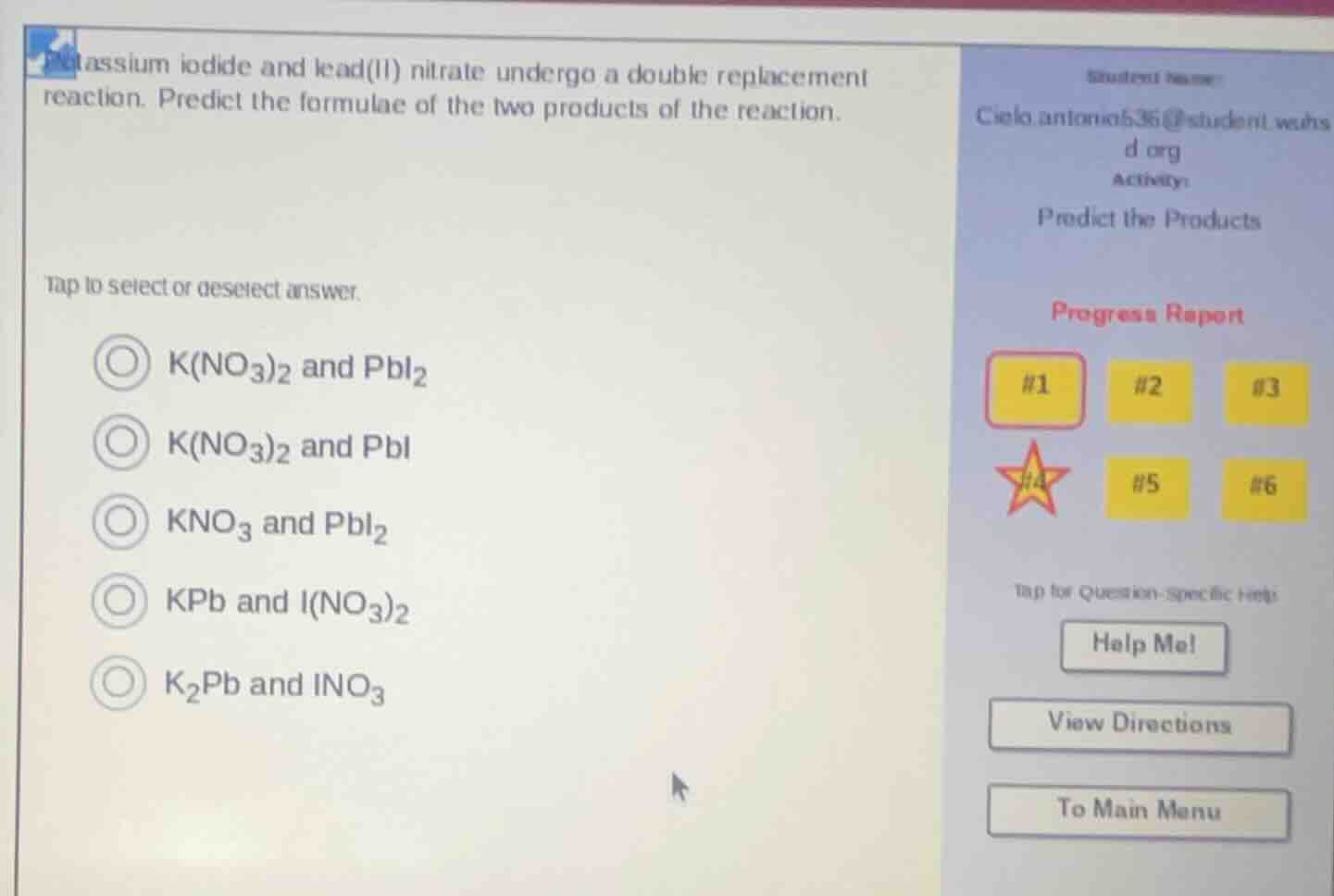
potassium iodide and lead(ii) nitrate undergo a double replacement reaction. predict the formulae of the two products of the reaction. tap to select or deselect answer. \\(\bigcirc\\) \\(\ce{k(no_{3})_{2}}\\) and \\(\ce{pbi_{2}}\\) \\(\bigcirc\\) \\(\ce{k(no_{3})_{2}}\\) and \\(\ce{pbi}\\) \\(\bigcirc\\) \\(\ce{kno_{3}}\\) and \\(\ce{pbi_{2}}\\) \\(\bigcirc\\) \\(\ce{kpb}\\) and \\(\ce{i(no_{3})_{2}}\\) \\(\bigcirc\\) \\(\ce{k_{2}pb}\\) and \\(\ce{ino_{3}}\\)
Step1: Identify reactants' formulas
Potassium iodide is \(KI\) (K⁺ and I⁻), lead(II) nitrate is \(Pb(NO_3)_2\) (Pb²⁺ and \(NO_3^-\)).
Step2: Apply double - replacement rules
In a double - replacement reaction \(AB + CD
ightarrow AD+CB\). So for \(KI\) and \(Pb(NO_3)_2\), the cations (K⁺ and Pb²⁺) and anions (I⁻ and \(NO_3^-\)) switch.
The products are formed by combining K⁺ with \(NO_3^-\) and Pb²⁺ with I⁻.
- For K⁺ (\(1 +\)) and \(NO_3^-\) (\(1-\)): The formula is \(KNO_3\) (since the charges balance as \(1\times( + 1)+1\times( - 1)=0\)).
- For Pb²⁺ (\(2+\)) and I⁻ (\(1-\)): To balance the charges, we need 2 I⁻ for 1 Pb²⁺, so the formula is \(PbI_2\) (\(1\times( + 2)+2\times( - 1)=0\)).

Snap & solve any problem in the app
Get step-by-step solutions on Sovi AI
Photo-based solutions with guided steps
Explore more problems and detailed explanations
C. \(KNO_3\) and \(PbI_2\)