QUESTION IMAGE
Question
1 practice 1
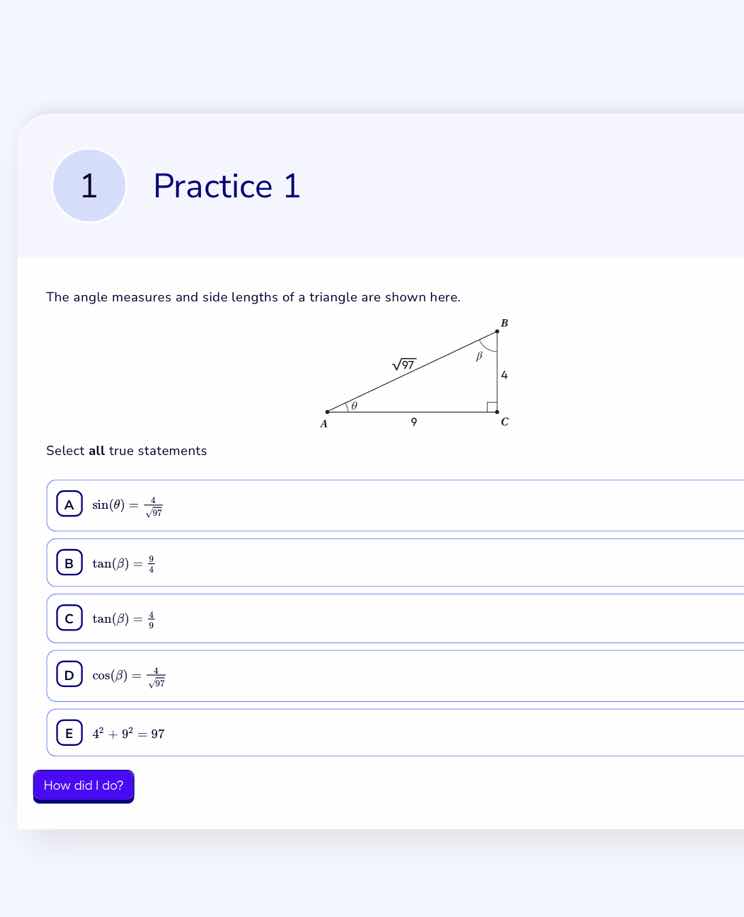
the angle measures and side lengths of a triangle are shown here.
select all true statements
a \\( \sin(\theta) = \frac{4}{\sqrt{97}} \\)
b \\( \tan(\beta) = \frac{9}{4} \\)
c \\( \tan(\beta) = \frac{4}{9} \\)
d \\( \cos(\beta) = \frac{4}{\sqrt{97}} \\)
e \\( 4^2 + 9^2 = 97 \\)
Step1: Recall Trigonometric Ratios and Pythagorean Theorem
In a right - triangle, the sine of an angle is defined as $\sin(\theta)=\frac{\text{opposite}}{\text{hypotenuse}}$, the tangent of an angle is $\tan(\theta)=\frac{\text{opposite}}{\text{adjacent}}$, the cosine of an angle is $\cos(\theta)=\frac{\text{adjacent}}{\text{hypotenuse}}$, and the Pythagorean theorem states that for a right - triangle with legs $a,b$ and hypotenuse $c$, $a^{2}+b^{2}=c^{2}$.
Step2: Analyze Option A
For angle $\theta$, the opposite side to $\theta$ is $BC = 4$, the hypotenuse is $AB=\sqrt{97}$. So, $\sin(\theta)=\frac{\text{opposite}}{\text{hypotenuse}}=\frac{4}{\sqrt{97}}$. So, option A is true.
Step3: Analyze Option B and C
For angle $\beta$, the opposite side to $\beta$ is $AC = 9$, the adjacent side to $\beta$ is $BC = 4$. Then, $\tan(\beta)=\frac{\text{opposite}}{\text{adjacent}}=\frac{9}{4}$. So, option B is true and option C is false.
Step4: Analyze Option D
For angle $\beta$, the adjacent side to $\beta$ is $BC = 4$, the hypotenuse is $AB=\sqrt{97}$. So, $\cos(\beta)=\frac{\text{adjacent}}{\text{hypotenuse}}=\frac{4}{\sqrt{97}}$, not $-\frac{4}{\sqrt{97}}$ (since $\beta$ is an acute angle in a right - triangle, cosine of an acute angle is positive). So, option D is false.
Step5: Analyze Option E
Using the Pythagorean theorem, for right - triangle $ABC$ with legs $AC = 9$ and $BC = 4$, and hypotenuse $AB=\sqrt{97}$, we have $AC^{2}+BC^{2}=AB^{2}$. Substituting the values, $9^{2}+4^{2}=81 + 16=97$ and $(\sqrt{97})^{2}=97$. So, $4^{2}+9^{2}=97$ is true.

Snap & solve any problem in the app
Get step-by-step solutions on Sovi AI
Photo-based solutions with guided steps
Explore more problems and detailed explanations
A. $\sin(\theta)=\frac{4}{\sqrt{97}}$
B. $\tan(\beta)=\frac{9}{4}$
E. $4^{2}+9^{2}=97$