QUESTION IMAGE
Question
practice 3
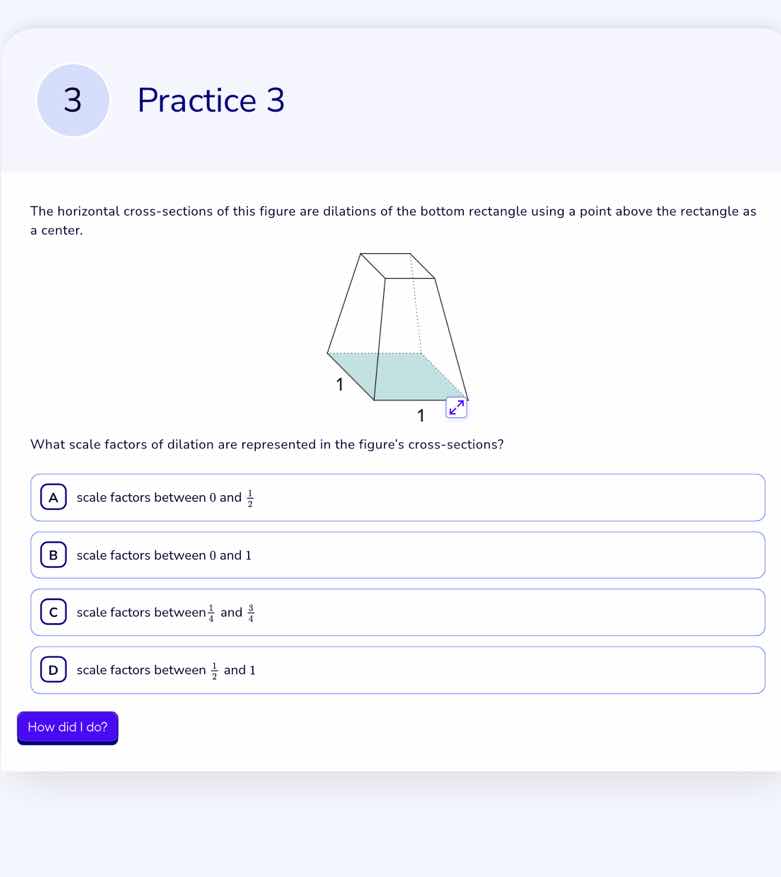
the horizontal cross - sections of this figure are dilations of the bottom rectangle using a point above the rectangle as
a center.
what scale factors of dilation are represented in the figure’s cross - sections?
a scale factors between 0 and \\(\frac{1}{2}\\)
b scale factors between 0 and 1
c scale factors between \\(\frac{1}{4}\\) and \\(\frac{3}{4}\\)
d scale factors between \\(\frac{1}{2}\\) and 1
A dilation scale factor determines how much a figure is enlarged or reduced. In this figure, the cross - sections are dilations of the bottom rectangle with a center above the rectangle. The top cross - section is smaller than the bottom one (since it's a frustum - like shape formed by dilation from a point above), but still has a positive scale factor. The bottom rectangle has a scale factor of 1 (since it's the original figure), and as we move up from the bottom to the top, the scale factor decreases but remains greater than 0 (because the cross - sections are still positive - sized, just smaller than the bottom). Also, the top is not extremely small (not going down to near 0 or to a fraction like 1/2 as a lower bound). So the scale factors are between 0 and 1? Wait, no, wait. Wait, the bottom is a rectangle, and the top is a smaller rectangle. Wait, actually, when you have a dilation from a point above, the scale factor at the bottom is 1 (since it's the original), and as we move up towards the top, the scale factor gets smaller but is still greater than 0? But wait, looking at the options, option D: between 1/2 and 1? Wait, maybe I made a mistake. Wait, the figure is a frustum, which is like a pyramid with the top cut off. So the original pyramid (before cutting) has a base (the bottom rectangle) and a top vertex. The cross - sections between the bottom and the top (the cut) are dilations from the top vertex. Wait, no, the problem says "dilations of the bottom rectangle using a point above the rectangle as a center". So the bottom rectangle is the original, and the cross - sections above it are dilations (so scaled down) from the point above. The top cross - section is smaller than the bottom, but how small? The bottom has side length 1 (from the diagram, the bottom has 1 and 1). The top is a rectangle, which is smaller than the bottom, but not extremely small. So the scale factor at the bottom is 1, and as we go up, the scale factor decreases, but is greater than, say, 1/2? Wait, no, maybe the key is that the top is a rectangle that is not zero - sized, and the bottom is size 1. So the scale factors are between 0 and 1? But option D is between 1/2 and 1. Wait, maybe I misinterpret the figure. Let's think again. The figure is a prismatoid with a bottom rectangle and a top rectangle, and the sides are trapezoids. So the horizontal cross - sections (parallel to the bottom) are rectangles that are dilations of the bottom rectangle from a point above. So the bottom rectangle has scale factor 1 (since it's the original). The top rectangle has a scale factor less than 1 (since it's smaller). Now, how small is the top? If the top were scale factor 0, it would be a point, but it's a rectangle, so scale factor is greater than 0. But the options: A is between 0 and 1/2, B between 0 and 1, C between 1/4 and 3/4, D between 1/2 and 1. Wait, maybe the figure's top is not too small. For example, if the top is about half the size of the bottom, then the scale factors would be between 1/2 and 1 (since at the bottom it's 1, and at the top it's at least 1/2). Wait, maybe the diagram shows that the top is not extremely small, so the scale factors are between 1/2 and 1. So the correct answer is D? Wait, no, maybe I messed up. Wait, let's recall: dilation scale factor. If the center is above the rectangle, then the bottom rectangle is at distance d from the center, and a cross - section at distance d + h from the center (above the bottom) would have a scale factor of d/(d + h). Since h is positive, d/(d + h) is less than 1. And as h increases (moving…

Snap & solve any problem in the app
Get step-by-step solutions on Sovi AI
Photo-based solutions with guided steps
Explore more problems and detailed explanations
D. scale factors between $\frac{1}{2}$ and 1