QUESTION IMAGE
Question
practice worksheet
name:
date:
class:
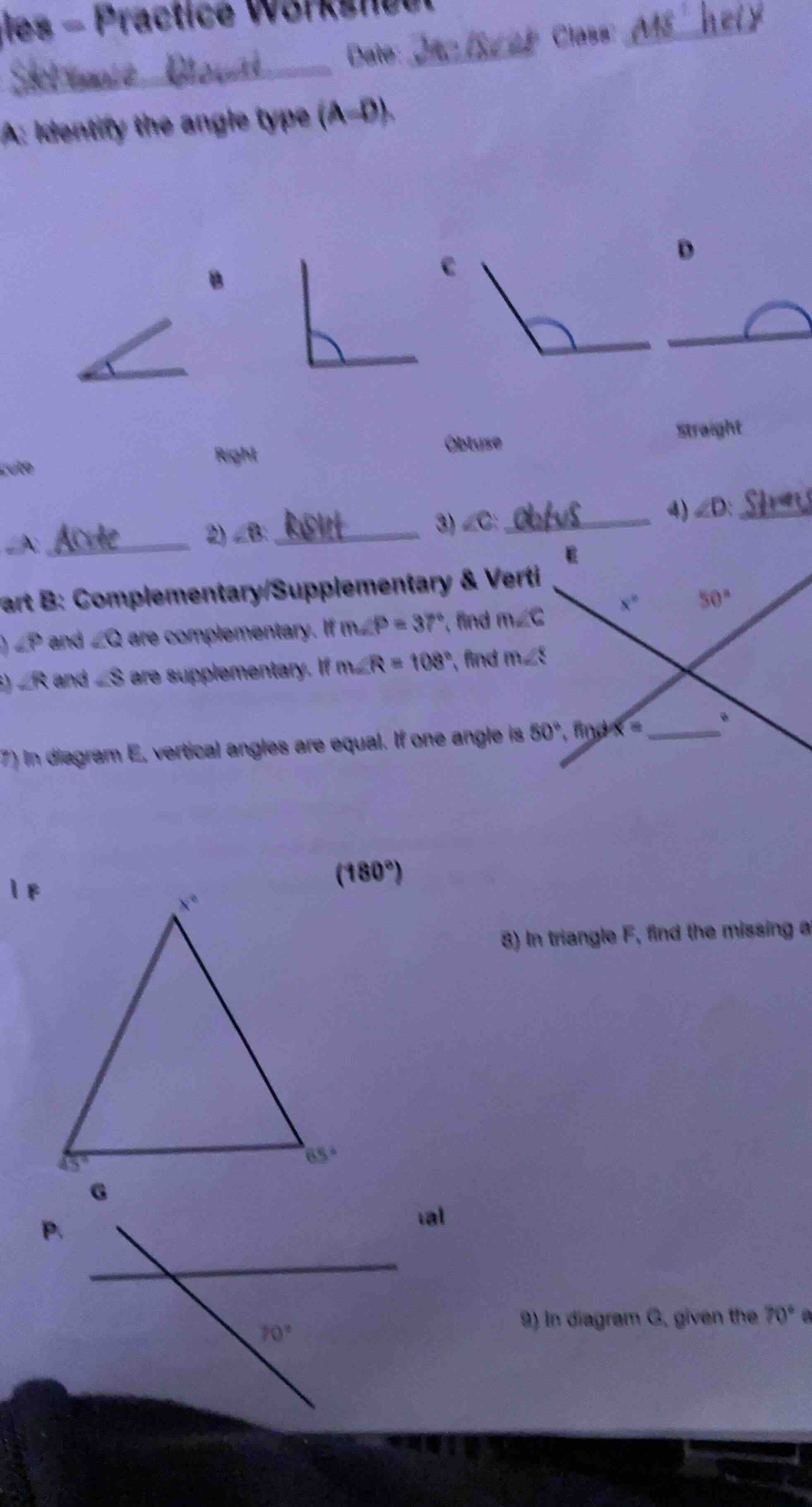
a: identify the angle type (a–d).
(angle a diagram: acute angle)
(angle b diagram: right angle)
(angle c diagram: obtuse angle)
(angle d diagram: straight angle)
- ∠a:
- ∠b:
- ∠c:
- ∠d:
part b: complementary/supplementary & vertical angles
- ∠p and ∠q are complementary. if m∠p = 37°, find m∠q
- ∠r and ∠s are supplementary. if m∠r = 108°, find m∠s
- in diagram e (intersecting lines with one angle 50°), vertical angles are equal. if one angle is 50°, find x =
- in triangle f (angles 45°, 65°, and x°), find the missing angle x
(diagram g: a transversal with a 70° angle)
- in diagram g, given the 70° angle...
Let's solve the problems one by one:
Part A: Identify the angle type
- ∠A: The angle is less than 90°, so it's an Acute angle.
- ∠B: The angle is 90° (right angle symbol), so it's a Right angle.
- ∠C: The angle is greater than 90° but less than 180°, so it's an Obtuse angle.
- ∠D: The angle is a straight line (180°), so it's a Straight angle.
Part B: Complementary/Supplementary & Vertical Angles
- ∠P and ∠Q are complementary (sum to 90°).
Given \( m\angle P = 37^\circ \),
\( m\angle Q = 90^\circ - 37^\circ = 53^\circ \).
- ∠R and ∠S are supplementary (sum to 180°).
Given \( m\angle R = 108^\circ \),
\( m\angle S = 180^\circ - 108^\circ = 72^\circ \).
- Vertical angles are equal (diagram E).
If one angle is \( 50^\circ \), then \( x = 50^\circ \) (vertical angles are congruent).
- Triangle F: Sum of angles in a triangle is 180°
Given angles: \( 45^\circ \) and \( 65^\circ \),
\( x = 180^\circ - 45^\circ - 65^\circ = 70^\circ \).
Final Answers (Key Problems):
- ∠Q: \( \boldsymbol{53^\circ} \)
- ∠S: \( \boldsymbol{72^\circ} \)
- \( x \) (diagram E): \( \boldsymbol{50^\circ} \)
- \( x \) (triangle F): \( \boldsymbol{70^\circ} \)

Snap & solve any problem in the app
Get step-by-step solutions on Sovi AI
Photo-based solutions with guided steps
Explore more problems and detailed explanations
Let's solve the problems one by one:
Part A: Identify the angle type
- ∠A: The angle is less than 90°, so it's an Acute angle.
- ∠B: The angle is 90° (right angle symbol), so it's a Right angle.
- ∠C: The angle is greater than 90° but less than 180°, so it's an Obtuse angle.
- ∠D: The angle is a straight line (180°), so it's a Straight angle.
Part B: Complementary/Supplementary & Vertical Angles
- ∠P and ∠Q are complementary (sum to 90°).
Given \( m\angle P = 37^\circ \),
\( m\angle Q = 90^\circ - 37^\circ = 53^\circ \).
- ∠R and ∠S are supplementary (sum to 180°).
Given \( m\angle R = 108^\circ \),
\( m\angle S = 180^\circ - 108^\circ = 72^\circ \).
- Vertical angles are equal (diagram E).
If one angle is \( 50^\circ \), then \( x = 50^\circ \) (vertical angles are congruent).
- Triangle F: Sum of angles in a triangle is 180°
Given angles: \( 45^\circ \) and \( 65^\circ \),
\( x = 180^\circ - 45^\circ - 65^\circ = 70^\circ \).
Final Answers (Key Problems):
- ∠Q: \( \boldsymbol{53^\circ} \)
- ∠S: \( \boldsymbol{72^\circ} \)
- \( x \) (diagram E): \( \boldsymbol{50^\circ} \)
- \( x \) (triangle F): \( \boldsymbol{70^\circ} \)