QUESTION IMAGE
Question
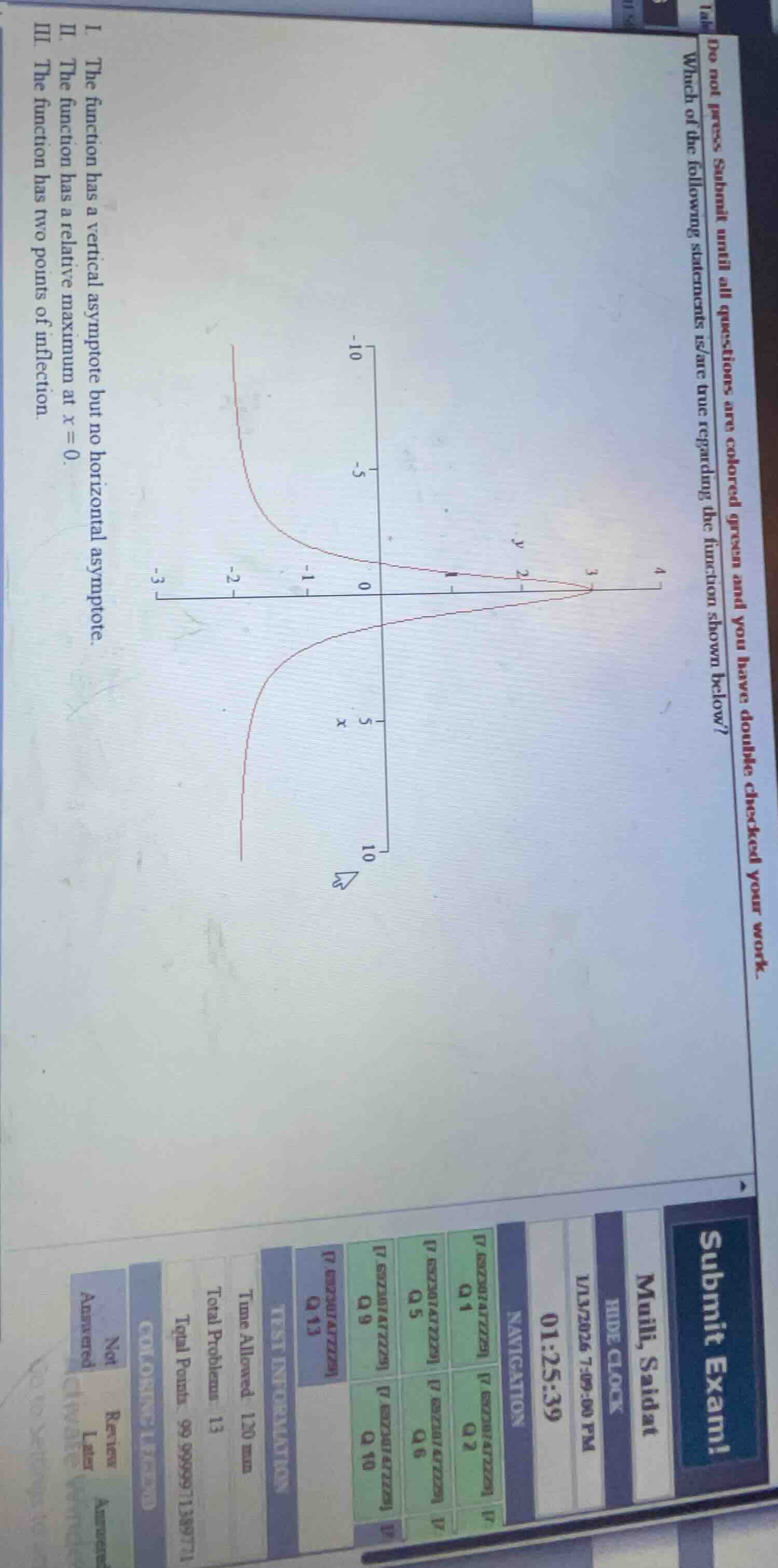
do not press submit until all questions are colored green and you have double checked your work. which of the following statements is/are true regarding the function shown below? i. the function has a vertical asymptote but no horizontal asymptote. ii. the function has a relative maximum at ( x = 0 ). iii. the function has two points of inflection.
To determine which statement is true, we analyze each one:
Statement I: Vertical vs. Horizontal Asymptotes
- A vertical asymptote occurs where the function approaches \( \pm\infty \) (e.g., near \( x = 0 \), the graph shoots up/down, suggesting a vertical asymptote).
- A horizontal asymptote is a horizontal line the function approaches as \( x \to \pm\infty \). From the graph, as \( x \to \pm\infty \), the function does not approach a horizontal line (it continues to curve or extend), so there is no horizontal asymptote. Thus, Statement I is true.
Statement II: Relative Maximum at \( x = 0 \)
A relative maximum is a point where the function changes from increasing to decreasing. At \( x = 0 \), the function has a vertical asymptote (not a smooth point of extrema). The graph does not have a "peak" or "valley" at \( x = 0 \); instead, it has a discontinuity (asymptote). Thus, Statement II is false.
Statement III: Two Points of Inflection
A point of inflection is where the concavity changes (second derivative changes sign). The graph appears to have a single curve (no two distinct points where concavity flips). Thus, Statement III is false.
- Statement I: The graph has a vertical asymptote at \( x = 0 \) (function approaches \( \pm\infty \)) and no horizontal asymptote (no horizontal line as \( x \to \pm\infty \)).
- Statement II: \( x = 0 \) is an asymptote, not a relative maximum (no peak/valley).
- Statement III: The graph does not show two concavity changes (inflection points).

Snap & solve any problem in the app
Get step-by-step solutions on Sovi AI
Photo-based solutions with guided steps
Explore more problems and detailed explanations
I. The function has a vertical asymptote but no horizontal asymptote.