QUESTION IMAGE
Question
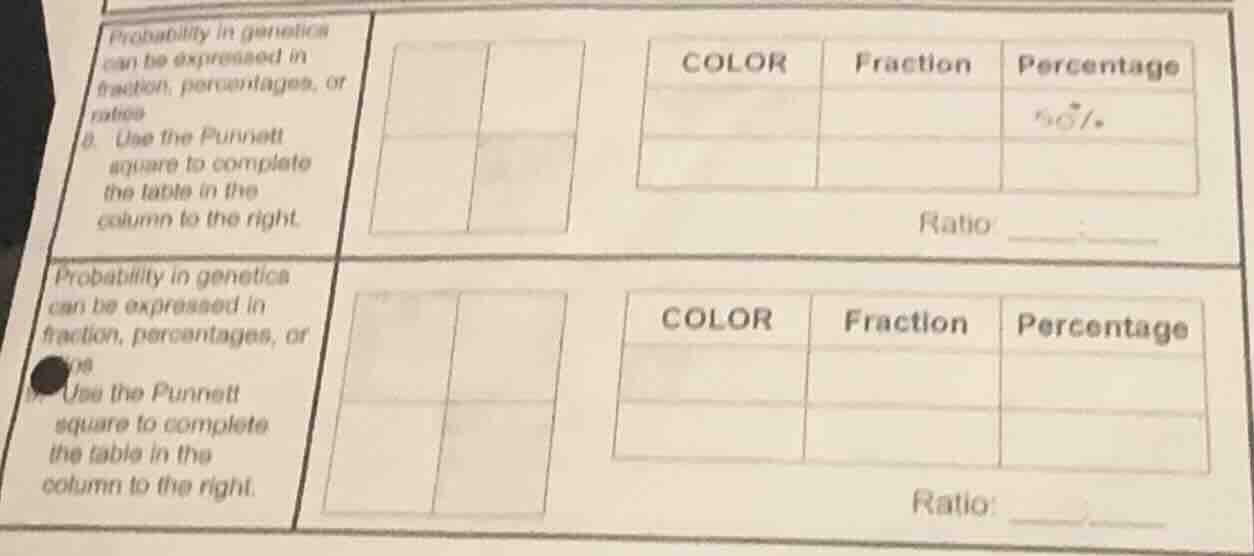
probability in genetics can be expressed in fraction, percentages, or ratios
- use the punnett square to complete the table in the column to the right.
probability in genetics can be expressed in fraction, percentages, or
use the punnett square to complete the table in the column to the right.
To solve this, we analyze the Punnett square (assuming a typical 2x2 grid with 4 cells, 1 shaded as an example for the first case):
First Punnett Square (1 shaded cell):
Step 1: Determine Fraction
Total cells = 4, Shaded cells = 1. So fraction = $\frac{1}{4}$.
Step 2: Convert to Percentage
Percentage = $\frac{1}{4} \times 100 = 25\%$.
Step 3: Determine Ratio (Shaded:Unshaded)
Unshaded cells = 4 - 1 = 3. Ratio = $1:3$.
Second Punnett Square (assuming 2 shaded cells, common in monohybrid crosses):
Step 1: Determine Fraction
Total cells = 4, Shaded cells = 2. Fraction = $\frac{2}{4} = \frac{1}{2}$.
Step 2: Convert to Percentage
Percentage = $\frac{1}{2} \times 100 = 50\%$.
Step 3: Determine Ratio (Shaded:Unshaded)
Unshaded cells = 4 - 2 = 2. Ratio = $1:1$.
Filling the Table (First Case):
| COLOR | Fraction | Percentage |
|---|---|---|
| Unshaded | $\frac{3}{4}$ | $75\%$ |
Ratio: $1:3$
Filling the Table (Second Case):
| COLOR | Fraction | Percentage |
|---|---|---|
| Unshaded | $\frac{1}{2}$ | $50\%$ |
Ratio: $1:1$
(Note: The exact numbers depend on the actual shading in the Punnett square. Adjust fractions/percentage/ratio based on the number of shaded cells.)
Final Answers (Example for 1 shaded cell):
- Fraction (Shaded): $\boldsymbol{\frac{1}{4}}$, Percentage: $\boldsymbol{25\%}$, Ratio: $\boldsymbol{1:3}$
- Fraction (Unshaded): $\boldsymbol{\frac{3}{4}}$, Percentage: $\boldsymbol{75\%}$
(For 2 shaded cells, adjust to $\frac{1}{2}$, $50\%$, and $1:1$ as shown.)

Snap & solve any problem in the app
Get step-by-step solutions on Sovi AI
Photo-based solutions with guided steps
Explore more problems and detailed explanations
To solve this, we analyze the Punnett square (assuming a typical 2x2 grid with 4 cells, 1 shaded as an example for the first case):
First Punnett Square (1 shaded cell):
Step 1: Determine Fraction
Total cells = 4, Shaded cells = 1. So fraction = $\frac{1}{4}$.
Step 2: Convert to Percentage
Percentage = $\frac{1}{4} \times 100 = 25\%$.
Step 3: Determine Ratio (Shaded:Unshaded)
Unshaded cells = 4 - 1 = 3. Ratio = $1:3$.
Second Punnett Square (assuming 2 shaded cells, common in monohybrid crosses):
Step 1: Determine Fraction
Total cells = 4, Shaded cells = 2. Fraction = $\frac{2}{4} = \frac{1}{2}$.
Step 2: Convert to Percentage
Percentage = $\frac{1}{2} \times 100 = 50\%$.
Step 3: Determine Ratio (Shaded:Unshaded)
Unshaded cells = 4 - 2 = 2. Ratio = $1:1$.
Filling the Table (First Case):
| COLOR | Fraction | Percentage |
|---|---|---|
| Unshaded | $\frac{3}{4}$ | $75\%$ |
Ratio: $1:3$
Filling the Table (Second Case):
| COLOR | Fraction | Percentage |
|---|---|---|
| Unshaded | $\frac{1}{2}$ | $50\%$ |
Ratio: $1:1$
(Note: The exact numbers depend on the actual shading in the Punnett square. Adjust fractions/percentage/ratio based on the number of shaded cells.)
Final Answers (Example for 1 shaded cell):
- Fraction (Shaded): $\boldsymbol{\frac{1}{4}}$, Percentage: $\boldsymbol{25\%}$, Ratio: $\boldsymbol{1:3}$
- Fraction (Unshaded): $\boldsymbol{\frac{3}{4}}$, Percentage: $\boldsymbol{75\%}$
(For 2 shaded cells, adjust to $\frac{1}{2}$, $50\%$, and $1:1$ as shown.)