QUESTION IMAGE
Question
problem 3-7
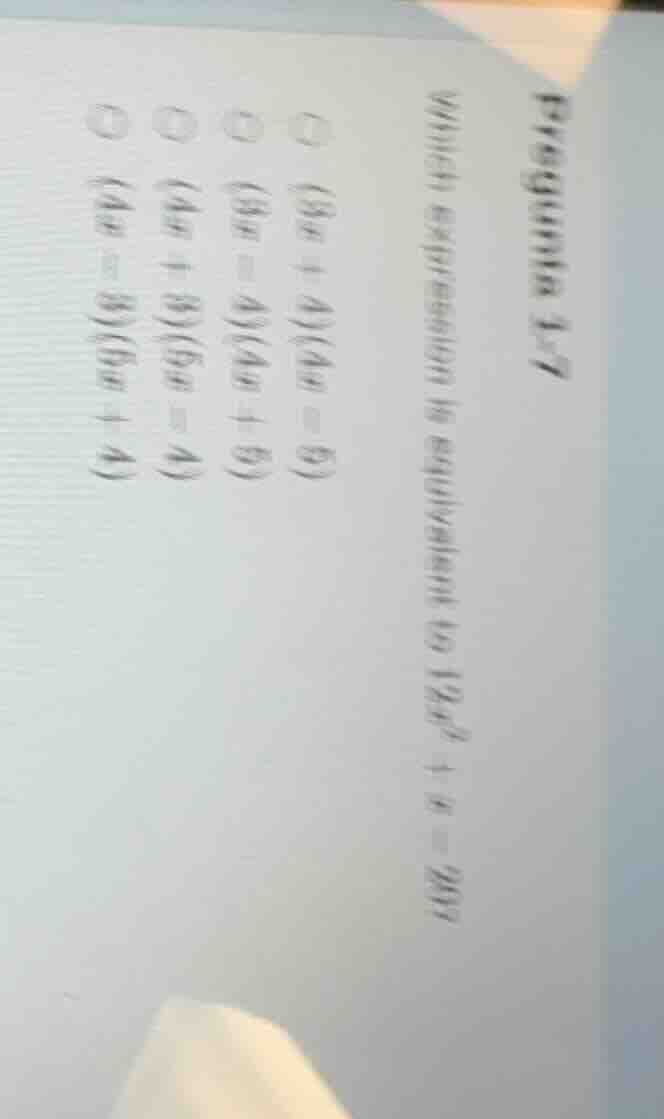
which expression is equivalent to (12x^2 + x - 20)?
((3x + 4)(4x - 5))
((3x - 4)(4x + 5))
((4x + 8)(5x - 4))
((4x - 8)(5x + 4))
To determine which expression is equivalent to \(12x^2 + x - 20\), we can expand each option using the distributive property (FOIL method) and compare the results.
Step 1: Expand Option A \((3x + 4)(4x - 5)\)
Using the FOIL method:
- First: \(3x \cdot 4x = 12x^2\)
- Outer: \(3x \cdot (-5) = -15x\)
- Inner: \(4 \cdot 4x = 16x\)
- Last: \(4 \cdot (-5) = -20\)
Combine like terms:
\(12x^2 - 15x + 16x - 20 = 12x^2 + x - 20\)
Step 2: Verify Other Options (Optional, but for completeness)
- Option B: \((3x - 4)(4x + 5)\)
- First: \(3x \cdot 4x = 12x^2\)
- Outer: \(3x \cdot 5 = 15x\)
- Inner: \(-4 \cdot 4x = -16x\)
- Last: \(-4 \cdot 5 = -20\)
- Combine: \(12x^2 + 15x - 16x - 20 = 12x^2 - x - 20\) (Not equivalent)
- Option C: \((4x + 8)(5x - 4)\)
- First: \(4x \cdot 5x = 20x^2\) (Already different from \(12x^2\), so not equivalent)
- Option D: \((4x - 8)(5x + 4)\)
- First: \(4x \cdot 5x = 20x^2\) (Different from \(12x^2\), not equivalent)

Snap & solve any problem in the app
Get step-by-step solutions on Sovi AI
Photo-based solutions with guided steps
Explore more problems and detailed explanations
A. \((3x + 4)(4x - 5)\)