QUESTION IMAGE
Question
problem 4
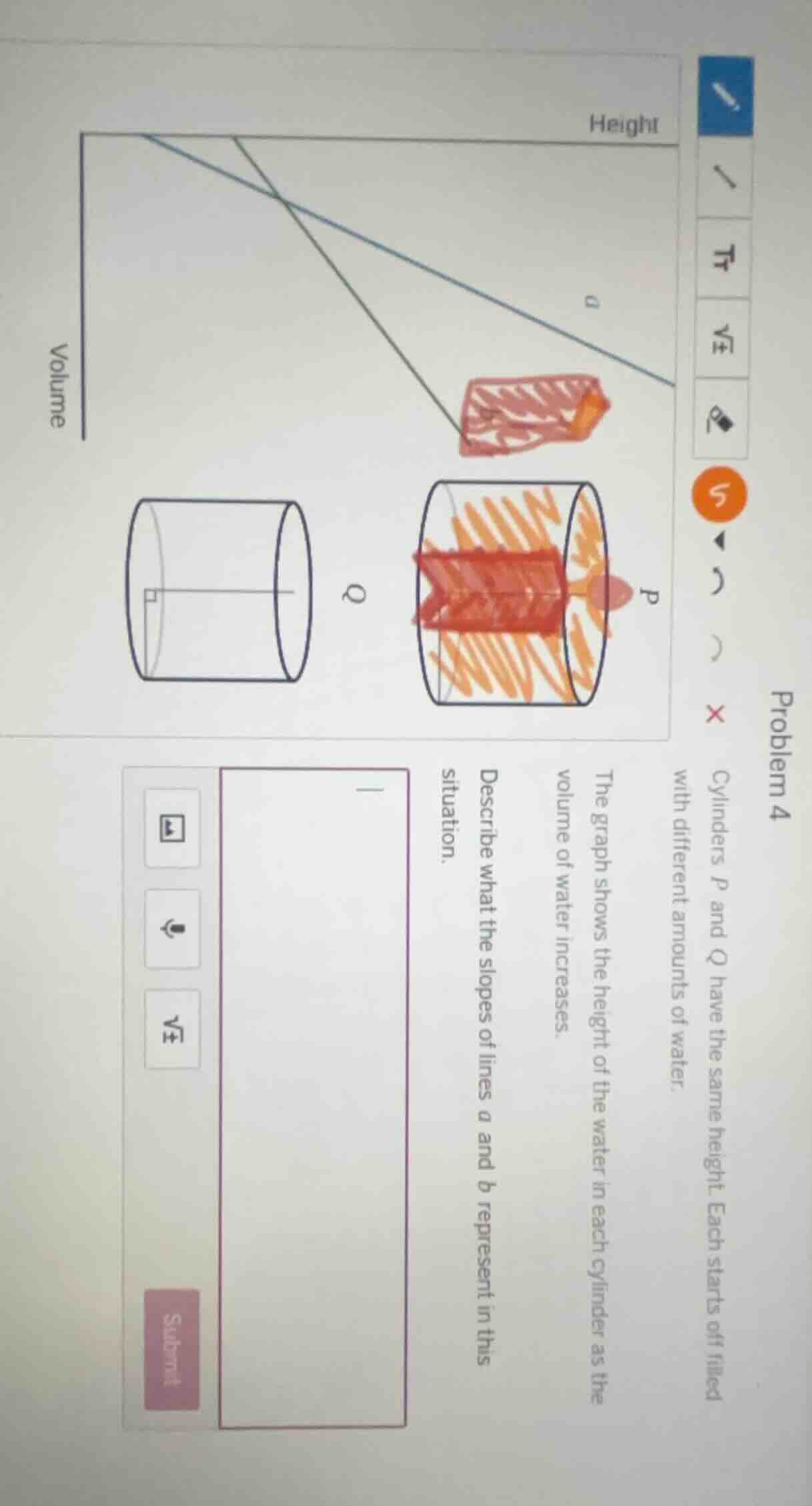
cylinders p and q have the same height. each starts off filled with different amounts of water.
the graph shows the height of the water in each cylinder as the volume of water increases.
describe what the slopes of lines a and b represent in this situation.
The slope of a line in a volume - height graph for a cylinder represents the rate of change of volume with respect to height. The formula for the volume of a cylinder is $V=\pi r^{2}h$, so the rate of change of volume with respect to height ($\frac{dV}{dh}$) is $\pi r^{2}$, which is related to the base area of the cylinder. A steeper slope means a larger rate of change of volume with height, which implies a larger base area (since $V = A\times h$ where $A$ is the base area, so $\frac{dV}{dh}=A$). Looking at the cylinders, cylinder $P$ seems to have a larger base area (from the diagram, maybe due to its wider appearance) and cylinder $Q$ has a smaller base area. Line $a$ has a less steep slope and line $b$ has a steeper slope. So the slope of line $a$ represents the rate at which the volume of water increases with height in the cylinder with the smaller base area (probably cylinder $Q$), and the slope of line $b$ represents the rate at which the volume of water increases with height in the cylinder with the larger base area (probably cylinder $P$). In other words, the slope of each line is the base area of the corresponding cylinder (since $V = A\times h$, so $\frac{V}{h}=A$), so a smaller slope means a smaller base area and a larger slope means a larger base area.

Snap & solve any problem in the app
Get step-by-step solutions on Sovi AI
Photo-based solutions with guided steps
Explore more problems and detailed explanations
The slope of a line (e.g., line \(a\) or \(b\)) in the volume - height graph represents the base area of the corresponding cylinder (since \(V=\pi r^{2}h\), so \(\frac{\Delta V}{\Delta h}=\pi r^{2}\), the base area). A less - steep slope (e.g., line \(a\)) corresponds to a cylinder with a smaller base area (e.g., cylinder \(Q\)), and a steeper slope (e.g., line \(b\)) corresponds to a cylinder with a larger base area (e.g., cylinder \(P\)). So the slopes represent the rate at which volume increases with height, which is equal to the base area of each cylinder.