QUESTION IMAGE
Question
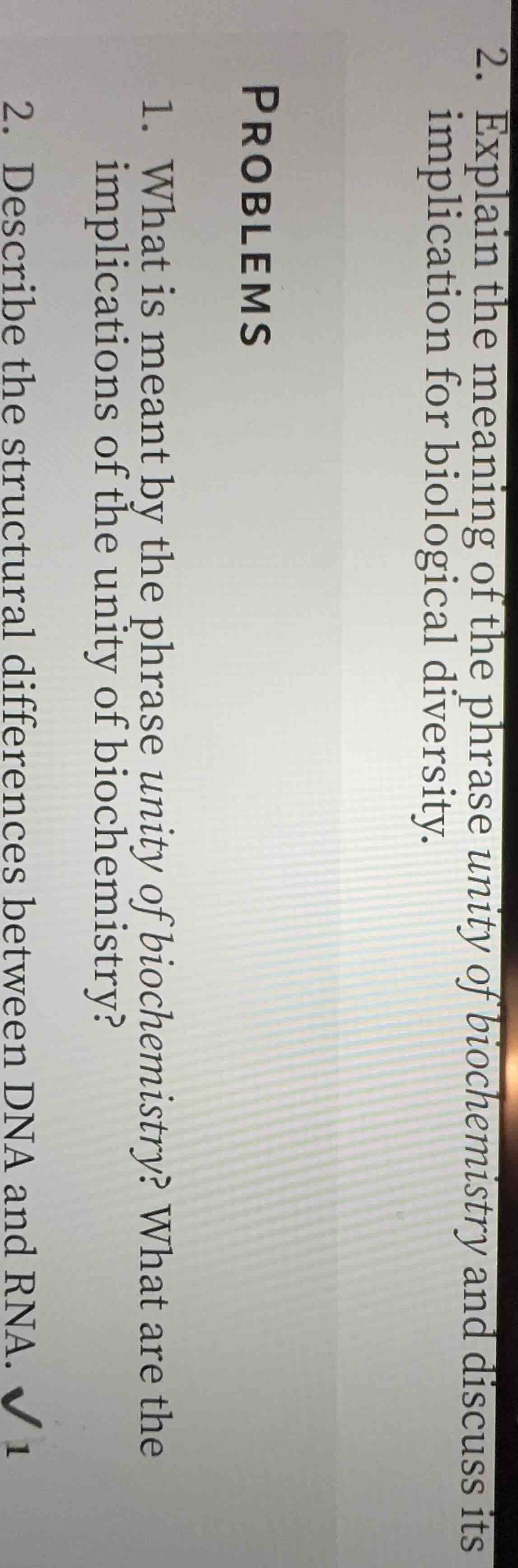
problems 1. what is meant by the phrase unity of biochemistry? what are the implications of the unity of biochemistry? 2. describe the structural differences between dna and rna. 2. explain the meaning of the phrase unity of biochemistry and discuss its implication for biological diversity.
- For Problem 1:
The "unity of biochemistry" refers to the shared core biochemical mechanisms and molecules across all living organisms. All life uses the same fundamental building blocks: DNA/RNA for genetic storage, amino acids for proteins, and ATP for energy. This unity arises from shared evolutionary ancestry, as all life descended from a common ancestor with these core systems.
For biological diversity, this unity means diverse organisms share a biochemical foundation, allowing evolutionary modifications of shared pathways to produce the wide range of life forms. It also means insights from one organism (e.g., bacterial genetics) can apply to all life, enabling cross-species research.
- For Problem 2:
DNA (deoxyribonucleic acid) and RNA (ribonucleic acid) have key structural differences:
- Sugar: DNA uses deoxyribose (lacks an oxygen on the 2' carbon of the sugar ring), while RNA uses ribose (has a 2' hydroxyl group).
- Nucleobases: DNA contains adenine (A), thymine (T), cytosine (C), guanine (G); RNA replaces thymine with uracil (U).
- Structure: DNA is typically a double-stranded, helical molecule; RNA is mostly single-stranded (though it can form secondary structures like hairpins).
- Stability: DNA is more stable due to the deoxyribose sugar and double helix, making it ideal for long-term genetic storage; RNA is less stable, suited for short-term functions like protein synthesis.

Snap & solve any problem in the app
Get step-by-step solutions on Sovi AI
Photo-based solutions with guided steps
Explore more problems and detailed explanations
- The "unity of biochemistry" is the principle that all living organisms share a common set of core biochemical molecules, pathways, and genetic systems, derived from a universal common ancestor. Its implications for biological diversity are:
- All diverse life forms are built on the same biochemical foundation, so evolutionary changes modify shared systems to generate new traits and species.
- It allows translational research: discoveries in one organism (e.g., yeast, mice) can be generalized to all other living things, accelerating biological and medical progress.
- Key structural differences between DNA and RNA:
- Sugar component: DNA has deoxyribose ($\text{C}_5\text{H}_{10}\text{O}_4$); RNA has ribose ($\text{C}_5\text{H}_{10}\text{O}_5$).
- Nitrogenous bases: DNA uses A, T, C, G; RNA uses A, U, C, G.
- Strand structure: DNA is almost always double-stranded (double helix); RNA is mostly single-stranded (with occasional intramolecular base pairing).
- Overall stability: DNA is chemically more stable, adapted for long-term genetic storage; RNA is less stable, suited for temporary roles like mRNA, tRNA, and rRNA in protein synthesis.