QUESTION IMAGE
Question
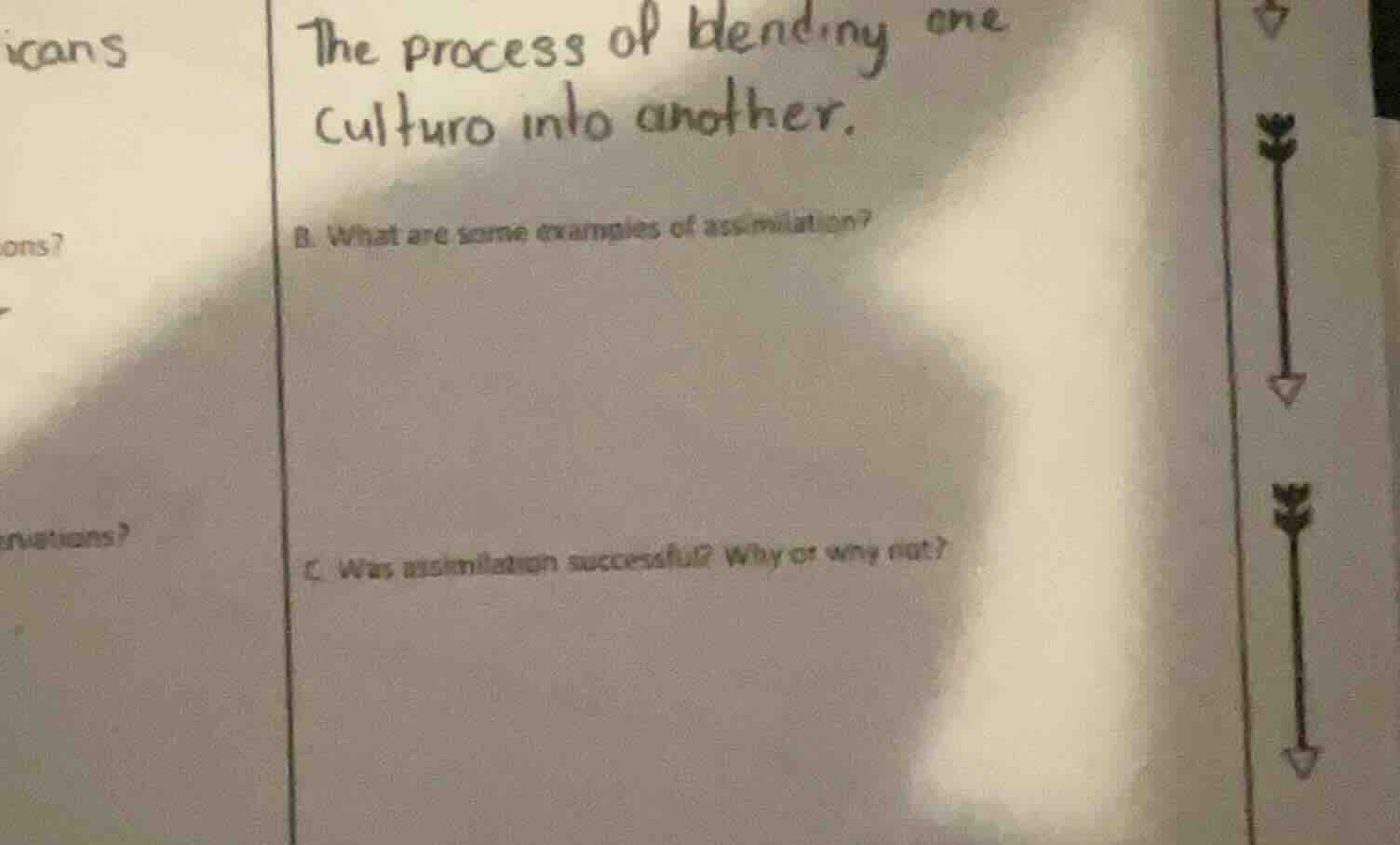
the process of blending one culture into another.
b. what are some examples of assimilation?
c. was assimilation successful? why or why not?
Brief Explanations
First, the term described is cultural assimilation. For part B, examples are drawn from historical and modern cases where a group adopts another culture's traits. For part C, success is evaluated based on cultural preservation, equity, and historical outcomes, as assimilation often harmed marginalized groups while sometimes meeting dominant culture goals.

Snap & solve any problem in the app
Get step-by-step solutions on Sovi AI
Photo-based solutions with guided steps
Explore more problems and detailed explanations
- The term defined is cultural assimilation
- Examples of assimilation:
- Indigenous children in Canada/US forced into residential schools, where they were forbidden from speaking their native languages and forced to adopt European-Canadian/European-American cultural norms.
- Immigrant groups in the United States (such as early 20th-century Italian, Polish, or Irish immigrants) adopting English, American holiday traditions, and mainstream social norms to integrate into dominant society.
- The forced assimilation of Korean people under Japanese colonial rule (1910-1945), where they were required to take Japanese names, speak Japanese, and abandon Korean cultural practices.
- Assimilation was not broadly successful, for these reasons:
- It caused severe cultural erasure: Many Indigenous languages, traditions, and cultural practices were lost or severely weakened due to assimilation policies, causing intergenerational trauma that persists today.
- It perpetuated inequality: Assimilation was often imposed by dominant, privileged groups on marginalized communities, reinforcing power imbalances rather than creating true equality.
- While it sometimes allowed individual immigrants access to mainstream society, it often required them to abandon their cultural identities, leading to loss of community and belonging.
- In cases like Japanese colonial rule in Korea, assimilation was resented as an act of oppression, and cultural identities re-emerged strongly after the end of colonial rule, showing the policy failed to fully erase the subjugated group's culture.