QUESTION IMAGE
Question
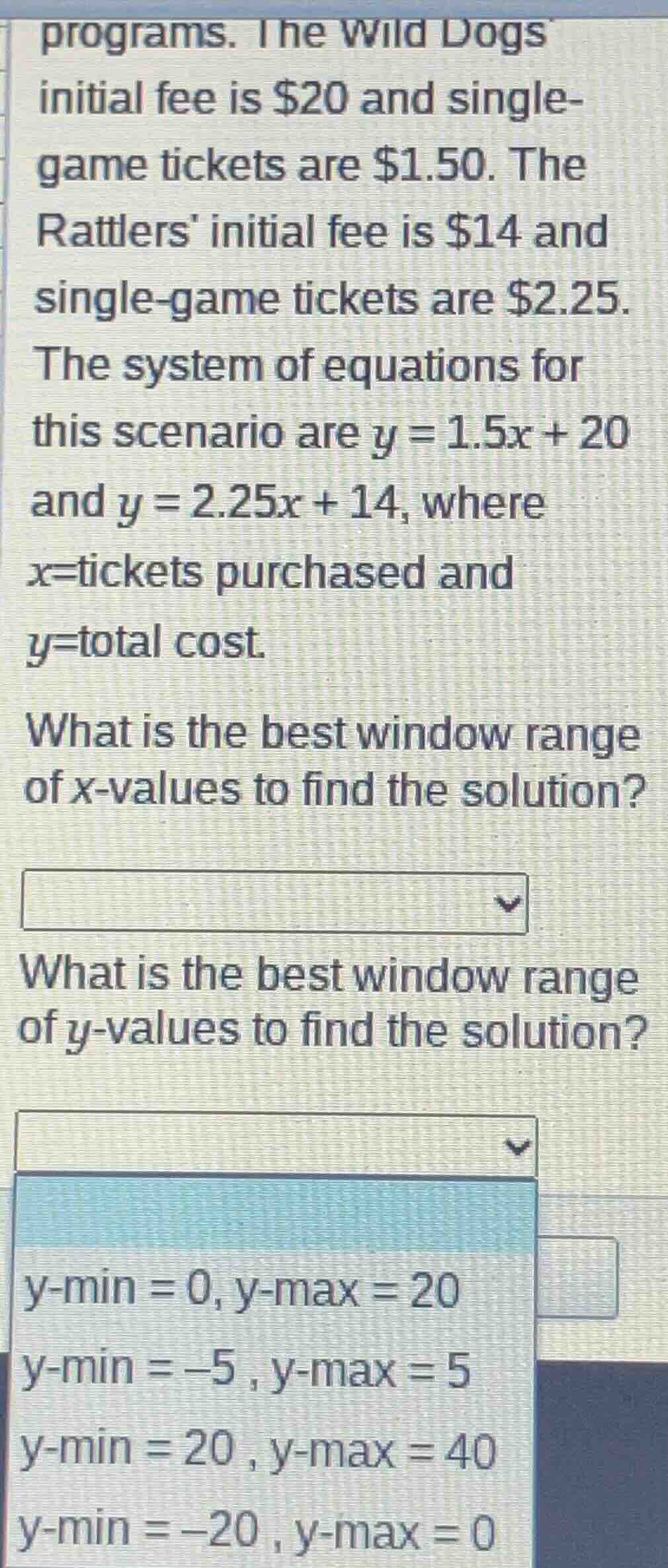
programs. the wild dogs initial fee is $20 and single-game tickets are $1.50. the rattlers initial fee is $14 and single-game tickets are $2.25. the system of equations for this scenario are $y = 1.5x + 20$ and $y = 2.25x + 14$, where $x$=tickets purchased and $y$=total cost. what is the best window range of $x$-values to find the solution? what is the best window range of $y$-values to find the solution? $y$-min = 0, $y$-max = 20 $y$-min = -5, $y$-max = 5 $y$-min = 20, $y$-max = 40 $y$-min = -20, $y$-max = 0
First, find the solution of the system of equations to determine the appropriate window ranges.
Step 1: Solve the system of equations
We have the two equations:
\( y = 1.5x + 20 \)
\( y = 2.25x + 14 \)
Set them equal to each other since they both equal \( y \):
\( 1.5x + 20 = 2.25x + 14 \)
Subtract \( 1.5x \) from both sides:
\( 20 = 0.75x + 14 \)
Subtract 14 from both sides:
\( 6 = 0.75x \)
Divide both sides by \( 0.75 \):
\( x = \frac{6}{0.75} = 8 \)
Now find \( y \) by plugging \( x = 8 \) into one of the equations, say \( y = 1.5x + 20 \):
\( y = 1.5(8) + 20 = 12 + 20 = 32 \)
So the solution is \( x = 8 \) and \( y = 32 \).
For the x - values window range:
We know that \( x \) represents the number of tickets purchased, so \( x\geq0 \). The solution occurs at \( x = 8 \), so a reasonable window for \( x \) would be from \( 0 \) to \( 10 \) (or a range that includes \( x = 8 \) and non - negative values since you can't buy a negative number of tickets). A common appropriate range could be \( x_{\text{min}} = 0 \), \( x_{\text{max}} = 10 \) (or similar range that includes \( x = 8 \)).
For the y - values window range:
We know that \( y \) represents the total cost, so \( y\geq0 \). The solution occurs at \( y = 32 \), and the initial fees are \( 20 \) and \( 14 \), and the cost increases with the number of tickets. Looking at the options:
- Option 1: \( y_{\text{min}} = 0 \), \( y_{\text{max}} = 20 \): The solution \( y = 32 \) is outside this range.
- Option 2: \( y_{\text{min}}=- 5 \), \( y_{\text{max}} = 5 \): The cost is positive and \( 32 \) is outside this range.
- Option 3: \( y_{\text{min}} = 20 \), \( y_{\text{max}} = 40 \): The solution \( y = 32 \) is within this range ( \( 20\leq32\leq40 \) ), and since the initial fees are \( 14 \) and \( 20 \), and the cost increases, this range makes sense.
- Option 4: \( y_{\text{min}}=-20 \), \( y_{\text{max}} = 0 \): Cost is non - negative, so this range is not appropriate.
To find the best \( y \) - values window range, we first solve the system of equations \( y = 1.5x+20 \) and \( y = 2.25x + 14 \). The solution is \( x = 8,y = 32 \). We analyze the options: \( y_{\text{min}} = 0,y_{\text{max}} = 20 \) does not include \( y = 32 \); \( y_{\text{min}}=-5,y_{\text{max}} = 5 \) is too small; \( y_{\text{min}}=-20,y_{\text{max}} = 0 \) is negative and inappropriate for cost. The range \( y_{\text{min}} = 20,y_{\text{max}} = 40 \) includes \( y = 32 \) and is reasonable for cost values (since initial fees are 14 and 20, and cost increases with tickets).

Snap & solve any problem in the app
Get step-by-step solutions on Sovi AI
Photo-based solutions with guided steps
Explore more problems and detailed explanations
for x - values window range:
A reasonable window range for \( x \) (since \( x \) is the number of tickets, \( x\geq0 \) and the solution is at \( x = 8 \)) could be \( x_{\text{min}} = 0 \), \( x_{\text{max}} = 10 \) (or a range like \( 0\leq x\leq10 \)).