QUESTION IMAGE
Question
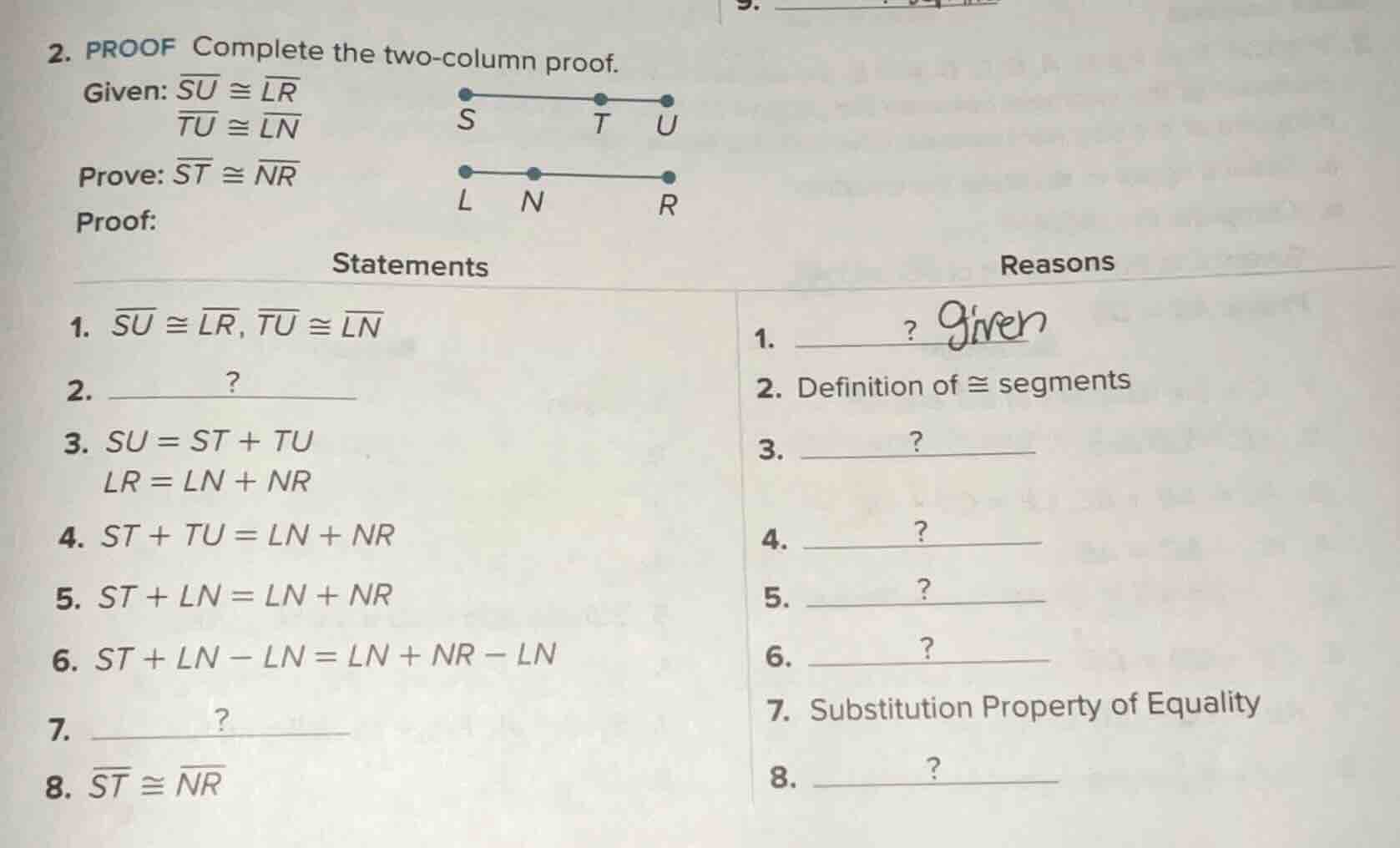
- proof complete the two - column proof.
given: $overline{su} \cong \overline{lr}$
$overline{tu} \cong \overline{ln}$
prove: $overline{st} \cong \overline{nr}$
proof:
| statements | reasons |
|---|---|
| 2. ? | 2. definition of $\cong$ segments |
| 3. $su = st + tu$<br>$lr = ln + nr$ | 3. ? |
| 4. $st + tu = ln + nr$ | 4. ? |
| 5. $st + ln = ln + nr$ | 5. ? |
| 6. $st + ln - ln = ln + nr - ln$ | 6. ? |
| 7. ? | 7. substitution property of equality |
| 8. $overline{st} \cong \overline{nr}$ | 8. ? |
Step 1: Identify Reason for Statement 1
The first statement lists the given congruent segments, so the reason is "Given".
Step 2: Determine Statement 2
By the definition of congruent segments (if two segments are congruent, their lengths are equal), we have \( SU = LR \) and \( TU = LN \).
Step 3: Reason for Statement 3
The equations \( SU = ST + TU \) and \( LR = LN + NR \) come from the "Segment Addition Postulate" (the whole segment is the sum of its parts).
Step 4: Reason for Statement 4
Since \( SU = LR \) (from Step 2) and \( SU = ST + TU \), \( LR = LN + NR \) (from Step 3), we use the "Substitution Property of Equality" to get \( ST + TU = LN + NR \).
Step 5: Reason for Statement 5
We know \( TU = LN \) (from Step 2), so we substitute \( TU \) with \( LN \) in \( ST + TU = LN + NR \), which is the "Substitution Property of Equality".
Step 6: Reason for Statement 6
Subtracting \( LN \) from both sides of \( ST + LN = LN + NR \) is the "Subtraction Property of Equality" (if \( a + b = b + c \), then \( a = c \) when we subtract \( b \) from both sides).
Step 7: Determine Statement 7
After subtracting \( LN \) from both sides, we get \( ST = NR \).
Step 8: Reason for Statement 8
Since \( ST = NR \), by the "Definition of Congruent Segments" (if two segments have equal length, they are congruent), we conclude \( \overline{ST} \cong \overline{NR} \).
Filling the Two - Column Proof:
| Statements | Reasons |
|---|---|
| 2. \( SU = LR, TU = LN \) | 2. Definition of \( \cong \) segments |
| 3. \( SU = ST + TU \); \( LR = LN + NR \) | 3. Segment Addition Postulate |
| 4. \( ST + TU = LN + NR \) | 4. Substitution Property of Equality (since \( SU = LR \)) |
| 5. \( ST + LN = LN + NR \) | 5. Substitution Property of Equality (since \( TU = LN \)) |
| 6. \( ST + LN - LN = LN + NR - LN \) | 6. Subtraction Property of Equality |
| 7. \( ST = NR \) | 7. Simplification (after subtracting \( LN \) from both sides) |
| 8. \( \overline{ST} \cong \overline{NR} \) | 8. Definition of \( \cong \) segments (since \( ST = NR \)) |

Snap & solve any problem in the app
Get step-by-step solutions on Sovi AI
Photo-based solutions with guided steps
Explore more problems and detailed explanations
The completed two - column proof is as shown in the table above. The key steps are using the given congruences, segment addition postulate, and properties of equality to show that the lengths of \( \overline{ST} \) and \( \overline{NR} \) are equal, hence the segments are congruent.