QUESTION IMAGE
Question
proof
4
segment proofs
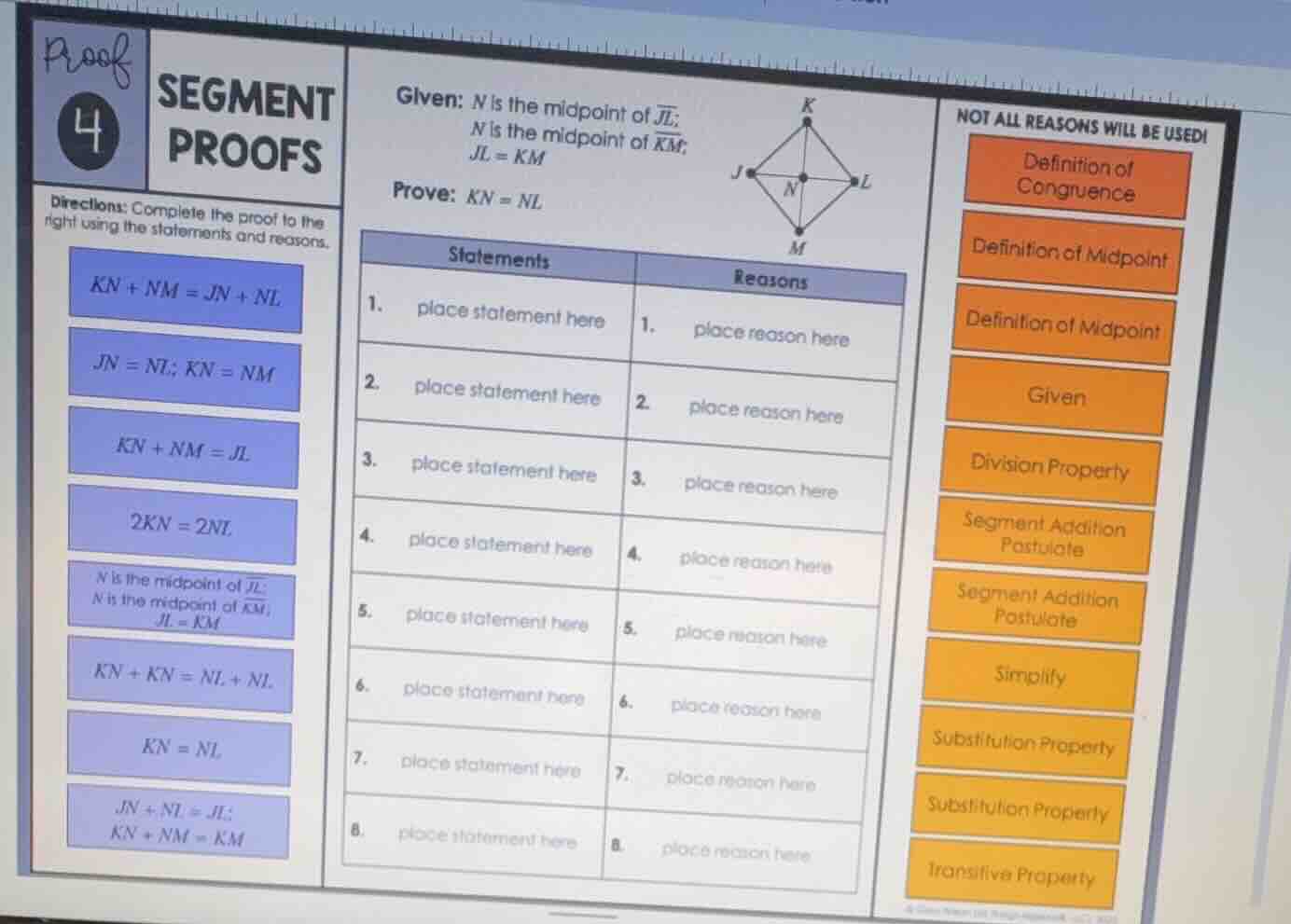
directions: complete the proof to the right using the statements and reasons.
given: n is the midpoint of (overline{jl});
n is the midpoint of (overline{km});
(jl = km)
prove: (kn = nl)
not all reasons will be used!
definition of congruence
definition of midpoint
definition of midpoint
given
division property
segment addition postulate
segment addition postulate
simplify
substitution property
substitution property
transitive property
Step1: Identify Given Information
The given information is: \( N \) is the midpoint of \( \overline{JL} \); \( N \) is the midpoint of \( \overline{KM} \); \( JL = KM \). So the first statement should be these given facts, and the reason is "Given".
Statement 1: \( N \) is the midpoint of \( \overline{JL} \); \( N \) is the midpoint of \( \overline{KM} \); \( JL = KM \)
Reason 1: Given
Step2: Apply Definition of Midpoint
By the definition of midpoint, if \( N \) is the midpoint of \( \overline{JL} \), then \( JN = NL \). If \( N \) is the midpoint of \( \overline{KM} \), then \( KN = NM \).
Statement 2: \( JN = NL \); \( KN = NM \)
Reason 2: Definition of Midpoint
Step3: Apply Segment Addition Postulate
The Segment Addition Postulate states that for a segment, the sum of its parts equals the whole. For \( \overline{JL} \), \( JN + NL = JL \). For \( \overline{KM} \), \( KN + NM = KM \).
Statement 3: \( JN + NL = JL \); \( KN + NM = KM \)
Reason 3: Segment Addition Postulate
Step4: Substitute \( JL \) and \( KM \)
We know \( JL = KM \) (given), so substitute \( JL \) with \( KM \) in the equations from Step 3. So \( JN + NL = KN + NM \).
Statement 4: \( JN + NL = KN + NM \)
Reason 4: Substitution Property (since \( JL = KM \))
Step5: Substitute \( JN \) and \( NM \)
From Step 2, we know \( JN = NL \) and \( KN = NM \). Substitute \( JN \) with \( NL \) and \( NM \) with \( KN \) in the equation from Step 4. So \( NL + NL = KN + KN \), which simplifies to \( 2NL = 2KN \) or \( KN + KN = NL + NL \).
Statement 5: \( KN + KN = NL + NL \) (or \( 2KN = 2NL \))
Reason 5: Substitution Property (substituting \( JN = NL \) and \( KN = NM \))
Step6: Simplify the Equation
Divide both sides of \( 2KN = 2NL \) by 2 (Division Property) or simplify \( KN + KN = NL + NL \) to \( 2KN = 2NL \) and then to \( KN = NL \).
Statement 6: \( 2KN = 2NL \) (from simplifying \( KN + KN = NL + NL \))
Reason 6: Simplify (or Division Property, dividing both sides by 2)
Step7: Conclude \( KN = NL \)
By dividing both sides of \( 2KN = 2NL \) by 2, we get \( KN = NL \).
Statement 7: \( KN = NL \)
Reason 7: Division Property (or Simplify, as dividing by 2 simplifies the equation)

Snap & solve any problem in the app
Get step-by-step solutions on Sovi AI
Photo-based solutions with guided steps
Explore more problems and detailed explanations
The completed proof is as follows:
| Statements | Reasons |
|---|---|
| 2. \( JN = NL \); \( KN = NM \) | 2. Definition of Midpoint |
| 3. \( JN + NL = JL \); \( KN + NM = KM \) | 3. Segment Addition Postulate |
| 4. \( JN + NL = KN + NM \) | 4. Substitution Property (since \( JL = KM \)) |
| 5. \( KN + KN = NL + NL \) (or \( 2KN = 2NL \)) | 5. Substitution Property (substituting \( JN = NL \), \( KN = NM \)) |
| 6. \( 2KN = 2NL \) (or simplified from Step 5) | 6. Simplify (or Division Property) |
| 7. \( KN = NL \) | 7. Division Property (dividing both sides by 2) |
The final conclusion is \( \boldsymbol{KN = NL} \).