QUESTION IMAGE
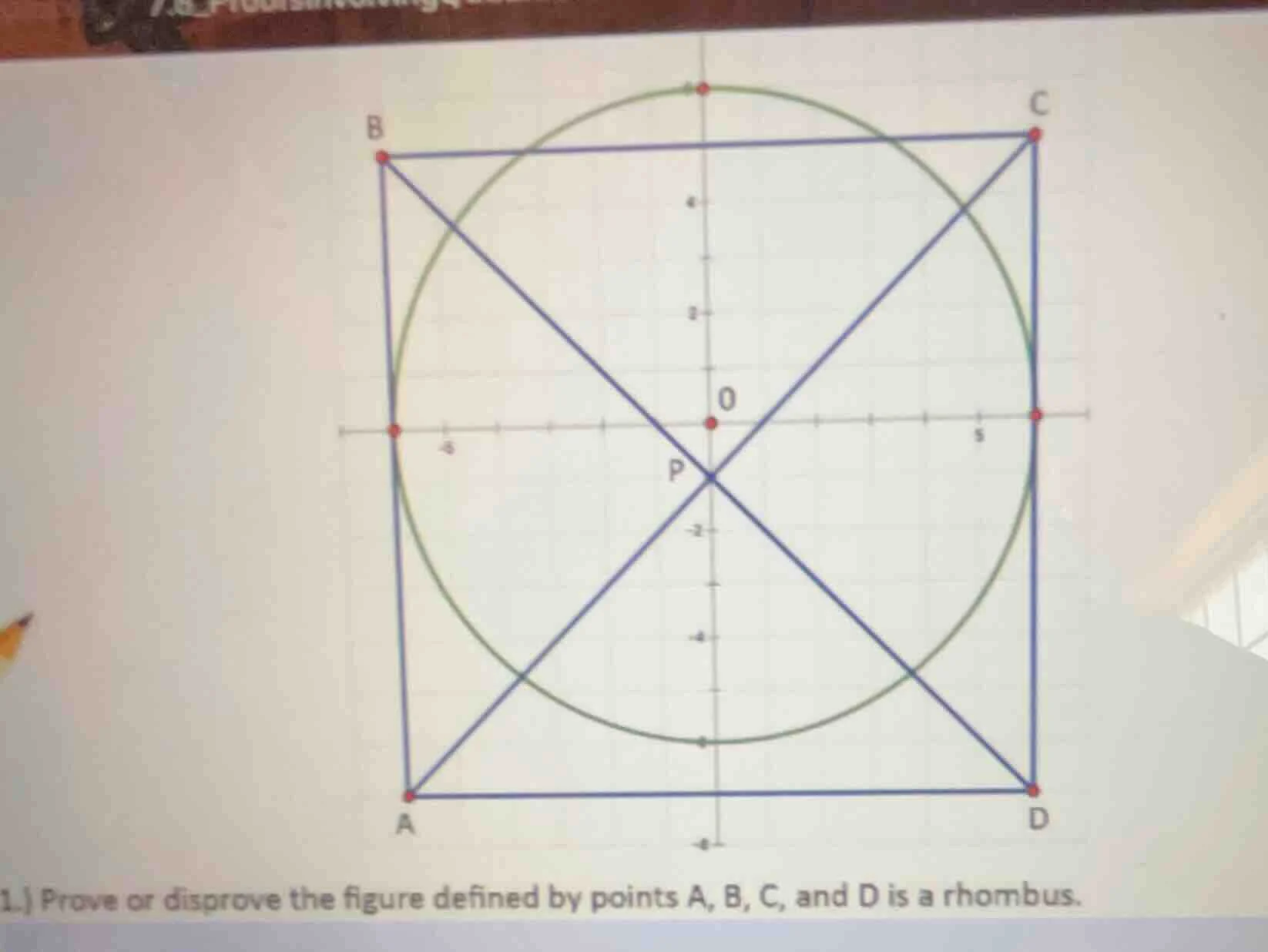
Question
1.) prove or disprove the figure defined by points a, b, c, and d is a rhombus.
Step1: Identify coordinates of vertices
From the grid:
$A(-6, -6)$, $B(-6, 6)$, $C(6, 6)$, $D(6, -6)$
Step2: Calculate side lengths
Use distance formula $d=\sqrt{(x_2-x_1)^2+(y_2-y_1)^2}$:
$AB=\sqrt{(-6+6)^2+(6+6)^2}=\sqrt{0+144}=12$
$BC=\sqrt{(6+6)^2+(6-6)^2}=\sqrt{144+0}=12$
$CD=\sqrt{(6-6)^2+(-6-6)^2}=\sqrt{0+144}=12$
$DA=\sqrt{(-6-6)^2+(-6+6)^2}=\sqrt{144+0}=12$
Step3: Calculate diagonal lengths
$AC=\sqrt{(6+6)^2+(6+6)^2}=\sqrt{144+144}=\sqrt{288}=12\sqrt{2}$
$BD=\sqrt{(6+6)^2+(-6-6)^2}=\sqrt{144+144}=\sqrt{288}=12\sqrt{2}$
Step4: Check rhombus criteria
A rhombus requires all sides equal, and diagonals are not equal (a square is a special rhombus, but we confirm: all sides are equal, and the figure is a parallelogram with 4 congruent sides). However, since diagonals are equal here, this is a square, which is a type of rhombus (all squares are rhombuses as they satisfy all rhombus properties: 4 equal sides, opposite sides parallel, diagonals bisect each other at right angles).

Snap & solve any problem in the app
Get step-by-step solutions on Sovi AI
Photo-based solutions with guided steps
Explore more problems and detailed explanations
The figure defined by points A, B, C, D is a rhombus (specifically a square, which is a special case of a rhombus, as all four sides are congruent, and it meets all the properties of a rhombus).