QUESTION IMAGE
Question
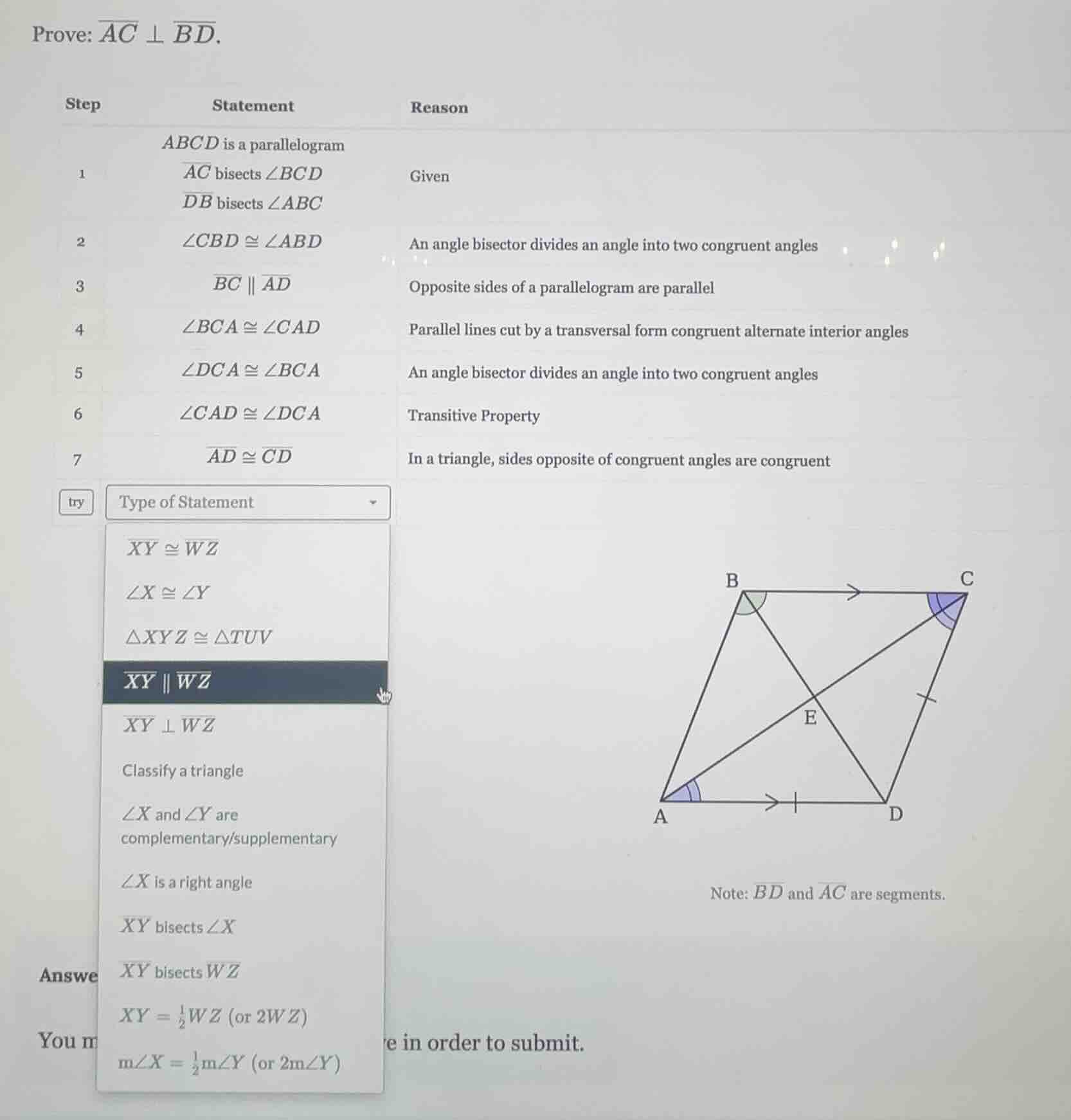
prove: \\(\overline{ac} \perp \overline{bd}\\).
step\tstatement\treason
1\t\\(abcd\\) is a parallelogram
\\(\overline{ac}\\) bisects \\(\angle bcd\\)
\\(db\\) bisects \\(\angle abc\\)\tgiven
2\t\\(\angle cbd \cong \angle abd\\)\tan angle bisector divides an angle into two congruent angles
3\t\\(\overline{bc} \parallel \overline{ad}\\)\topposite sides of a parallelogram are parallel
4\t\\(\angle bca \cong \angle cad\\)\tparallel lines cut by a transversal form congruent alternate interior angles
5\t\\(\angle dca \cong \angle bca\\)\tan angle bisector divides an angle into two congruent angles
6\t\\(\angle cad \cong \angle dca\\)\ttransitive property
7\t\\(\overline{ad} \cong \overline{cd}\\)\tin a triangle, sides opposite of congruent angles are congruent
(try dropdown with various statements like \\(\overline{xy} \cong \overline{wz}\\), \\(\angle x \cong \angle y\\), etc.)
(image of parallelogram \\(abcd\\) with diagonals \\(ac\\) and \\(bd\\) intersecting at \\(e\\), angle markings at \\(a\\), \\(b\\), \\(c\\))
note: \\(bd\\) and \\(ac\\) are segments.
answer
you m (incomplete, but main problem is proving perpendicularity with given steps and image)
Step1: Identify ABCD as rhombus
Since $ABCD$ is a parallelogram with $\overline{AD} \cong \overline{CD}$, all sides are congruent: $\overline{AB} \cong \overline{BC} \cong \overline{CD} \cong \overline{AD}$.
Step2: Prove $\triangle ABC$ is isosceles
$\overline{AB} \cong \overline{BC}$, so $\triangle ABC$ is isosceles.
Step3: Use angle bisector property
$\overline{BD}$ bisects $\angle ABC$. In an isosceles triangle, the angle bisector of the vertex angle is perpendicular to the base.
Step4: Conclude perpendicularity
Thus, $\overline{AC} \perp \overline{BD}$.

Snap & solve any problem in the app
Get step-by-step solutions on Sovi AI
Photo-based solutions with guided steps
Explore more problems and detailed explanations
$\overline{AC} \perp \overline{BD}$ is proven. The missing statement to advance the proof (aligning with the dropdown context) leads to establishing $ABCD$ is a rhombus, whose diagonals are perpendicular.