QUESTION IMAGE
Question
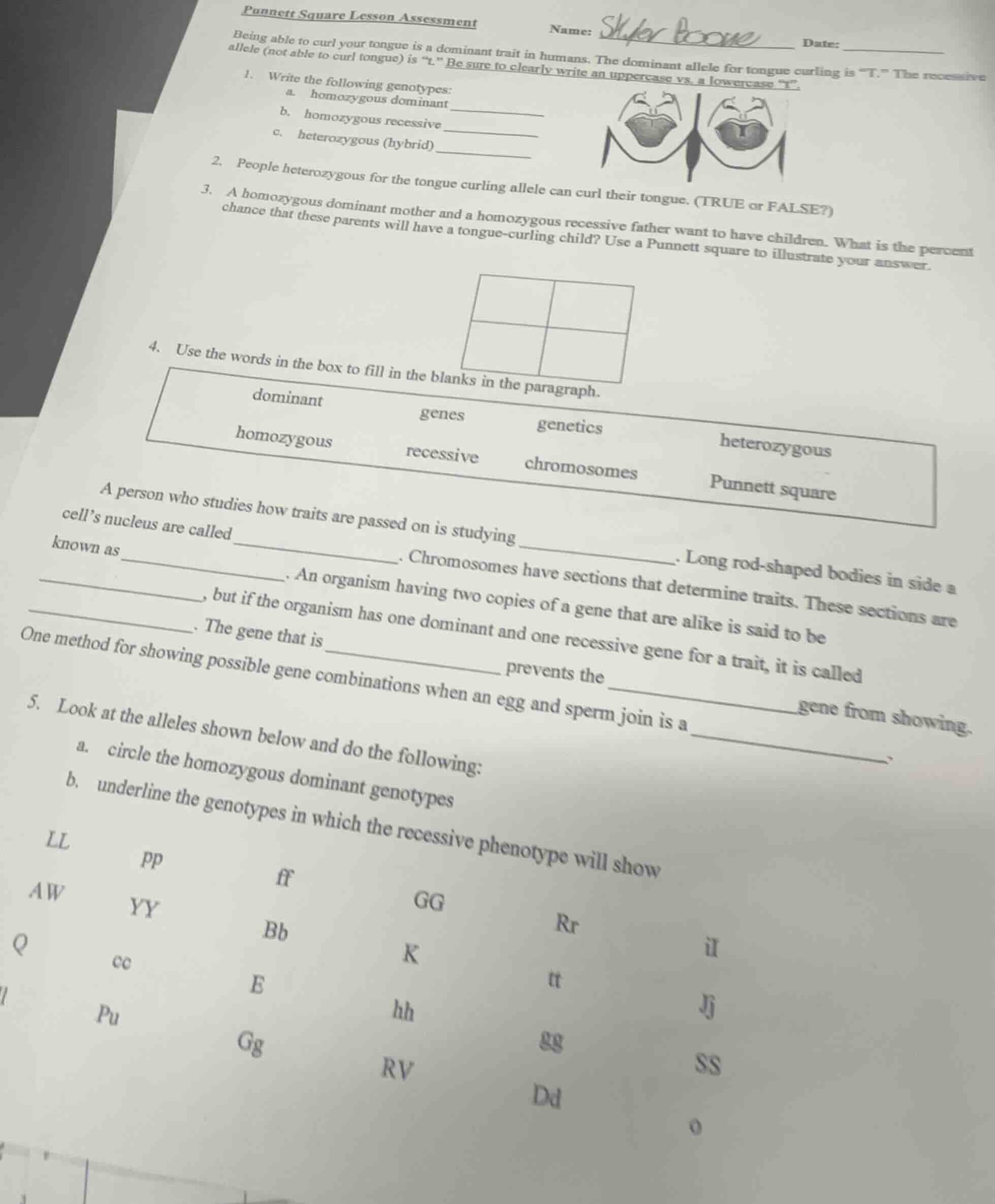
punnett square lesson assessmentname: skyler boonedate:being able to curl your tongue is a dominant trait in humans. the dominant allele for tongue curling is \t.\ the recessive allele (not able to curl tongue) is \t.\ be sure to clearly write an uppercase vs. a lowercase \t\.1. write the following genotypes:a. homozygous dominant _____________b. homozygous recessive ___________c. heterozygous (hybrid) ___________2. people heterozygous for the tongue curling allele can curl their tongue. (true or false?)3. a homozygous dominant mother and a homozygous recessive father want to have children. what is the percent chance that these parents will have a tongue-curling child? use a punnett square to illustrate your answer.4. use the words in the box to fill in the blanks in the paragraph.dominant genes genetics heterozygoushomozygous recessive chromosomes punnett squarea person who studies how traits are passed on is studying _______________. long rod-shaped bodies in side a cells nucleus are called _______________. chromosomes have sections that determine traits. these sections are known as _______________. an organism having two copies of a gene that are alike is said to be _______________, but if the organism has one dominant and one recessive gene for a trait, it is called _______________. the gene that is _______________ prevents the _______________ gene from showing. one method for showing possible gene combinations when an egg and sperm join is a _________________.5. look at the alleles shown below and do the following:a. circle the homozygous dominant genotypesb. underline the genotypes in which the recessive phenotype will showll pp ff gg rr iiaw yy bb k tt jjq cc e hh gg sspu gg rv dd o
Step1: Define genotype terms
Part 1a: Homozygous dominant (same dominant alleles)
$TT$
Part 1b: Homozygous recessive (same recessive alleles)
$tt$
Part 1c: Heterozygous (different alleles)
$Tt$
Step2: Evaluate heterozygous trait expression
Heterozygous ($Tt$) has dominant allele $T$, so tongue curling is expressed.
TRUE
Step3: Set up Punnett square
Mother (homozygous dominant): $TT$, so gametes = $T, T$
Father (homozygous recessive): $tt$, so gametes = $t, t$
All offspring are $Tt$ (tongue-curling trait).
Percent chance = $\frac{4}{4} \times 100\% = 100\%$
Step4: Fill genetics vocabulary blanks
Match terms to definitions:
- Study of trait inheritance: genetics
- Rod-shaped nuclear structures: chromosomes
- Trait-determining chromosome sections: genes
- Two identical alleles: homozygous
- One dominant, one recessive allele: heterozygous
- Trait-masking allele: dominant
- Masked allele: recessive
- Gene combination tool: Punnett square
Step5: Identify genotypes
Part 5a: Homozygous dominant (same uppercase alleles)
Circle: $LL$, $GG$, $YY$, $SS$
Part 5b: Recessive phenotype (homozygous recessive, same lowercase alleles)
Underline: $pp$, $ff$, $tt$, $cc$, $hh$, $gg$

Snap & solve any problem in the app
Get step-by-step solutions on Sovi AI
Photo-based solutions with guided steps
Explore more problems and detailed explanations
1.
a. $TT$
b. $tt$
c. $Tt$
- TRUE
- 100%
Punnett square:
4.
A person who studies how traits are passed on is studying genetics. Long rod-shaped bodies inside a cell’s nucleus are called chromosomes. Chromosomes have sections that determine traits. These sections are known as genes. An organism having two copies of a gene that are alike is said to be homozygous, but if the organism has one dominant and one recessive gene for a trait, it is called heterozygous. The gene that is dominant prevents the recessive gene from showing. One method for showing possible gene combinations when an egg and sperm join is a Punnett square.
5.
a. Circled homozygous dominant genotypes: $LL$, $GG$, $YY$, $SS$
b. Underlined recessive phenotype genotypes: $pp$, $ff$, $tt$, $cc$, $hh$, $gg$