QUESTION IMAGE
Question
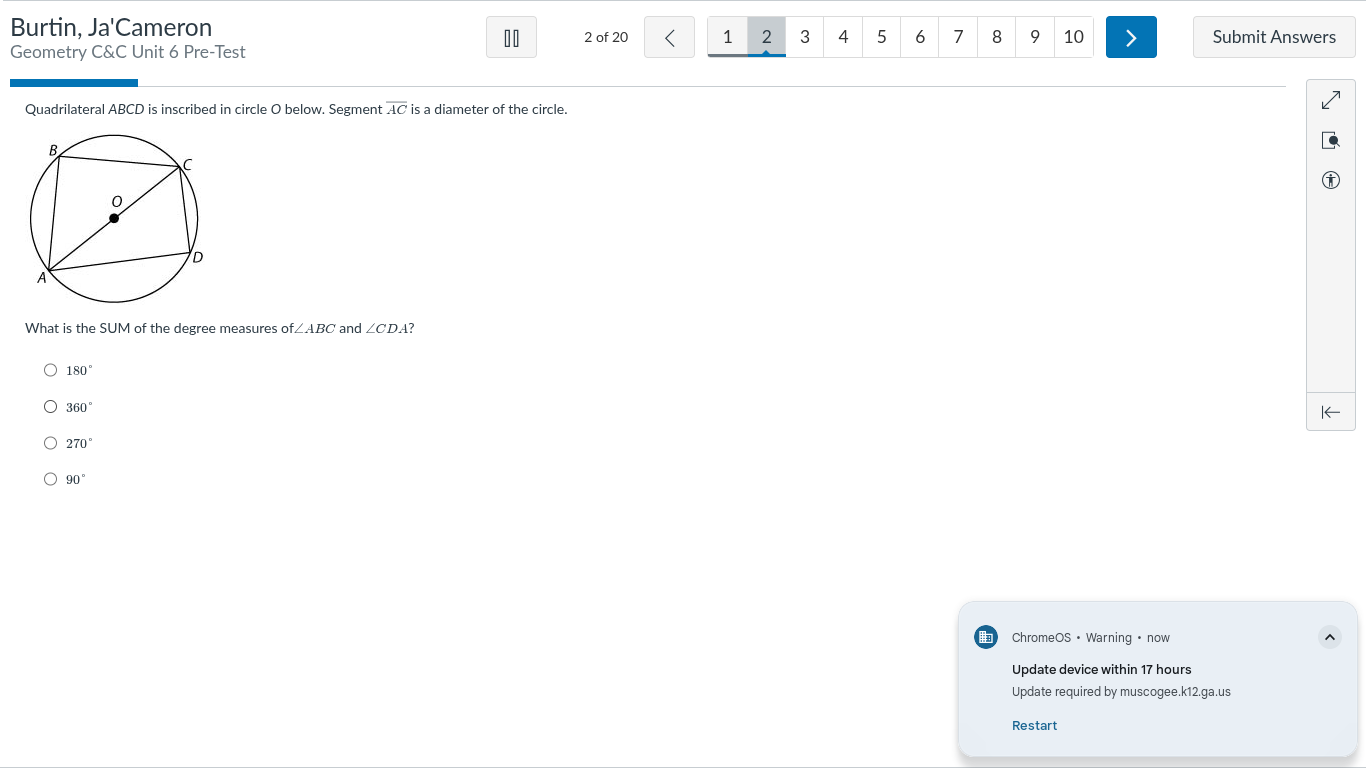
quadrilateral abcd is inscribed in circle o below. segment \\(\overline{ac}\\) is a diameter of the circle.
what is the sum of the degree measures of \\(\angle abc\\) and \\(\angle cda\\)?
\\(\circ\\) \\(180^\circ\\)
\\(\circ\\) \\(360^\circ\\)
\\(\circ\\) \\(270^\circ\\)
\\(\circ\\) \\(90^\circ\\)
- Recall the property of a cyclic quadrilateral: Opposite angles in a cyclic quadrilateral sum to \(180^\circ\). Also, an angle inscribed in a semicircle is a right angle? Wait, no, wait. Wait, \(AC\) is a diameter. So \(\angle ABC\) and \(\angle CDA\): Wait, quadrilateral \(ABCD\) is cyclic (inscribed in a circle). Also, since \(AC\) is a diameter, \(\angle ABC\) and \(\angle ADC\) (wait, the question has \(\angle CDA\), which is the same as \(\angle ADC\)): Wait, actually, in a cyclic quadrilateral, opposite angles sum to \(180^\circ\)? Wait, no, wait. Wait, no, a cyclic quadrilateral's opposite angles are supplementary (sum to \(180^\circ\))? Wait, no, wait, no—wait, no, the sum of all interior angles of a quadrilateral is \(360^\circ\), and in a cyclic quadrilateral, opposite angles are supplementary. Wait, but here, \(AC\) is a diameter. So \(\angle ABC\) and \(\angle ADC\) (since \(AC\) is diameter, \(\angle ABC\) is an angle inscribed in a semicircle? Wait, no, \(\angle ABC\) is inscribed in the circle with \(AC\) as diameter. Wait, an angle inscribed in a semicircle is a right angle? Wait, no, if \(AC\) is a diameter, then any angle subtended by \(AC\) on the circle is a right angle. So \(\angle ABC\) and \(\angle ADC\) (since \(B\) and \(D\) are on the circle) would both be right angles? Wait, no, that can't be. Wait, no, \(ABCD\) is a cyclic quadrilateral. Wait, maybe I made a mistake. Wait, the question is about the sum of \(\angle ABC\) and \(\angle CDA\). Let's think again.
Wait, quadrilateral \(ABCD\) is cyclic (inscribed in circle \(O\)). So by the property of cyclic quadrilaterals, the sum of a pair of opposite angles is \(180^\circ\)? Wait, no, actually, the sum of all interior angles of a quadrilateral is \(360^\circ\), and in a cyclic quadrilateral, opposite angles are supplementary (sum to \(180^\circ\)). Wait, but here, \(AC\) is a diameter. So \(\angle ABC\) and \(\angle ADC\) (since \(AC\) is diameter, \(\angle ABC\) is an angle subtended by diameter \(AC\), so \(\angle ABC = 90^\circ\)? Wait, no, an angle inscribed in a semicircle is a right angle. So if \(AC\) is a diameter, then \(\angle ABC\) and \(\angle ADC\) (because \(B\) and \(D\) are on the circle) are both right angles? Wait, that would mean each is \(90^\circ\), so their sum is \(180^\circ\)? Wait, no, that can't be. Wait, no, maybe I confused. Wait, let's re-express:
Wait, \(AC\) is a diameter. So the arc \(AC\) is \(180^\circ\). Then \(\angle ABC\) is an inscribed angle subtended by arc \(AC\), so \(\angle ABC = \frac{1}{2} \times 180^\circ = 90^\circ\). Similarly, \(\angle ADC\) (which is \(\angle CDA\)) is also an inscribed angle subtended by arc \(AC\), so \(\angle ADC = 90^\circ\). Therefore, the sum of \(\angle ABC\) and \(\angle CDA\) is \(90^\circ + 90^\circ = 180^\circ\)? Wait, no, that can't be. Wait, no, wait, \(B\) and \(D\) are on opposite sides of \(AC\)? Wait, the diagram shows \(ABCD\) as a quadrilateral with \(B\) and \(D\) on the circle, \(AC\) as diameter. So \(\angle ABC\) and \(\angle ADC\) are both subtended by \(AC\), but on opposite sides? Wait, no, if \(AC\) is a diameter, then any point on the circle (other than \(A\) and \(C\)) will form a right angle with \(A\) and \(C\). So \(\angle ABC = 90^\circ\) and \(\angle ADC = 90^\circ\), so their sum is \(180^\circ\). Alternatively, since \(ABCD\) is cyclic, the sum of \(\angle ABC\) and \(\angle ADC\) (since they are opposite angles? Wait, no, \(ABCD\) has angles at \(A\), \(B\), \(C\), \(D\). So opposite angles are \(\angle A\) and \(\angle C\), \(\angle B\) and \(\angle D…

Snap & solve any problem in the app
Get step-by-step solutions on Sovi AI
Photo-based solutions with guided steps
Explore more problems and detailed explanations
A. \(180^\circ\)