QUESTION IMAGE
Question
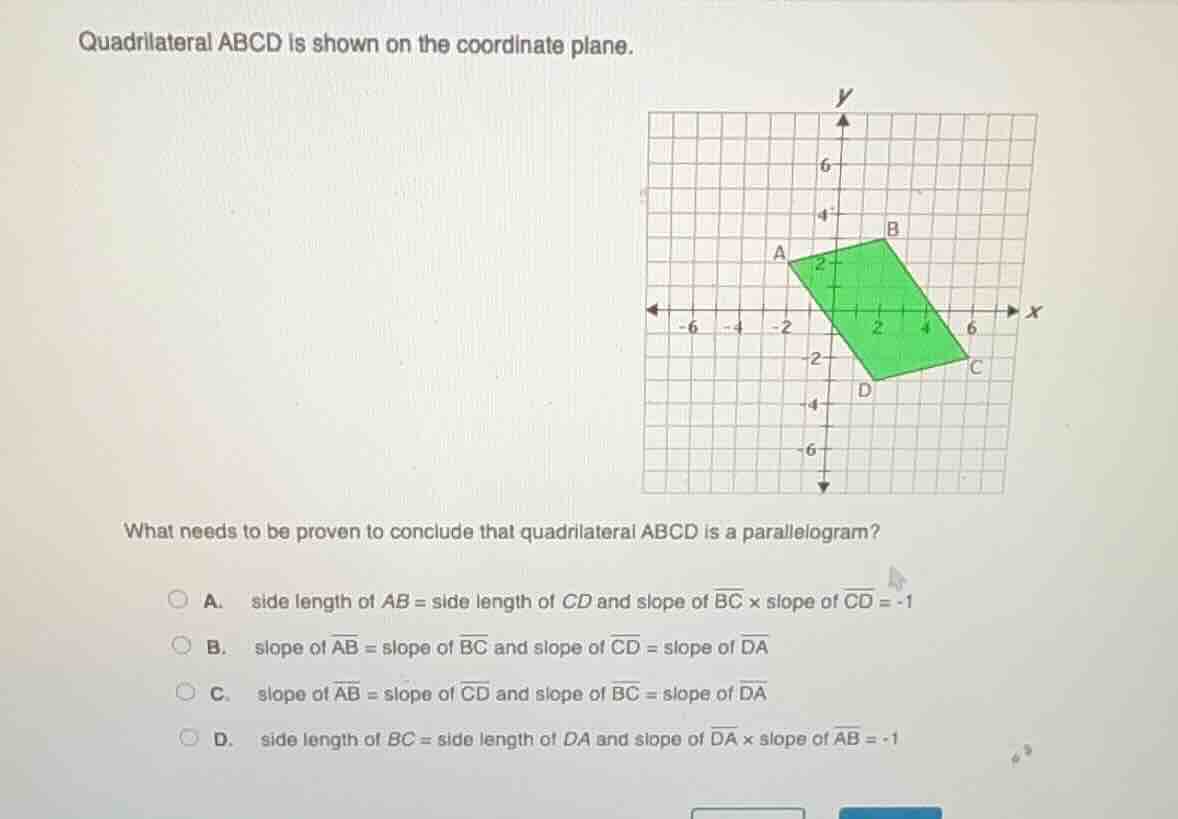
quadrilateral abcd is shown on the coordinate plane.
image of coordinate plane with quadrilateral abcd
what needs to be proven to conclude that quadrilateral abcd is a parallelogram?
a. side length of ab = side length of cd and slope of \\(\overline{bc}\\) × slope of \\(\overline{cd}\\) = -1
b. slope of \\(\overline{ab}\\) = slope of \\(\overline{bc}\\) and slope of \\(\overline{cd}\\) = slope of \\(\overline{da}\\)
c. slope of \\(\overline{ab}\\) = slope of \\(\overline{cd}\\) and slope of \\(\overline{bc}\\) = slope of \\(\overline{da}\\)
d. side length of bc = side length of da and slope of \\(\overline{da}\\) × slope of \\(\overline{ab}\\) = -1
A parallelogram is defined as a quadrilateral with both pairs of opposite sides parallel. Parallel lines have equal slopes. So, to conclude ABCD is a parallelogram, we need to prove that the slope of \(\overline{AB}\) equals the slope of \(\overline{CD}\) (so \(AB \parallel CD\)) and the slope of \(\overline{BC}\) equals the slope of \(\overline{DA}\) (so \(BC \parallel DA\)).
- Option A: The product of slopes being -1 implies perpendicular lines, not parallel, and equal side lengths alone (without parallelism of opposite sides) isn't enough for a parallelogram.
- Option B: Slopes of adjacent sides being equal would imply consecutive sides are parallel (a rhombus or square if all sides equal, but not a general parallelogram; also, this would mean angles are 180° or 0°, which is not the case for a parallelogram's definition).
- Option C: Matches the definition of a parallelogram (both pairs of opposite sides parallel, so equal slopes for opposite sides).
- Option D: Equal side lengths of adjacent sides and perpendicular slopes (product -1) imply a rectangle or square, not a general parallelogram.

Snap & solve any problem in the app
Get step-by-step solutions on Sovi AI
Photo-based solutions with guided steps
Explore more problems and detailed explanations
C. slope of \(\overline{AB}\) = slope of \(\overline{CD}\) and slope of \(\overline{BC}\) = slope of \(\overline{DA}\)