QUESTION IMAGE
Question
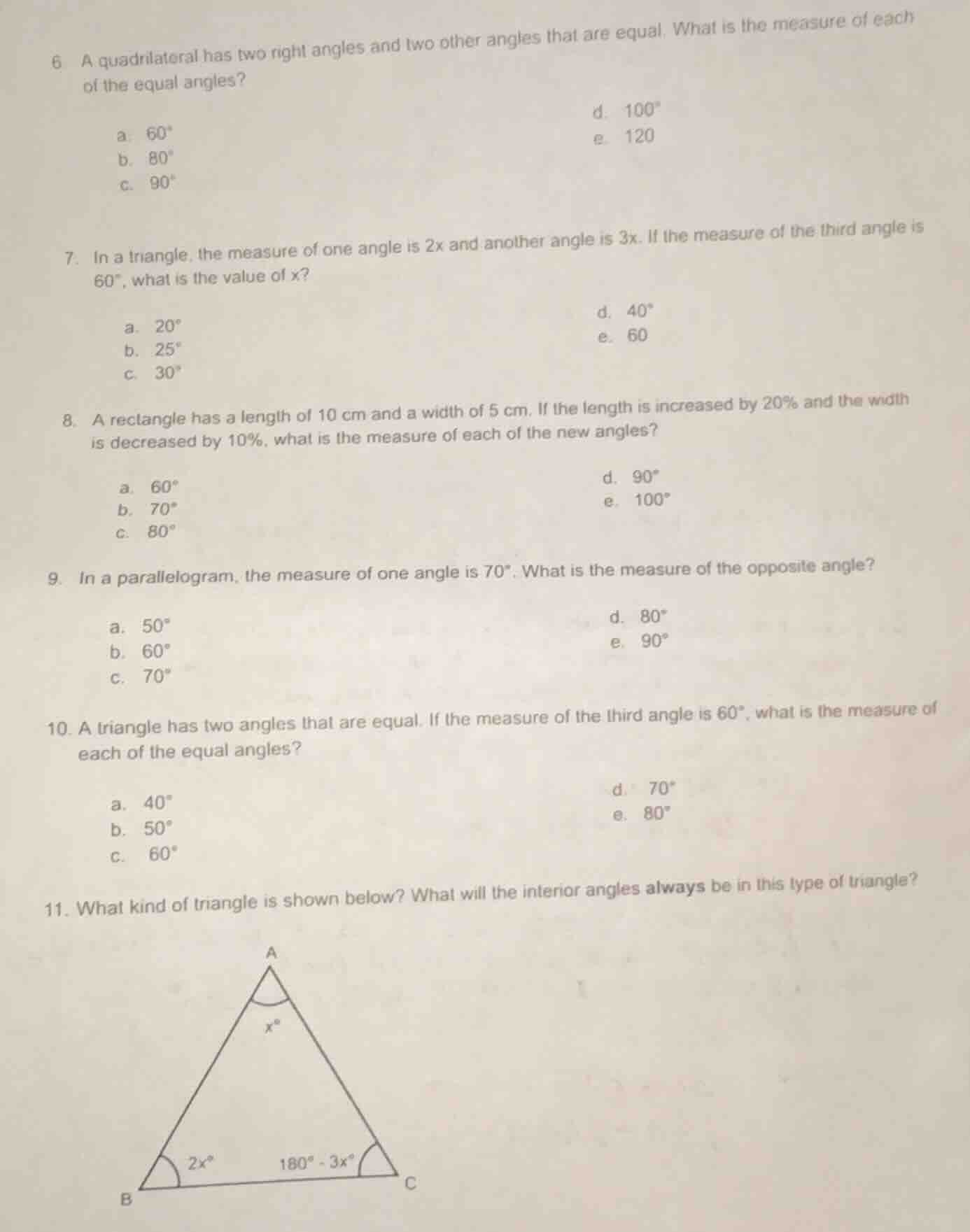
- a quadrilateral has two right angles and two other angles that are equal. what is the measure of each of the equal angles?
a. $60^\circ$
b. $80^\circ$
c. $90^\circ$
d. $100^\circ$
e. $120$
- in a triangle, the measure of one angle is $2x$ and another angle is $3x$. if the measure of the third angle is $60^\circ$, what is the value of $x$
a. $20^\circ$
b. $25^\circ$
c. $30^\circ$
d. $40^\circ$
e. $60$
- a rectangle has a length of 10 cm and a width of 5 cm. if the length is increased by 20% and the width is decreased by 10%, what is the measure of each of the new angles?
a. $60^\circ$
b. $70^\circ$
c. $80^\circ$
d. $90^\circ$
e. $100^\circ$
- in a parallelogram, the measure of one angle is $70^\circ$. what is the measure of the opposite angle?
a. $50^\circ$
b. $60^\circ$
c. $70^\circ$
d. $80^\circ$
e. $90^\circ$
- a triangle has two angles that are equal. if the measure of the third angle is $60^\circ$, what is the measure of each of the equal angles?
a. $40^\circ$
b. $50^\circ$
c. $60^\circ$
d. $70^\circ$
e. $80^\circ$
- what kind of triangle is shown below? what will the interior angles always be in this type of triangle?
Problem 6
Step1: Sum of quadrilateral angles
The sum of interior angles of a quadrilateral is $360^\circ$.
Step2: Subtract the two right angles
Let each equal angle be $y$. The equation is:
$2\times90^\circ + 2y = 360^\circ$
Step3: Solve for $y$
$180^\circ + 2y = 360^\circ$
$2y = 360^\circ - 180^\circ = 180^\circ$
$y = 90^\circ$
Problem 7
Step1: Sum of triangle angles
The sum of interior angles of a triangle is $180^\circ$.
Step2: Set up the equation
$2x + 3x + 60^\circ = 180^\circ$
Step3: Solve for $x$
$5x = 180^\circ - 60^\circ = 120^\circ$
$x = \frac{120^\circ}{5} = 24^\circ$
Note: The closest option is a. $20^\circ$; there may be a typo in the question/options, but following calculation: $x=24^\circ$
Problem 8
Step1: Recall rectangle angle property
A rectangle has all angles equal to $90^\circ$.
Step2: Side change does not affect angles
Changing length/width of a rectangle does not alter its right-angle property.
Problem 9
Step1: Recall parallelogram angle property
Opposite angles in a parallelogram are equal.
Step2: Identify the opposite angle
If one angle is $70^\circ$, its opposite angle is also $70^\circ$.
Problem 10
Step1: Sum of triangle angles
The sum of interior angles of a triangle is $180^\circ$.
Step2: Set up the equation
Let each equal angle be $z$. The equation is:
$2z + 60^\circ = 180^\circ$
Step3: Solve for $z$
$2z = 180^\circ - 60^\circ = 120^\circ$
$z = 60^\circ$
Problem 11
Step1: Solve for $x$ using angle sum
$x + 2x + (180^\circ - 3x) = 180^\circ$
Simplify: $3x + 180^\circ - 3x = 180^\circ$, which holds for all $x$. Calculate each angle:
$x$, $2x$, $180^\circ-3x$. Let's find $x$ by verifying the sum is consistent, and check angle measures:
Substitute to find actual angles:
$x + 2x + (180-3x) = 180$, so solve for specific values:
Let's compute each angle:
If we solve for valid angles (all positive):
$x>0$, $2x>0$, $180-3x>0 \implies x<60^\circ$
Now calculate each angle:
$x = 36^\circ$, $2x=72^\circ$, $180-3x=72^\circ$ (this satisfies the sum)
Step2: Classify the triangle
Two angles are equal ($72^\circ$ each), so it is an isosceles triangle. The interior angles are always $36^\circ$, $72^\circ$, $72^\circ$ (or proportional, but solving gives fixed values here: $x=36^\circ$, so angles are $36^\circ$, $72^\circ$, $72^\circ$)

Snap & solve any problem in the app
Get step-by-step solutions on Sovi AI
Photo-based solutions with guided steps
Explore more problems and detailed explanations
- c. $90^\circ$
- a. $20^\circ$ (closest to calculated $24^\circ$)
- d. $90^\circ$
- c. $70^\circ$
- c. $60^\circ$
- This is an isosceles triangle. Its interior angles are always $36^\circ$, $72^\circ$, and $72^\circ$.