QUESTION IMAGE
Question
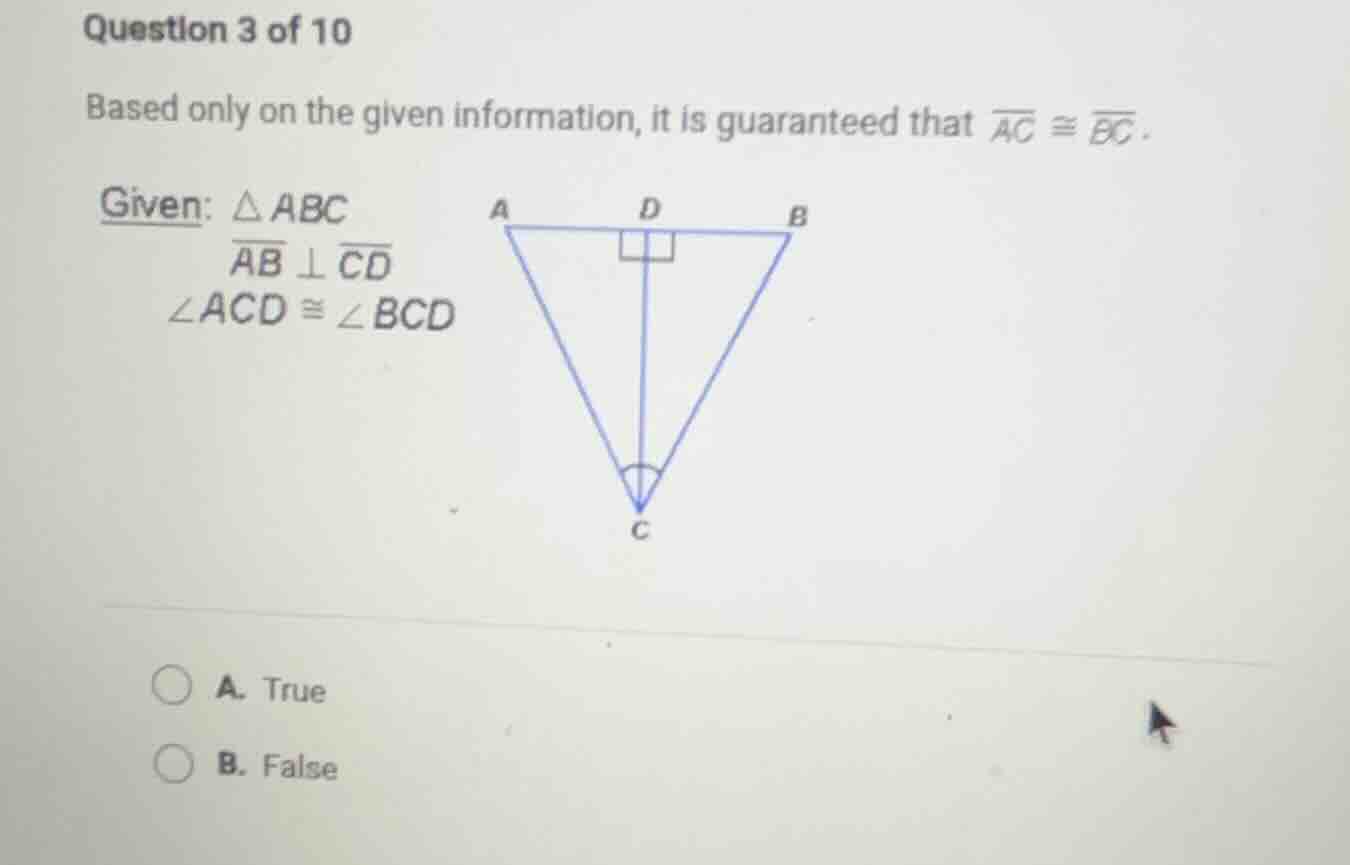
question 3 of 10 based only on the given information, it is guaranteed that \\(\overline{ac} \cong \overline{bc}\\). given: \\(\triangle abc\\) \\(\overline{ab} \perp \overline{cd}\\) \\(\angle acd \cong \angle bcd\\) a. true b. false
Step1: Identify Common Elements
We have \( \overline{AB} \perp \overline{CD} \), so \( \angle CDA = \angle CDB = 90^\circ \). Also, \( \angle ACD \cong \angle BCD \) and \( \overline{CD} \) is common to both \( \triangle ACD \) and \( \triangle BCD \).
Step2: Apply ASA Congruence
In \( \triangle ACD \) and \( \triangle BCD \):
- \( \angle ACD \cong \angle BCD \) (given)
- \( \overline{CD} \cong \overline{CD} \) (common side)
- \( \angle CDA \cong \angle CDB = 90^\circ \) (since \( \overline{AB} \perp \overline{CD} \))
By the Angle - Side - Angle (ASA) congruence criterion, \( \triangle ACD \cong \triangle BCD \).
Step3: Corresponding Parts of Congruent Triangles
Since \( \triangle ACD \cong \triangle BCD \), their corresponding sides \( \overline{AC} \) and \( \overline{BC} \) are congruent, i.e., \( \overline{AC} \cong \overline{BC} \).

Snap & solve any problem in the app
Get step-by-step solutions on Sovi AI
Photo-based solutions with guided steps
Explore more problems and detailed explanations
A. True