QUESTION IMAGE
Question
question 8 of 10
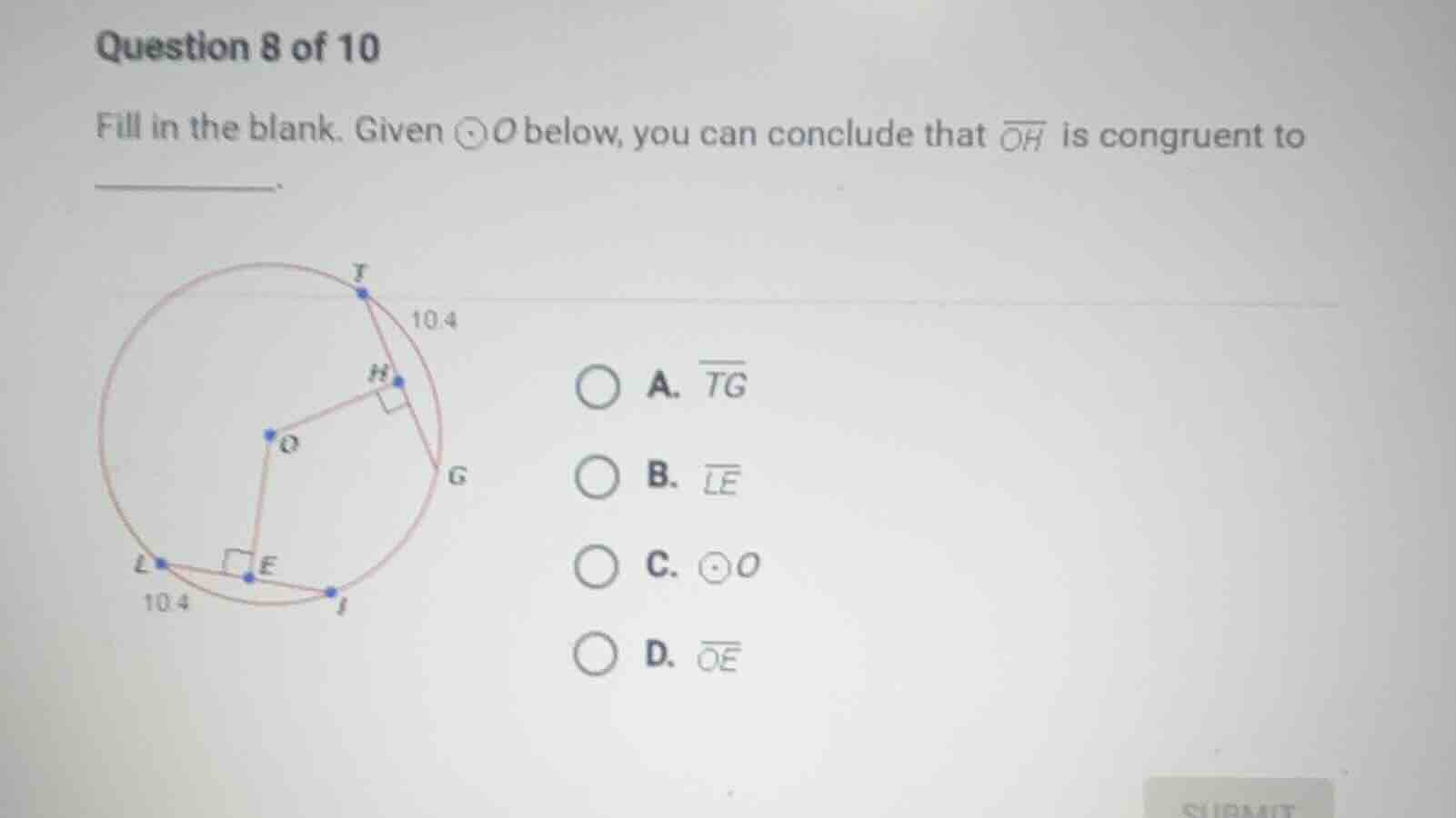
fill in the blank. given \\( \odot o \\) below, you can conclude that \\( \overline{oh} \\) is congruent to
\\( \underline{quadquad} \\).
\\( \bigcirc \\) a. \\( \overline{tg} \\)
\\( \bigcirc \\) b. \\( \overline{le} \\)
\\( \bigcirc \\) c. \\( \odot o \\)
\\( \bigcirc \\) d. \\( \overline{oe} \\)
Step1: Recall circle chord theorem
In a circle, the distances from the center to two congruent chords are equal.
Step2: Identify congruent chords
Chord $\overline{TG}$ and $\overline{LI}$ both have length 10.4, so $\overline{TG} \cong \overline{LI}$.
Step3: Match distance segments
$\overline{OH}$ is the distance from center $O$ to $\overline{TG}$, and $\overline{OE}$ is the distance from center $O$ to $\overline{LI}$. Thus $\overline{OH} \cong \overline{OE}$.

Snap & solve any problem in the app
Get step-by-step solutions on Sovi AI
Photo-based solutions with guided steps
Explore more problems and detailed explanations
D. $\overline{OE}$