QUESTION IMAGE
Question
question 8 of 10
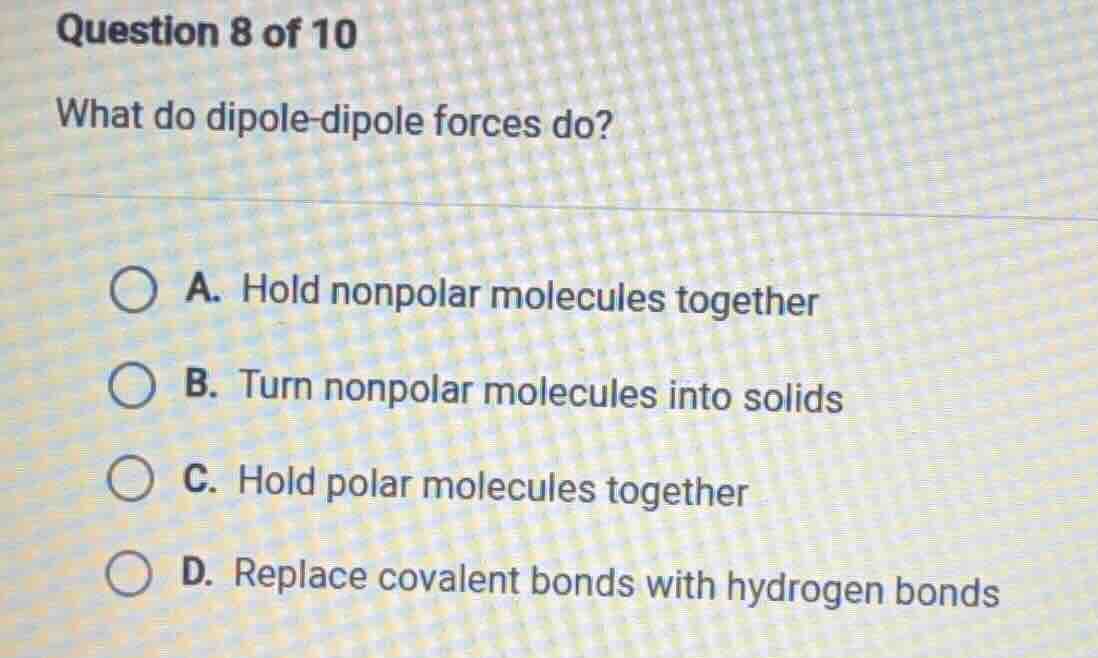
what do dipole-dipole forces do?
a. hold nonpolar molecules together
b. turn nonpolar molecules into solids
c. hold polar molecules together
d. replace covalent bonds with hydrogen bonds
Brief Explanations
Dipole - dipole forces are intermolecular forces that act between polar molecules. Polar molecules have a permanent dipole moment (a separation of positive and negative charges within the molecule). Dipole - dipole forces occur when the positive end of one polar molecule is attracted to the negative end of another polar molecule.
- Option A: Nonpolar molecules are held together by London dispersion forces (or van der Waals forces), not dipole - dipole forces, so A is incorrect.
- Option B: The process of a substance changing state (like from gas to solid) involves various factors, and dipole - dipole forces do not "turn" nonpolar molecules into solids. Also, nonpolar molecules are not held by dipole - dipole forces, so B is incorrect.
- Option C: Since dipole - dipole forces are intermolecular forces between polar molecules, they hold polar molecules together. This is consistent with the definition of dipole - dipole forces.
- Option D: Dipole - dipole forces are intermolecular forces, while covalent bonds are intramolecular (within a molecule) and hydrogen bonds are a special type of dipole - dipole force. Dipole - dipole forces do not replace covalent bonds with hydrogen bonds, so D is incorrect.

Snap & solve any problem in the app
Get step-by-step solutions on Sovi AI
Photo-based solutions with guided steps
Explore more problems and detailed explanations
C. Hold polar molecules together