QUESTION IMAGE
Question
question 3 of 10
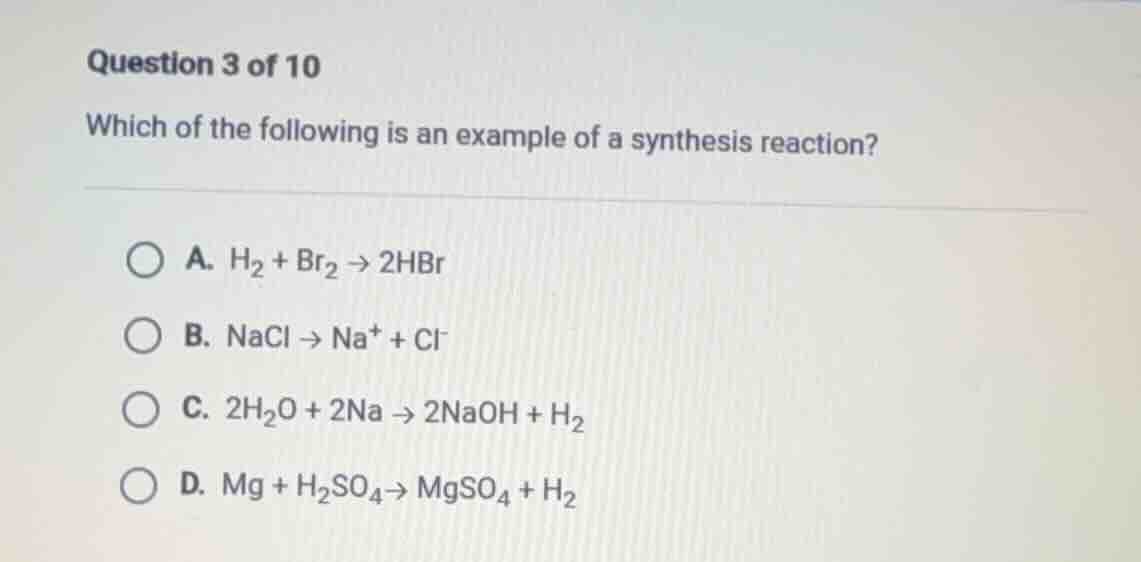
which of the following is an example of a synthesis reaction?
a. $\ce{h_{2} + br_{2} -> 2hbr}$
b. $\ce{nacl -> na^{+} + cl^{-}}$
c. $\ce{2h_{2}o + 2na -> 2naoh + h_{2}}$
d. $\ce{mg + h_{2}so_{4} -> mgso_{4} + h_{2}}$
A synthesis reaction is when two or more substances combine to form a single product. Let's analyze each option:
- Option A: \( \ce{H_2 + Br_2
ightarrow 2HBr} \) shows two reactants (\( \ce{H_2} \) and \( \ce{Br_2} \)) combining to form one product (\( \ce{HBr} \)), which fits a synthesis reaction.
- Option B: \( \ce{NaCl
ightarrow Na^+ + Cl^-} \) is a dissociation (ionization) of a compound into ions, not a synthesis.
- Option C: \( \ce{2H_2O + 2Na
ightarrow 2NaOH + H_2} \) is a single - replacement reaction (Na replaces H in \( \ce{H_2O} \)).
- Option D: \( \ce{Mg + H_2SO_4
ightarrow MgSO_4 + H_2} \) is also a single - replacement reaction (Mg replaces H in \( \ce{H_2SO_4} \)).

Snap & solve any problem in the app
Get step-by-step solutions on Sovi AI
Photo-based solutions with guided steps
Explore more problems and detailed explanations
A. \( \ce{H_2 + Br_2
ightarrow 2HBr} \)