QUESTION IMAGE
Question
question 6 of 10
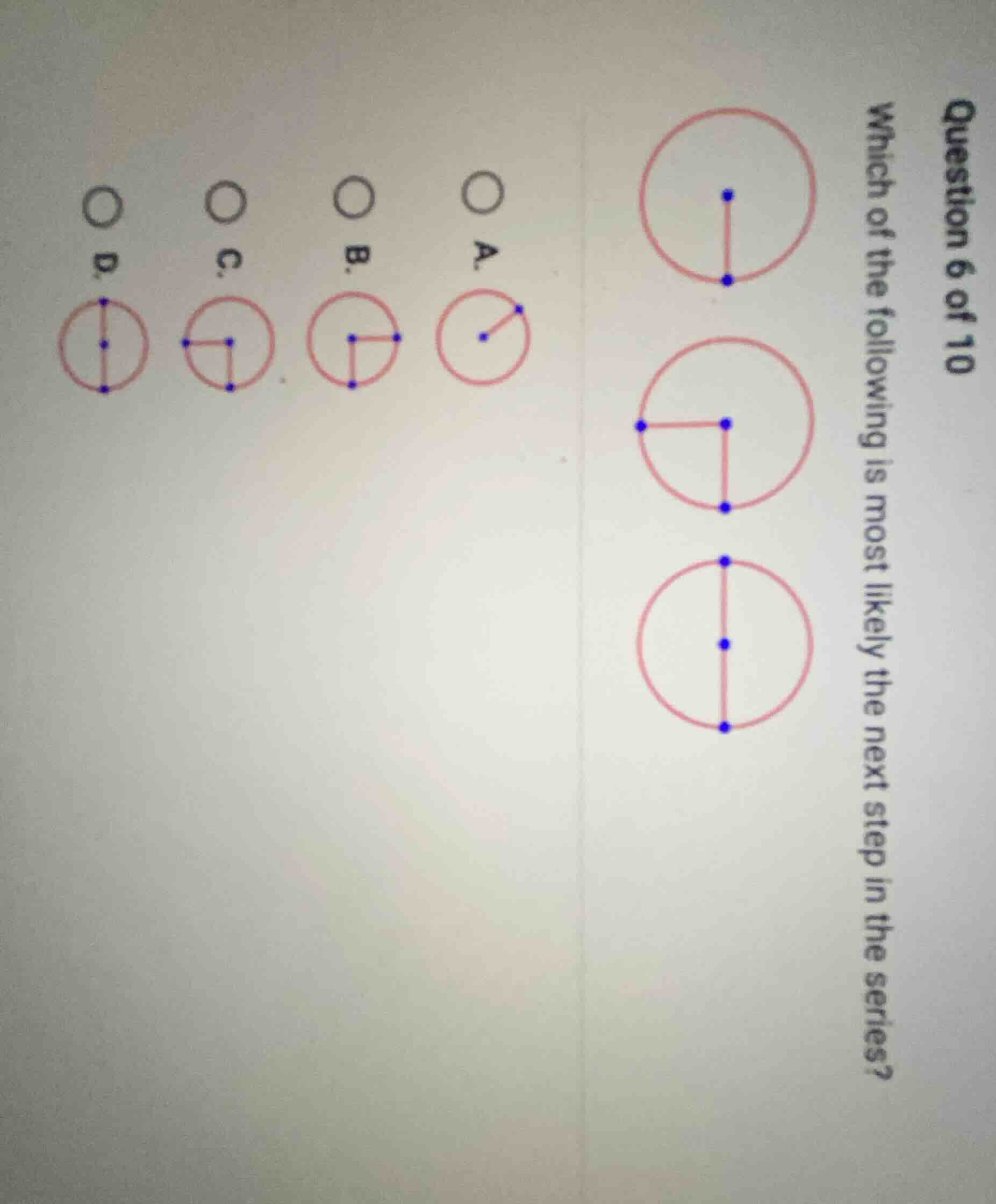
which of the following is most likely the next step in the series?
three circle diagrams on the right, four multiple - choice options (a, b, c, d) with circle diagrams on the left
Step1: Analyze the series pattern
First, observe the number of line segments (radii or diameters) and their positions. The first figure has 1 radius, the second has 2 perpendicular radii, the third has a diameter (2 colinear radii). Wait, no, let's check again. Wait, the first circle (top right) has a radius (1 segment), the second has two perpendicular radii (2 segments, 90 degrees), the third has a diameter (2 segments, 180 degrees). Now, looking at the options, we need to see the pattern of the number of points and segments. Wait, maybe the pattern is about the number of radii/diameters and their angles. Wait, the first figure: 1 radius (two points: center and circumference). Second: two radii, perpendicular (three points: center and two on circumference, 90 degrees apart). Third: diameter (three points: center and two on circumference, 180 degrees apart). Wait, no, the third figure is a diameter (two points on circumference, center in between). Wait, maybe the pattern is the number of radii: 1, 2 (perpendicular), 2 (colinear, diameter). Now, the options: A has 1 radius, B has two radii (perpendicular? No, B's two radii: one vertical, one horizontal? Wait, no, the options: A is 1 radius, B is two radii (like second figure but smaller), C is two radii (perpendicular, three points), D is a diameter (two points on circumference, center). Wait, the original series: first (top) is radius (1 segment, 2 points: center and circumference), second (middle) is two perpendicular radii (2 segments, 3 points: center and two on circumference), third (bottom) is diameter (1 segment, 3 points: center and two on circumference, colinear). Wait, maybe the pattern is the number of segments: 1, 2, 1? No, that doesn't make sense. Wait, another approach: the length of the circle (radius). Wait, the first circle (top) has a certain radius, the second (middle) has the same center, larger radius? No, the circles in the options are smaller. Wait, maybe the pattern is the angle between the segments. First: 1 radius (angle undefined, or 360? No). Second: two radii, 90 degrees (right angle). Third: two radii, 180 degrees (straight line, diameter). So the angle between the segments (if two) is 90, then 180? Wait, no, the third figure is a diameter, which is 180 degrees. Now, the options: we need to see the next in the series. Wait, maybe the pattern is the number of radii: 1, 2 (90 degrees), 2 (180 degrees). Now, the options: D is a diameter (like third figure but smaller? Wait, the original third figure is a diameter (large circle), and the options are smaller circles. Wait, maybe the pattern is the type of segment: radius, two perpendicular radii, diameter. Now, the next in the series: after diameter (180 degrees), what? Wait, no, maybe the pattern is the number of points on the circumference. First figure: 1 point on circumference (plus center: 2 points). Second: 2 points on circumference (plus center: 3 points), 90 degrees apart. Third: 2 points on circumference (plus center: 3 points), 180 degrees apart. Now, the options: D has 2 points on circumference (plus center: 3 points), 180 degrees apart (diameter), same as third figure? No, that can't be. Wait, maybe I'm overcomplicating. Let's look at the options. The original three figures: first (top) is a radius (center to top), second (middle) is center to left and center to bottom (perpendicular), third (bottom) is center to top and center to bottom (diameter, colinear). Wait, no, the third figure is a diameter (top to bottom, center in middle). Now, the options: D is a diameter (two points on circumferenc…

Snap & solve any problem in the app
Get step-by-step solutions on Sovi AI
Photo-based solutions with guided steps
Explore more problems and detailed explanations
D. (The circle with a diameter, two points on the circumference and the center in between)