QUESTION IMAGE
Question
question 16 (mandatory) (1 point) saved
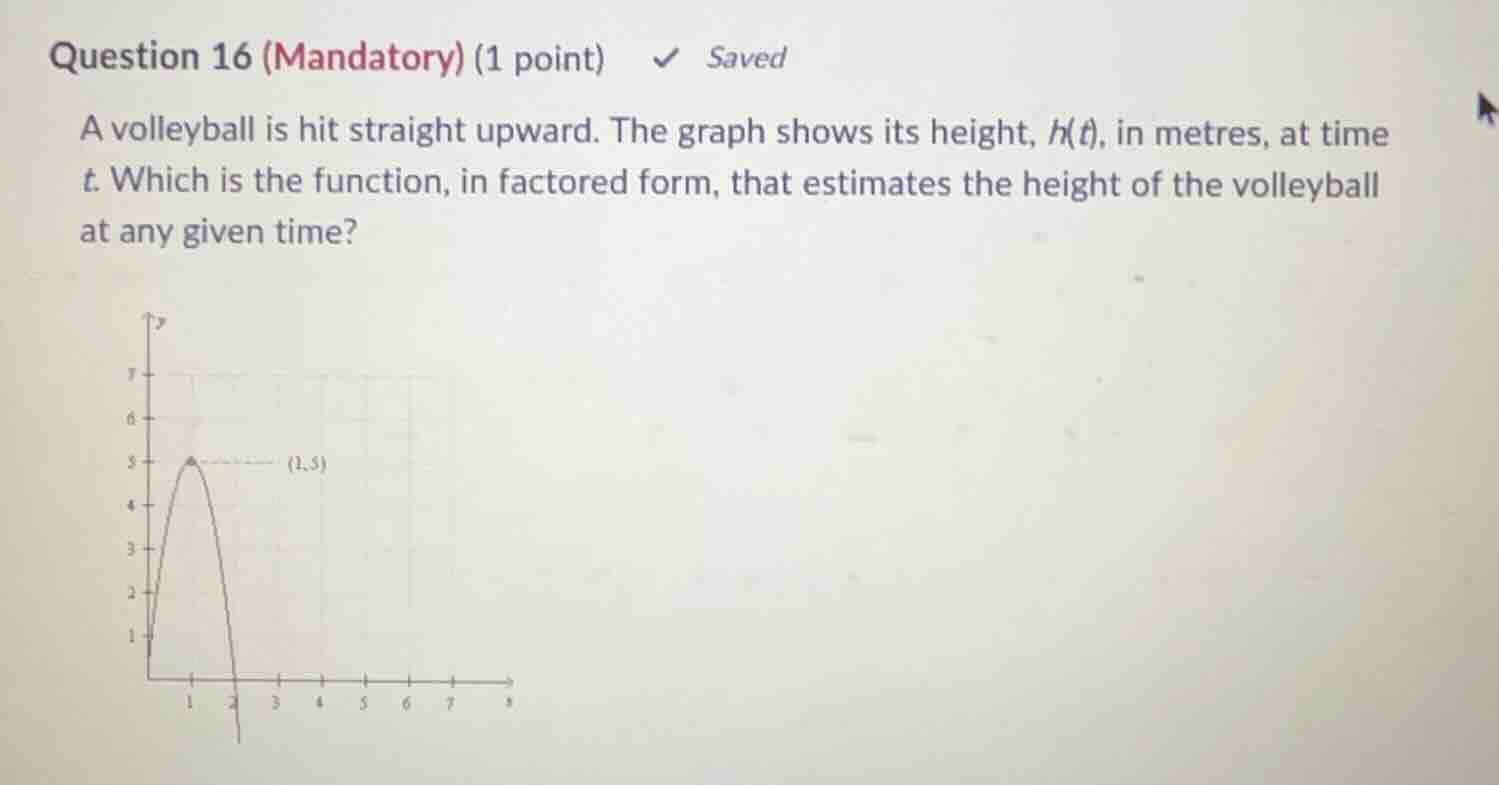
a volleyball is hit straight upward. the graph shows its height, h(t), in metres, at time
t. which is the function, in factored form, that estimates the height of the volleyball
at any given time?
graph with a parabola, vertex at (1,5), passing through (2,0) and near (0,1)
Step1: Identify the roots of the quadratic function
From the graph, the volleyball hits the ground (height = 0) at \( t = 2 \) and we assume it starts from some initial time. Also, the vertex is at \( (1, 5) \). A quadratic function in factored form is \( h(t)=a(t - r_1)(t - r_2) \), where \( r_1 \) and \( r_2 \) are roots. We know one root is \( t = 2 \), and since the vertex is at \( t = 1 \) (the axis of symmetry is \( t = 1 \)), the other root should be symmetric about \( t = 1 \), so \( t = 0 \) (because the distance from \( t = 1 \) to \( t = 2 \) is 1, so the other root is \( 1 - 1=0 \)). So the factored form is \( h(t)=a(t - 0)(t - 2)=a t(t - 2) \).
Step2: Find the value of \( a \)
We use the vertex \( (1, 5) \) to find \( a \). Substitute \( t = 1 \) and \( h(t)=5 \) into \( h(t)=a t(t - 2) \):
\( 5=a(1)(1 - 2) \)
\( 5=a(1)(-1) \)
\( 5=-a \)
So \( a=- 5 \)? Wait, no, wait. Wait, when \( t = 0 \), what's the height? From the graph, at \( t = 0 \), the height is 1? Wait, maybe my initial assumption about the root at \( t = 0 \) is wrong. Wait, looking at the graph, when \( t = 0 \), \( h(0)\approx1 \)? Wait, no, maybe the y - intercept is 1? Wait, let's re - examine. The graph passes through \( (0, 1) \)? Wait, no, the point at \( t = 0 \) is near 1? Wait, maybe I made a mistake in the roots. Wait, the graph crosses the t - axis at \( t = 2 \), so one root is \( t = 2 \). Let's assume the function is \( h(t)=a(t - 0)(t - 2) \) (assuming it starts at \( t = 0 \) with some height). Wait, when \( t = 1 \), \( h(1)=5 \). Let's plug into \( h(t)=a t(t - 2) \):
\( 5=a(1)(1 - 2)\)
\( 5=a(-1)\)
\( a=- 5 \). But then at \( t = 0 \), \( h(0)=-5(0)(0 - 2)=0 \), but the graph at \( t = 0 \) is around 1. Wait, maybe the y - intercept is 1. So let's use the point \( (0, 1) \). Wait, if the factored form is \( h(t)=a(t - r_1)(t - r_2) \), and we know \( t = 2 \) is a root, and let's say the other root is \( t = 0 \), but then \( h(0)=a(0)(-2)=0 \), but the graph at \( t = 0 \) is 1. So maybe my root at \( t = 0 \) is wrong. Wait, maybe the function is \( h(t)=a(t - 1)^2+5 \) (vertex form) and we can convert to factored form. Let's expand vertex form: \( h(t)=a(t^2 - 2t + 1)+5=a t^2-2a t+a + 5 \). Now, we know that when \( t = 0 \), \( h(0)=1 \) (from the graph, the y - intercept is 1). So substitute \( t = 0 \), \( h(0)=1 \):
\( 1=a(0)^2-2a(0)+a + 5 \)
\( 1=a + 5 \)
\( a=1 - 5=-4 \). Wait, no, that doesn't match. Wait, maybe the y - intercept is 2? Wait, the graph at \( t = 0 \) is at y = 2? Wait, the grid: the y - axis has marks at 1, 2, 3, 4, 5, 6, 7. The point at \( t = 0 \) is at y = 2? Wait, maybe I misread. Let's start over.
The graph of the height of a volleyball is a parabola (since it's a projectile motion, quadratic function). The roots (where \( h(t)=0 \)) are at \( t = 0 \) and \( t = 2 \)? Wait, no, the graph crosses the t - axis at \( t = 2 \), and at \( t = 0 \), the height is 0? No, the graph starts at some point. Wait, the standard projectile motion function is \( h(t)=-gt^2+v_0t+h_0 \), which is a quadratic. In factored form, it's \( h(t)=-a(t - t_1)(t - t_2) \), where \( t_1 \) and \( t_2 \) are the times when height is 0. From the graph, the volleyball hits the ground at \( t = 2 \), and we can assume it starts at \( t = 0 \) with initial height, but the vertex is at \( (1, 5) \). So the axis of symmetry is \( t = 1 \), so the two roots are \( t = 0 \) and \( t = 2 \) (since the distance from \( t = 1 \) to each root is 1). So factored form is \( h(t)=a(t - 0)(t - 2)=a t(t - 2) \). Now, use the vertex \( (1, 5) \)…

Snap & solve any problem in the app
Get step-by-step solutions on Sovi AI
Photo-based solutions with guided steps
Explore more problems and detailed explanations
\( h(t)=-5t(t - 2) \) (or equivalent factored form like \( h(t)=5t(2 - t) \))