QUESTION IMAGE
Question
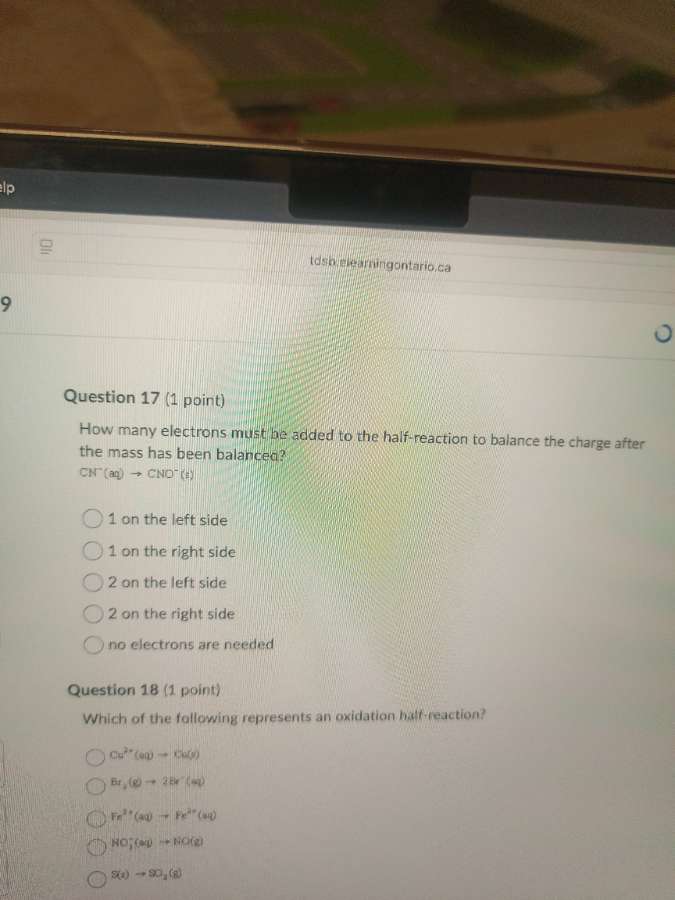
question 17 (1 point)
how many electrons must be added to the half - reaction to balance the charge after
the mass has been balanced?
cn⁻(aq) → cno⁻(s)
1 on the left side
1 on the right side
2 on the left side
2 on the right side
no electrons are needed
question 18 (1 point)
which of the following represents an oxidation half - reaction?
cu²⁺(aq) → cu(s)
br₂(l) → 2br⁻(aq)
fe²⁺(aq) → fe³⁺(aq)
no₃⁻(aq) → no(g)
so₃²⁻(aq) → so₄²⁻(aq)
Question 17
Step1: Determine initial charges
The reactant is \( \text{CN}^-(aq) \), so the charge on the left side (before balancing electrons) is -1. The product is \( \text{CNO}^-(s) \), so the charge on the right side is -1? Wait, no, wait. Wait, let's check the oxidation states or just the charge. Wait, no, maybe I made a mistake. Wait, let's balance the mass first. Wait, the half - reaction is \( \text{CN}^-(aq)
ightarrow\text{CNO}^-(s) \). Let's balance O and H (assuming acidic or basic? Wait, maybe basic? Wait, but first, mass balance. Let's see, C and N are balanced. Now, for O: we need to add \( \text{H}_2\text{O} \) or \( \text{OH}^- \)? Wait, maybe it's a basic solution? Wait, but the question is about charge balance after mass balance. Wait, maybe I was wrong. Wait, let's calculate the charge on each side. The left side: \( \text{CN}^- \) has a charge of -1. The right side: \( \text{CNO}^- \) has a charge of -1? No, wait, maybe the oxidation state of C: in \( \text{CN}^- \), C is +2 (since N is -3, +2 + (-3)= -1). In \( \text{CNO}^- \), N is -3, O is -2, so C + (-3)+(-2)= -1 → C = +4. So C is oxidized from +2 to +4, so it loses 2 electrons? Wait, no, wait the charge balance. Wait, maybe I messed up. Wait, let's do charge balance. Left side charge: -1. Right side charge: -1? No, that can't be. Wait, maybe the half - reaction is in basic medium. Let's balance the half - reaction properly.
- Balance non - O, non - H atoms: C and N are balanced.
- Balance O: Add \( \text{H}_2\text{O} \) to the left side? Wait, no, right side has O. So \( \text{CN}^-(aq)
ightarrow\text{CNO}^-(s) \). To balance O, add \( \text{H}_2\text{O} \) to the left: \( \text{CN}^-(aq)+\text{H}_2\text{O}(l)
ightarrow\text{CNO}^-(s) \)
- Balance H: Add \( \text{H}^+ \) to the right: \( \text{CN}^-(aq)+\text{H}_2\text{O}(l)
ightarrow\text{CNO}^-(s) + 2\text{H}^+(aq) \)
- Balance charge: Left side charge: - 1 (from \( \text{CN}^- \)) + 0 (from \( \text{H}_2\text{O} \))=-1. Right side charge: - 1 (from \( \text{CNO}^- \))+2(+1) (from \( 2\text{H}^+ \)) = +1. Wait, that can't be. Wait, maybe it's basic medium. So after adding \( \text{H}^+ \), we add \( \text{OH}^- \) to both sides. So add 2 \( \text{OH}^- \) to both sides: \( \text{CN}^-(aq)+\text{H}_2\text{O}(l)+2\text{OH}^-(aq)
ightarrow\text{CNO}^-(s)+2\text{H}_2\text{O}(l) \)
Simplify: \( \text{CN}^-(aq)+2\text{OH}^-(aq)
ightarrow\text{CNO}^-(s)+\text{H}_2\text{O}(l) \)
Now, charge balance: Left side: charge of \( \text{CN}^- \) is - 1, charge of \( 2\text{OH}^- \) is - 2, total charge: - 3. Right side: charge of \( \text{CNO}^- \) is - 1, charge of \( \text{H}_2\text{O} \) is 0, total charge: - 1. So to balance charge, we need to add electrons. The difference in charge is (-1)-(-3) = +2. So we need to add 2 electrons to the right side? Wait, no. Wait, oxidation: loss of electrons. C goes from +2 to +4, so it loses 2 electrons. So the half - reaction is \( \text{CN}^-(aq)+2\text{OH}^-(aq)
ightarrow\text{CNO}^-(s)+\text{H}_2\text{O}(l)+2e^- \). So the electrons are on the right side, and the number of electrons is 2. Wait, but maybe I overcomplicated. Let's go back to the question: "How many electrons must be added to the half - reaction to balance the charge after the mass has been balanced?". Let's consider the charge before electron balance. Left side: \( \text{CN}^- \) has charge - 1. Right side: \( \text{CNO}^- \) has charge - 1? No, that's not right. Wait, maybe the mass balance is already done (assuming that C, N are balanced, and maybe O is balanced by some means). Wait, maybe the problem is simpler. Le…
To determine an oxidation half - reaction, we look for a reaction where the oxidation state of an element increases (loss of electrons).
- For \( \text{Cu}^{2 + }(aq)
ightarrow\text{Cu}(s) \): Cu goes from +2 to 0, gain of electrons (reduction).
- For \( \text{Br}_2(l)
ightarrow2\text{Br}^-(aq) \): Br goes from 0 to - 1, gain of electrons (reduction).
- For \( \text{Fe}^{2 + }(aq)
ightarrow\text{Fe}^{3 + }(aq) \): Fe goes from +2 to +3, loss of electrons (oxidation).
- For \( \text{NO}_3^-(aq)
ightarrow\text{NO}(g) \): N goes from +5 to +2, gain of electrons (reduction).
- For \( \text{SO}_2(g)
ightarrow\text{SO}_3(g) \): S goes from +4 to +6, loss of electrons (oxidation)? Wait, wait the last option: \( \text{SO}(g)
ightarrow\text{SO}_3(s) \)? Wait, the original option is \( \text{SO}(g)
ightarrow\text{SO}_3(s) \)? Wait, maybe a typo, but among the given options, \( \text{Fe}^{2 + }(aq)
ightarrow\text{Fe}^{3 + }(aq) \) is an oxidation half - reaction as Fe loses an electron (oxidation state increases from +2 to +3). Also, \( \text{SO}(g)
ightarrow\text{SO}_3(s) \): S in SO is +2, in \( \text{SO}_3 \) is +4, so it's also oxidation. But among the options, \( \text{Fe}^{2 + }(aq)
ightarrow\text{Fe}^{3 + }(aq) \) is a clear oxidation half - reaction (loss of electron, increase in oxidation state).

Snap & solve any problem in the app
Get step-by-step solutions on Sovi AI
Photo-based solutions with guided steps
Explore more problems and detailed explanations
2 on the right side