QUESTION IMAGE
Question
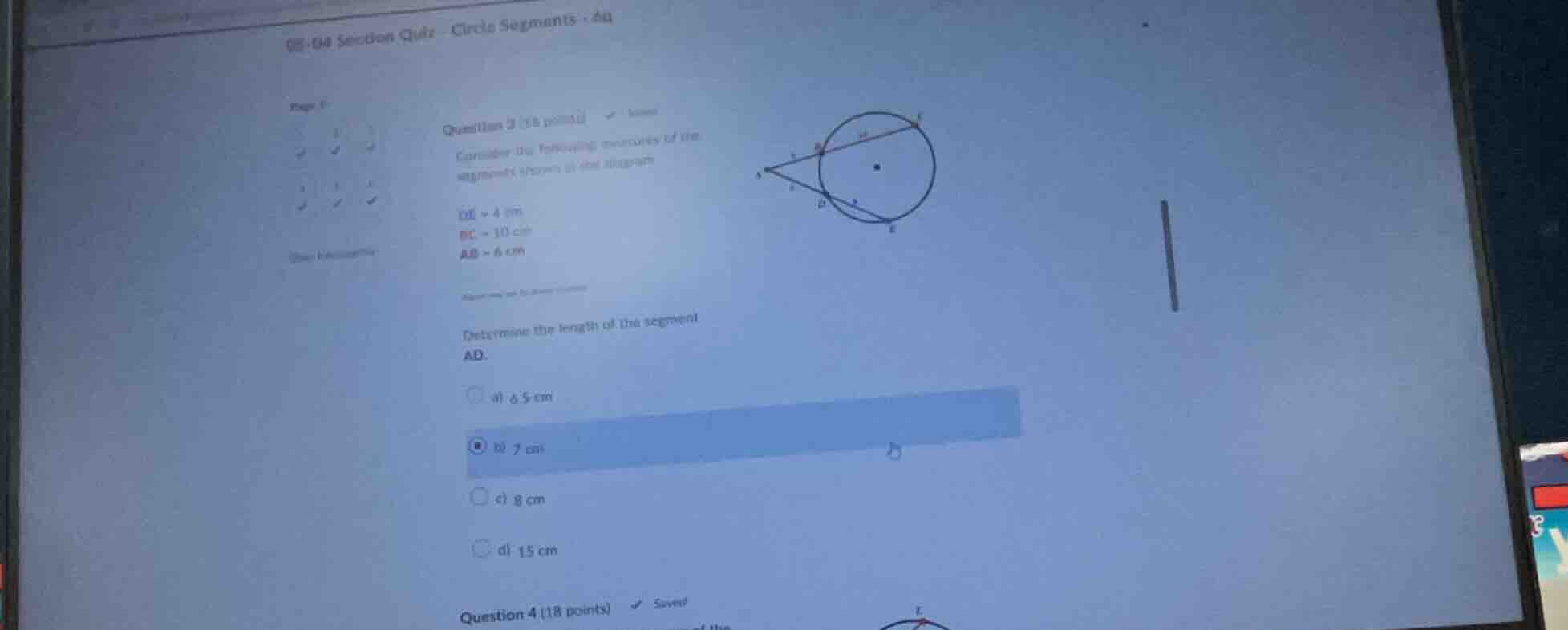
question 3 (18 points) consider the following measures of the segments shown in the diagram de = 4 cm bc = 10 cm ab = 6 cm determine the length of the segment ad. a) 6.5 cm b) 7 cm c) 8 cm d) 15 cm
Step1: Recall the Power of a Point Theorem
The Power of a Point Theorem states that for a point \( A \) outside a circle, if a secant segment \( ABC \) (where \( AB \) is the external part and \( BC \) is the internal part of the secant) and a tangent segment \( AD \) (or a secant segment \( ADE \) where \( AD \) is the external part and \( DE \) is the internal part) are drawn from \( A \) to the circle, then \( AB \times AC = AD \times AE \). But in the case of two secant segments, if we have two secant segments \( ABC \) and \( ADE \) (where \( AB \) and \( AD \) are the external parts, \( BC \) and \( DE \) are the internal parts), the formula is \( AB \times (AB + BC)=AD \times (AD + DE) \). Wait, actually, the correct formula for two secant segments from a common external point \( A \) is: if one secant has external length \( x \) and internal length \( y \), and the other secant has external length \( x \) (wait, no, same external point, so let's define: let \( AD = x \), \( AB = 6 \) cm, \( BC = 10 \) cm, \( DE = 4 \) cm. Then the secant \( ABC \) has length \( AB + BC=6 + 10 = 16 \) cm, and the secant \( ADE \) has length \( AD + DE=x + 4 \) cm. By the Power of a Point Theorem, \( AB\times(AB + BC)=AD\times(AD + DE) \), so \( 6\times(6 + 10)=x\times(x + 4) \). Wait, no, that's not right. Wait, the correct formula is: if a secant from \( A \) passes through \( B \) (external) and \( C \) (internal), so \( AB \) is the external segment, \( BC \) is the internal segment, so the entire secant length is \( AB + BC \). And another secant from \( A \) passes through \( D \) (external) and \( E \) (internal), so \( AD \) is the external segment, \( DE \) is the internal segment, entire secant length is \( AD + DE \). Then the Power of a Point Theorem states that \( AB\times(AB + BC)=AD\times(AD + DE) \)? No, wait, no. The correct formula is \( AB\times AC = AD\times AE \), where \( AC = AB + BC \) and \( AE = AD + DE \). So \( AB\times(AB + BC)=AD\times(AD + DE) \). Let's let \( AD = x \). Then:
\( 6\times(6 + 10)=x\times(x + 4) \)
\( 6\times16=x(x + 4) \)
\( 96=x^{2}+4x \)
\( x^{2}+4x - 96 = 0 \)
Wait, that quadratic equation: \( x^{2}+4x - 96 = 0 \). Let's solve for \( x \). Using quadratic formula: \( x=\frac{-4\pm\sqrt{16 + 384}}{2}=\frac{-4\pm\sqrt{400}}{2}=\frac{-4\pm20}{2} \). We take the positive root: \( \frac{-4 + 20}{2}=\frac{16}{2}=8 \)? Wait, but that's not matching the options. Wait, maybe I made a mistake in the formula. Wait, maybe the diagram is such that \( BC \) is the entire secant? Wait, no, the problem says \( BC = 10 \) cm, \( AB = 6 \) cm, \( DE = 4 \) cm. Wait, maybe the diagram is that \( AB \) is the external part, \( BC \) is the chord (so the secant is \( AB + BC \), but actually, in the Power of a Point, for a secant and a secant, the formula is \( AB \times AC = AD \times AE \), where \( AC = AB + BC \) (if \( B \) is between \( A \) and \( C \)) and \( AE = AD + DE \) (if \( D \) is between \( A \) and \( E \)). Wait, maybe the labels are different. Wait, maybe \( BC \) is the length of the chord, and \( AB \) is the external segment, so the secant length is \( AB + BC \)? No, that doesn't make sense. Wait, maybe the correct formula is that if two secants are drawn from \( A \), one intersecting the circle at \( B \) and \( C \) (with \( AB \) being the external part, \( BC \) the internal part), and the other intersecting at \( D \) and \( E \) (with \( AD \) external, \( DE \) internal), then \( AB \times (AB + BC)=AD \times (AD + DE) \). Let's plug in the numbers. Let \( AD = x \). Then \(…

Snap & solve any problem in the app
Get step-by-step solutions on Sovi AI
Photo-based solutions with guided steps
Explore more problems and detailed explanations
\( \boxed{8} \) (corresponding to option c: 8 cm)