QUESTION IMAGE
Question
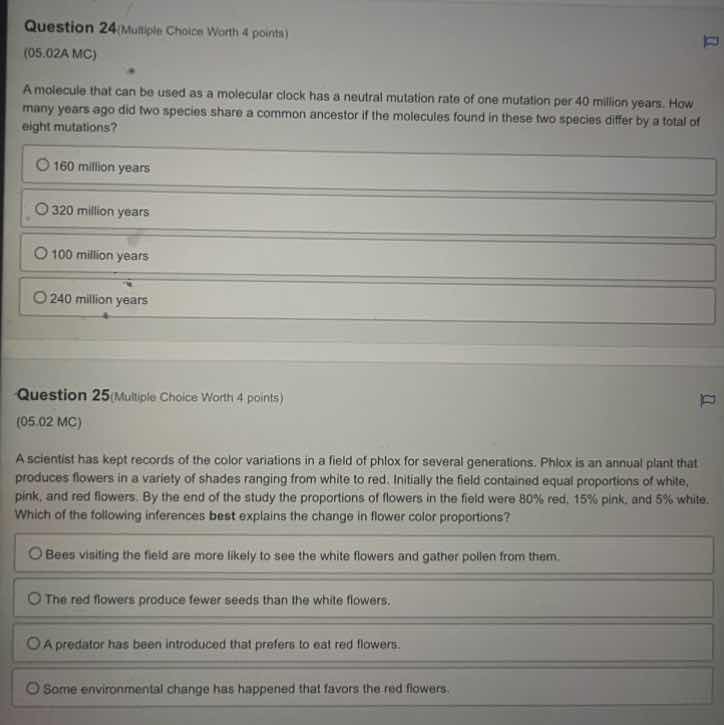
question 24 (multiple choice worth 4 points) (05.02a mc) a molecule that can be used as a molecular clock has a neutral mutation rate of one mutation per 40 million years. how many years ago did two species share a common ancestor if the molecules found in these two species differ by a total of eight mutations? 160 million years 320 million years 100 million years 240 million years question 25 (multiple choice worth 4 points) (05.02 mc) a scientist has kept records of the color variations in a field of phlox for several generations. phlox is an annual plant that produces flowers in a variety of shades ranging from white to red. initially the field contained equal proportions of white, pink, and red flowers. by the end of the study the proportions of flowers in the field were 80% red, 15% pink, and 5% white. which of the following inferences best explains the change in flower color proportions? bees visiting the field are more likely to see the white flowers and gather pollen from them. the red flowers produce fewer seeds than the white flowers. a predator has been introduced that prefers to eat red flowers. some environmental change has happened that favors the red flowers.
Question 24
Step1: Understand the mutation rate
The molecular clock has a neutral mutation rate of 1 mutation per 40 million years.
Step2: Calculate total time for 8 mutations
If 1 mutation occurs in 40 million years, then for 8 mutations, the time is $8\times40$ million years.
$8\times40 = 320$ million years.
- Option 1: If bees prefer white flowers, white flowers would reproduce more, but red flowers increased, so this is incorrect.
- Option 2: If red flowers produce fewer seeds, their proportion should decrease, not increase, so incorrect.
- Option 3: If a predator prefers red flowers, red flowers' proportion should decrease, incorrect.
- Option 4: An environmental change favoring red flowers would lead to more red flowers surviving and reproducing, increasing their proportion, which matches the data.

Snap & solve any problem in the app
Get step-by-step solutions on Sovi AI
Photo-based solutions with guided steps
Explore more problems and detailed explanations
320 million years (corresponding to the option "320 million years")