QUESTION IMAGE
Question
question 7 of 50
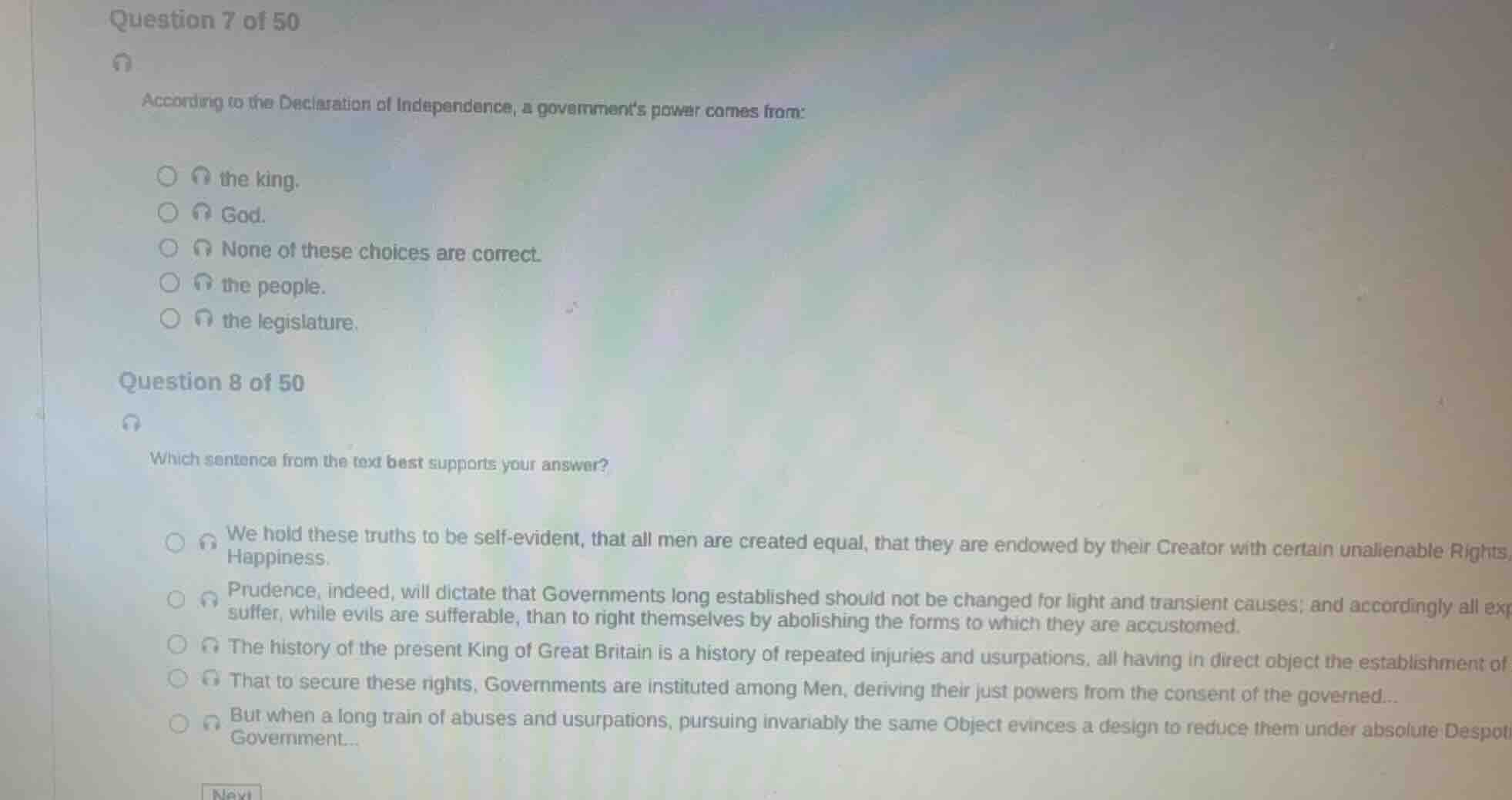
according to the declaration of independence, a governments power comes from:
○ the king.
○ god.
○ none of these choices are correct.
○ the people.
○ the legislature.
question 8 of 50
which sentence from the text best supports your answer?
○ we hold these truths to be self - evident, that all men are created equal, that they are endowed by their creator with certain unalienable rights, happiness.
○ prudence, indeed, will dictate that governments long established should not be changed for light and transient causes; and accordingly all exp suffer, while evils are sufferable, than to right themselves by abolishing the forms to which they are accustomed.
○ the history of the present king of great britain is a history of repeated injuries and usurpations, all having in direct object the establishment of
○ that to secure these rights, governments are instituted among men, deriving their just powers from the consent of the governed..
○ but when a long train of abuses and usurpations, pursuing invariably the same object evinces a design to reduce them under absolute despot government...
Question 7
The Declaration of Independence states that governments derive their just powers from the consent of the governed (the people). The king, God, and the legislature are not the sources of a government's power as per the Declaration. So the correct option is the one related to the people.
The sentence "That to secure these rights, Governments are instituted among Men, deriving their just powers from the consent of the governed..." directly supports the idea that a government's power comes from the people (the governed), which aligns with the answer to Question 7. Other sentences focus on rights, government change, or the king's actions, not the source of government power.

Snap & solve any problem in the app
Get step-by-step solutions on Sovi AI
Photo-based solutions with guided steps
Explore more problems and detailed explanations
D. the people (assuming the options are labeled A to E with D being "the people")