QUESTION IMAGE
Question
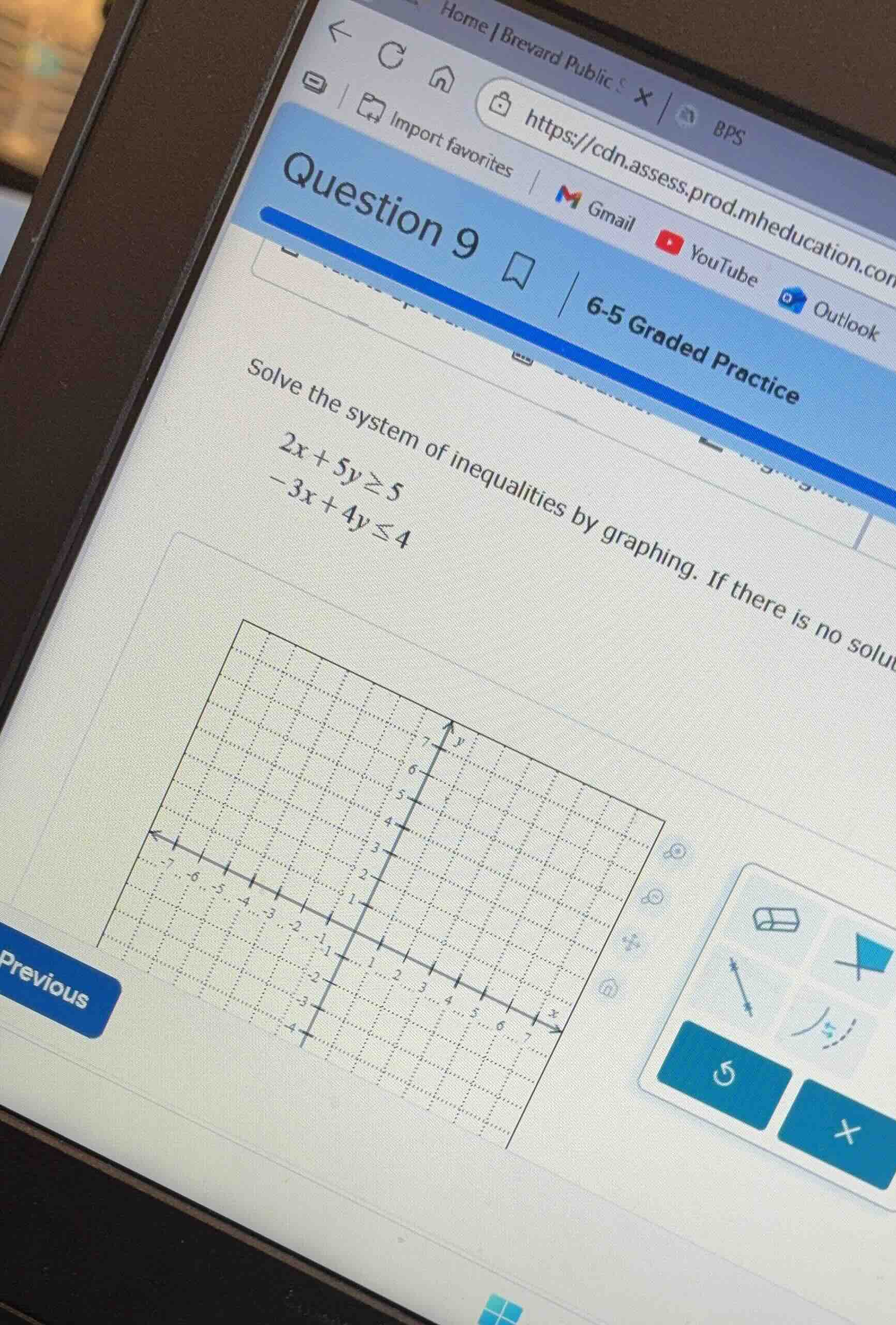
question 9 6-5 graded practice solve the system of inequalities by graphing. if there is no solut 2x + 5y ≥ 5 -3x + 4y ≤ 4
Step1: Rewrite the first inequality
For the inequality \(2x + 5y\geq5\), we solve for \(y\):
\[
\]
This is a linear inequality. The boundary line is \(y = -\frac{2}{5}x+1\) (a straight line with slope \(-\frac{2}{5}\) and \(y\)-intercept \(1\)). Since the inequality is \(\geq\), we draw a solid line and shade the region above the line.
Step2: Rewrite the second inequality
For the inequality \(-3x + 4y\leq4\), we solve for \(y\):
\[
\]
The boundary line is \(y=\frac{3}{4}x + 1\) (a straight line with slope \(\frac{3}{4}\) and \(y\)-intercept \(1\)). Since the inequality is \(\leq\), we draw a solid line and shade the region below the line.
Step3: Find the intersection region
To solve the system, we find the region that is shaded by both inequalities.
- First, plot the line \(y = -\frac{2}{5}x + 1\): when \(x = 0\), \(y=1\); when \(y = 0\), \(2x=5\) so \(x=\frac{5}{2}=2.5\).
- Then, plot the line \(y=\frac{3}{4}x + 1\): when \(x = 0\), \(y = 1\); when \(y=0\), \(- 3x=4\) so \(x=-\frac{4}{3}\approx - 1.33\).
The two lines intersect at \((0,1)\) (by setting \(-\frac{2}{5}x + 1=\frac{3}{4}x + 1\), we get \(-\frac{2}{5}x=\frac{3}{4}x\), \(-\frac{8}{20}x-\frac{15}{20}x = 0\), \(-\frac{23}{20}x=0\) so \(x = 0\) and then \(y = 1\)).
The solution region is the set of all points \((x,y)\) that are above (or on) \(y=-\frac{2}{5}x + 1\) and below (or on) \(y=\frac{3}{4}x + 1\). To describe the solution, we can also find the intersection of the two half - planes.

Snap & solve any problem in the app
Get step-by-step solutions on Sovi AI
Photo-based solutions with guided steps
Explore more problems and detailed explanations
The solution to the system of inequalities is the region that lies above (or on) the line \(y = -\frac{2}{5}x + 1\) and below (or on) the line \(y=\frac{3}{4}x + 1\). In set - builder notation, it is \(\{(x,y):y\geq-\frac{2}{5}x + 1\text{ and }y\leq\frac{3}{4}x + 1\}\). If we want to find the vertices of the solution region (if it is a polygon), we can also find the intersection of the boundary lines with the axes and with each other. The intersection of the two boundary lines is \((0,1)\), the intersection of \(y = -\frac{2}{5}x + 1\) with the \(x\) - axis is \((2.5,0)\), and the intersection of \(y=\frac{3}{4}x + 1\) with the \(x\) - axis is \((-\frac{4}{3},0)\). But the main description of the solution is the region defined by the two inequalities.