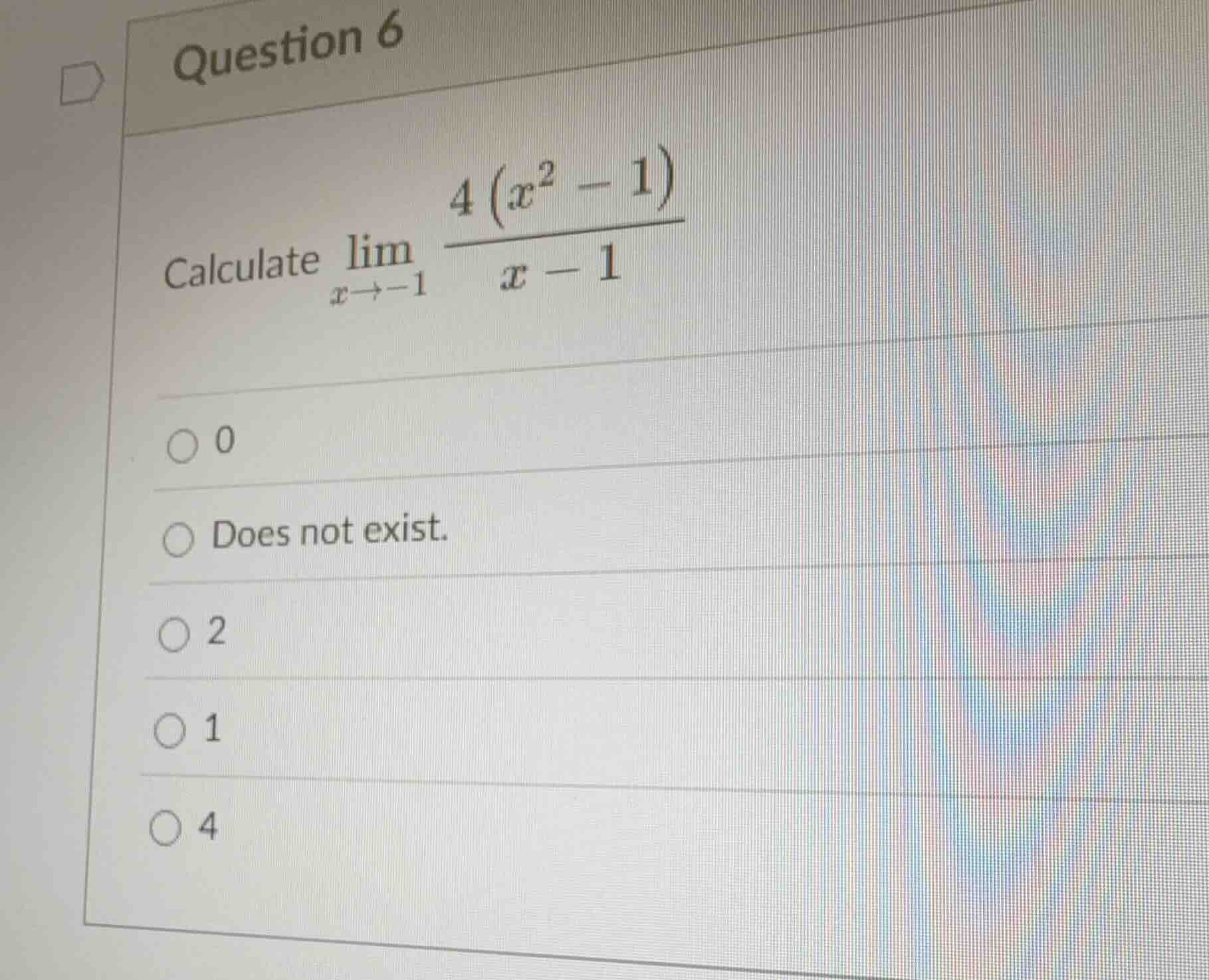
QUESTION IMAGE
Question
question 6
calculate \\(\lim\limits_{x\to -1} \dfrac{4\left(x^2 - 1\
ight)}{x - 1}\\)
\\(\bigcirc\\) 0
\\(\bigcirc\\) does not exist.
\\(\bigcirc\\) 2
\\(\bigcirc\\) 1
\\(\bigcirc\\) 4
Step1: Factor the numerator
We know that \(x^2 - 1\) can be factored using the difference of squares formula \(a^2 - b^2=(a + b)(a - b)\). So, \(x^2 - 1=(x + 1)(x - 1)\).
Substituting this into the function, we get:
\(\frac{4(x^2 - 1)}{x - 1}=\frac{4(x + 1)(x - 1)}{x - 1}\)
Step2: Cancel common factors
As long as \(x
eq1\) (since we are taking the limit as \(x
ightarrow - 1\), \(x = 1\) is not in the neighborhood of \(x=-1\)), we can cancel the common factor \((x - 1)\) from the numerator and the denominator.
After canceling, the function simplifies to \(4(x + 1)\).
Step3: Evaluate the limit
Now we find the limit as \(x
ightarrow - 1\) of \(4(x + 1)\).
Using the limit laws, \(\lim_{x
ightarrow - 1}4(x + 1)=4\times(\lim_{x
ightarrow - 1}x+\lim_{x
ightarrow - 1}1)\)
We know that \(\lim_{x
ightarrow - 1}x=-1\) and \(\lim_{x
ightarrow - 1}1 = 1\).
So, \(4\times(-1 + 1)=4\times0 = 0\)

Snap & solve any problem in the app
Get step-by-step solutions on Sovi AI
Photo-based solutions with guided steps
Explore more problems and detailed explanations
0