QUESTION IMAGE
Question
question
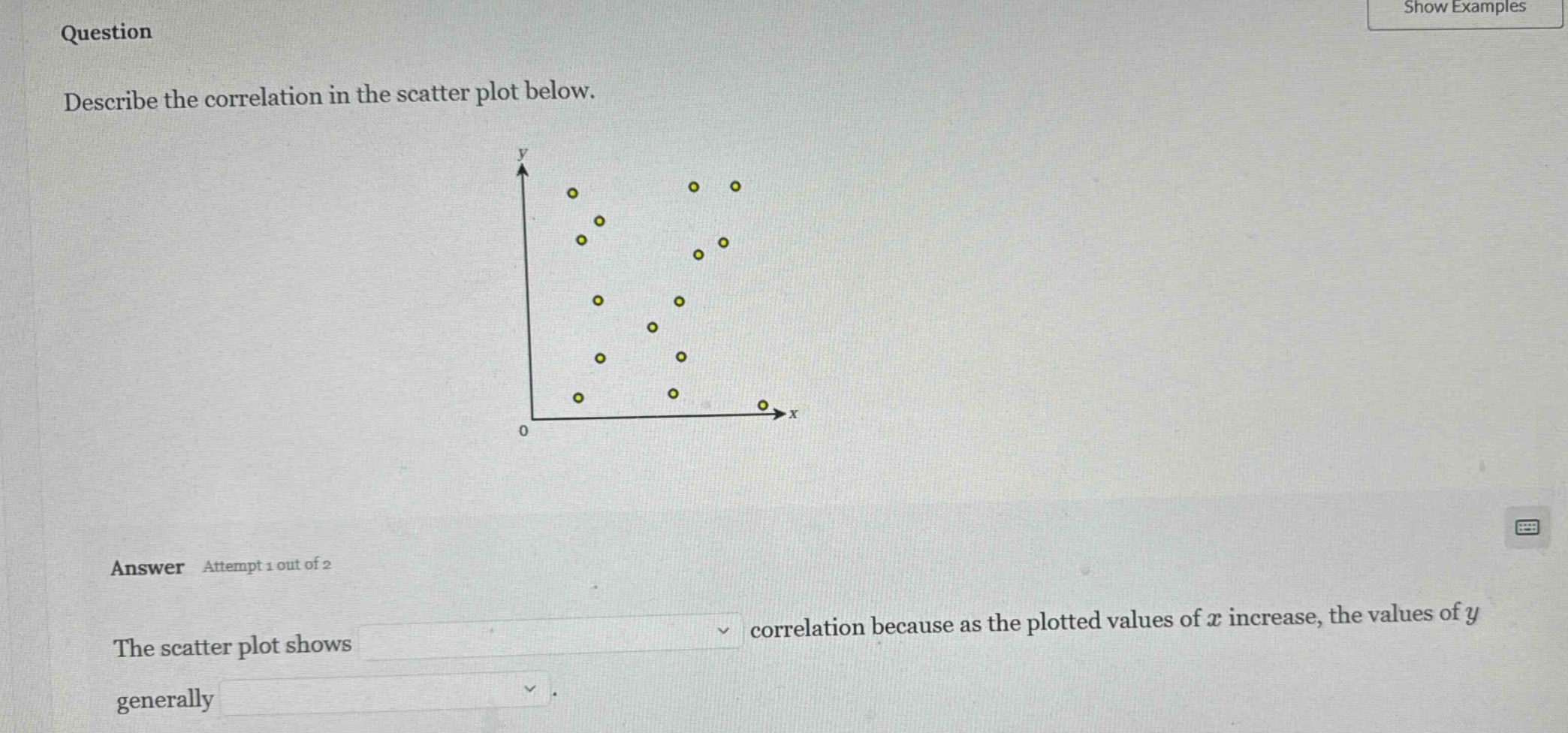
describe the correlation in the scatter plot below.
answer attempt 1 out of 2
the scatter plot shows
correlation because as the plotted values of ( x ) increase, the values of ( y ) generally
.
To determine the correlation, we analyze the scatter plot. Observing the points, there's no clear upward or downward trend as \( x \) increases. The points are scattered randomly, indicating no linear relationship. So the correlation is "no" (or "zero") and as \( x \) increases, \( y \) doesn't show a consistent increase or decrease (so "stay the same" or "have no clear trend", but for the first blank, "no" (or "zero") correlation, and the second blank: since there's no trend, if we consider the options (likely "no", "positive", "negative" for first; "increase", "decrease", "stay the same" for second), the points are scattered, so first is "no" (or "zero") correlation, and as \( x \) increases, \( y \) generally "do not follow a trend" (but in typical options, first blank: "no" (or "zero"), second blank: "stay the same" or "have no clear pattern", but more precisely, when points are scattered with no linear trend, it's "no correlation" and \( y \) doesn't increase or decrease consistently, so "stay the same" (or "not show a consistent increase/decrease").

Snap & solve any problem in the app
Get step-by-step solutions on Sovi AI
Photo-based solutions with guided steps
Explore more problems and detailed explanations
The scatter plot shows \(\boldsymbol{\text{no}}\) correlation because as the plotted values of \( x \) increase, the values of \( y \) generally \(\boldsymbol{\text{stay the same}}\) (or "do not follow a consistent trend").
(Note: If the dropdown options are "positive", "negative", "no" for the first blank, and "increase", "decrease", "stay the same" for the second, then the correct choices are "no" for the first and "stay the same" (or the equivalent option in the dropdown) for the second.)