QUESTION IMAGE
Question
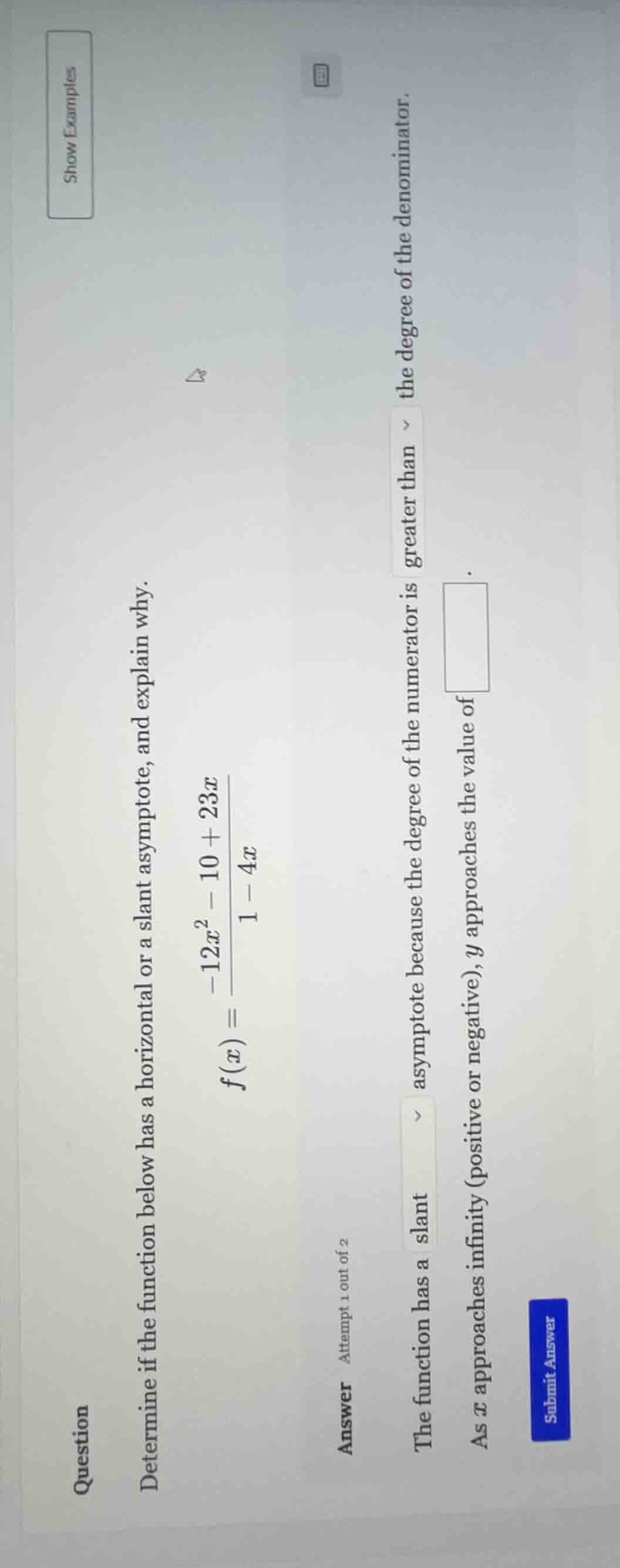
question determine if the function below has a horizontal or a slant asymptote, and explain why. \\( f(x) = \frac{-12x^2 - 10 + 23x}{1 - 4x} \\) answer attempt 1 out of 2 the function has a slant asymptote because the degree of the numerator is greater than the degree of the denominator. as \\( x \\) approaches infinity (positive or negative), \\( y \\) approaches the value of \\( \square \\).
Step1: Analyze degrees of numerator and denominator
The numerator is \(-12x^2 - 10 + 23x\) (rewritten as \(-12x^2 + 23x - 10\)), so its degree is \(2\) (the highest power of \(x\) is \(2\)). The denominator is \(1 - 4x\) (or \(-4x + 1\)), so its degree is \(1\). Since \(2>1\), the function has a slant asymptote (we find it by polynomial long division).
Step2: Perform polynomial long division
Divide \(-12x^2 + 23x - 10\) by \(-4x + 1\).
First term: \(\frac{-12x^2}{-4x}=3x\). Multiply \(-4x + 1\) by \(3x\): \(3x(-4x + 1)=-12x^2 + 3x\).
Subtract from numerator: \((-12x^2 + 23x - 10)-(-12x^2 + 3x)=20x - 10\).
Next term: \(\frac{20x}{-4x}=-5\). Multiply \(-4x + 1\) by \(-5\): \(-5(-4x + 1)=20x - 5\).
Subtract: \((20x - 10)-(20x - 5)=-5\).
So, \(\frac{-12x^2 + 23x - 10}{-4x + 1}=3x - 5+\frac{-5}{-4x + 1}\). As \(x\to\pm\infty\), the fraction \(\frac{-5}{-4x + 1}\to0\), so \(y\) approaches \(3x - 5\). But the question asks for the slant asymptote's equation (or the linear function \(y\) approaches). Wait, actually, when we do the division, the slant asymptote is the quotient (ignoring the remainder fraction). So the slant asymptote is \(y = 3x - 5\). But the problem's second part: "As \(x\) approaches infinity (positive or negative), \(y\) approaches the value of..." Wait, no—wait, the slant asymptote is a line, so as \(x\to\pm\infty\), \(y\) approaches the slant asymptote line \(y = 3x - 5\). But maybe the question is asking for the slant asymptote's equation, or the linear function. Wait, let's re - check.
Wait, the function is \(f(x)=\frac{-12x^2 + 23x - 10}{1 - 4x}\). Let's simplify the division again.
Dividend: \(-12x^2+23x - 10\), Divisor: \(-4x + 1\).
\(-12x^2\div(-4x)=3x\). Multiply divisor by \(3x\): \(3x(-4x + 1)=-12x^2+3x\). Subtract from dividend: \((-12x^2 + 23x - 10)-(-12x^2 + 3x)=20x - 10\).
\(20x\div(-4x)=-5\). Multiply divisor by \(-5\): \(-5(-4x + 1)=20x - 5\). Subtract: \((20x - 10)-(20x - 5)=-5\).
So \(f(x)=3x - 5+\frac{-5}{-4x + 1}\). As \(x\to\infty\) (or \(x\to-\infty\)), \(\frac{-5}{-4x + 1}\to0\), so \(y\) approaches \(3x - 5\). But the problem's text: "As \(x\) approaches infinity (positive or negative), \(y\) approaches the value of..." Wait, maybe there's a mis - reading. Wait, the slant asymptote is a linear function, so as \(x\) gets very large (positive or negative), \(y\) gets close to the line \(y = 3x - 5\). But if we consider the leading terms: for large \(|x|\), the function behaves like \(\frac{-12x^2}{-4x}=3x\) (wait, no, wait: \(\frac{ax^n}{bx^m}\) for large \(x\) is \(\frac{a}{b}x^{n - m}\). Here \(n = 2\), \(m = 1\), so \(n - m=1\), so it's a linear function, i.e., slant asymptote. The long division gives the exact slant asymptote as \(y = 3x - 5\). But maybe the question is asking for the slant asymptote's equation, so when \(x\) approaches infinity, \(y\) approaches \(3x - 5\). But let's check the calculation again. Wait, maybe I made a sign error. Let's redo the division with denominator \(1 - 4x=-4x + 1\).
Dividing \(-12x^2 + 23x - 10\) by \(-4x + 1\):
\(-12x^2\div(-4x)=3x\). Multiply \(-4x + 1\) by \(3x\): \(3x\times(-4x)+3x\times1=-12x^2 + 3x\). Subtract from numerator: \((-12x^2 + 23x - 10)-(-12x^2 + 3x)=20x - 10\).
Then \(20x\div(-4x)=-5\). Multiply \(-4x + 1\) by \(-5\): \(-5\times(-4x)+(-5)\times1=20x - 5\). Subtract: \((20x - 10)-(20x - 5)=-5\). So the division is correct: \(f(x)=3x - 5+\frac{-5}{-4x + 1}\). So as \(x\to\pm\infty\), \(\frac{-5}{-4x + 1}\to0\), so \(y\) approaches \(3x - 5\).

Snap & solve any problem in the app
Get step-by-step solutions on Sovi AI
Photo-based solutions with guided steps
Explore more problems and detailed explanations
The slant asymptote is \(y = 3x - 5\), so as \(x\) approaches infinity (positive or negative), \(y\) approaches \(3x - 5\). If we consider the linear part (the slant asymptote), the answer is \(y = 3x - 5\) (or just the linear function \(3x - 5\)).