QUESTION IMAGE
Question
question
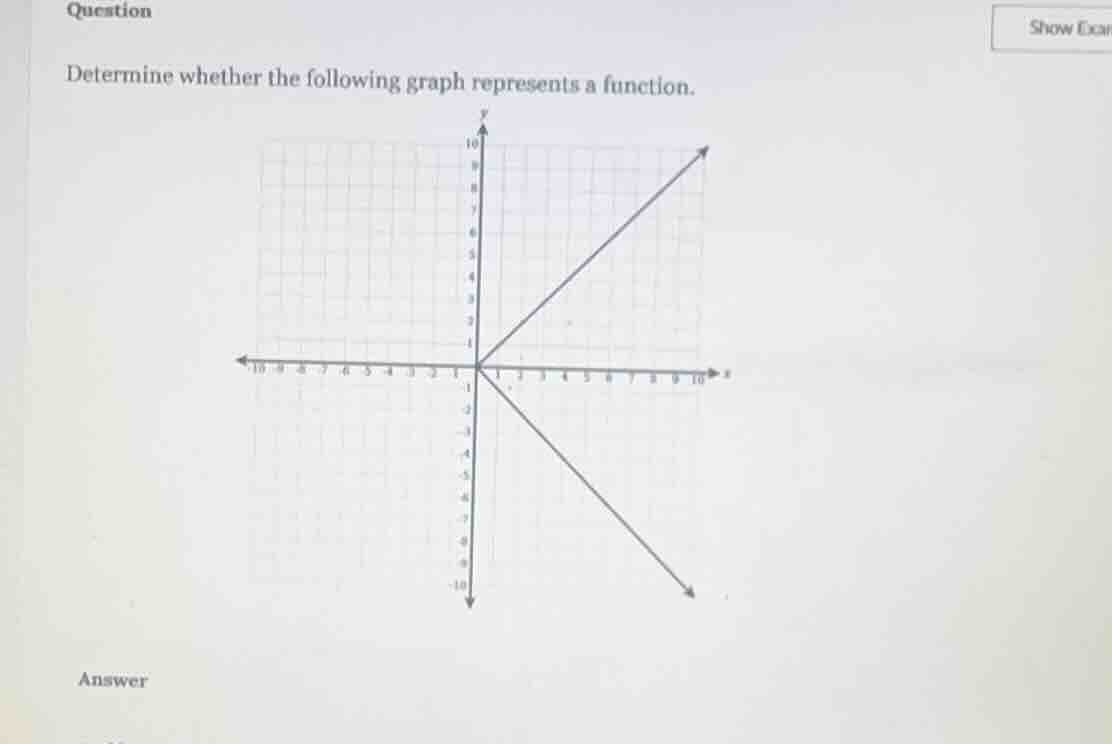
determine whether the following graph represents a function.
answer
Step1: Recall the vertical line test
A graph represents a function if every vertical line intersects the graph at most once.
Step2: Apply the vertical line test to the given graph
For the given graph (two lines through the origin, one in the first and third quadrants? Wait, no, looking at the graph: one line is in the first and third? Wait, no, the graph has two lines: one going from the origin up to the first quadrant, and another going from the origin down to the fourth quadrant? Wait, no, actually, when we draw a vertical line (e.g., \(x = 1\)), how many times does it intersect the graph? Let's check \(x = 1\). The upper line (positive slope) at \(x = 1\) has a \(y\)-value, and the lower line (negative slope) at \(x = 1\) also has a \(y\)-value. Wait, no, wait the graph: actually, the two lines: one is \(y = x\) (upper, from origin to first quadrant) and the other is \(y=-x\) (lower, from origin to fourth quadrant)? Wait, no, when \(x = 1\), for \(y = x\), \(y = 1\); for \(y=-x\), \(y=-1\). Wait, but a vertical line at \(x = 1\) would intersect both lines? Wait, no, wait the graph: actually, the two lines are such that for a given \(x\) (except \(x = 0\)), there are two \(y\)-values? Wait, no, wait the graph: let's see, the upper line is from (0,0) going to (10,10) (positive slope), and the lower line is from (0,0) going to (10,-10) (negative slope). So for any \(x>0\), a vertical line at that \(x\) will intersect both lines, meaning two \(y\)-values for the same \(x\). Wait, but the vertical line test: if any vertical line intersects the graph more than once, it's not a function. So for \(x = 1\), vertical line \(x = 1\) intersects the upper line at (1,1) and the lower line at (1,-1), so two points. Therefore, the graph does not pass the vertical line test.
Wait, but maybe I misread the graph. Wait, the original graph: the two lines, are they such that for each \(x\), there's only one \(y\)? No, because for \(x = 1\), two \(y\)-values. So the vertical line test fails.

Snap & solve any problem in the app
Get step-by-step solutions on Sovi AI
Photo-based solutions with guided steps
Explore more problems and detailed explanations
The graph does not represent a function.