QUESTION IMAGE
Question
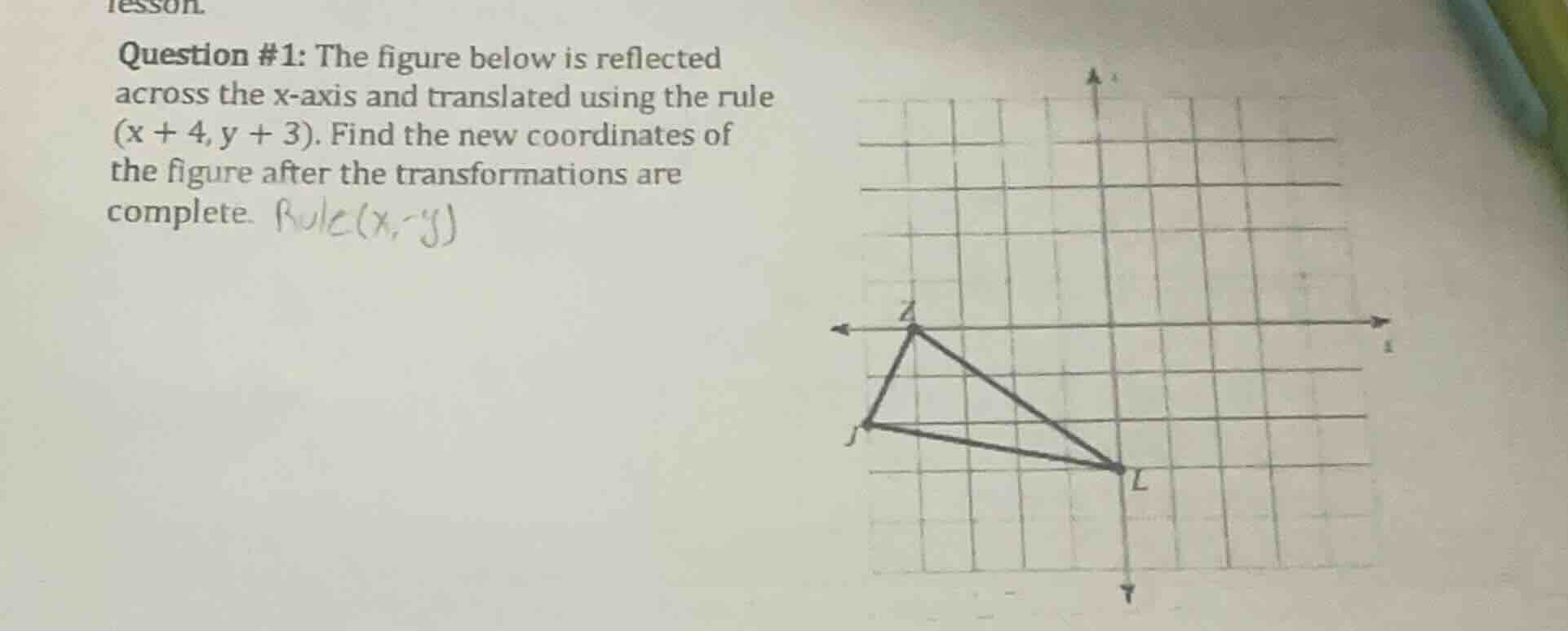
question #1: the figure below is reflected across the x - axis and translated using the rule (x + 4, y + 3). find the new coordinates of the figure after the transformations are complete. rule (x, -y)
First, we need to determine the original coordinates of the vertices of the triangle (let's assume the vertices are Z, J, L). From the graph, let's find their original coordinates:
- Let's assume Z is at \((-4, 0)\), J is at \((-5, -2)\), and L is at \((0, -3)\) (we need to confirm the coordinates from the grid; let's check the positions: Z is on the x - axis, 4 units left of the origin, so \((-4,0)\); J is 5 units left on x and 2 units down on y, so \((-5, -2)\); L is at the origin's x = 0 and y=-3, so \((0, -3)\)).
Step 1: Reflect across the x - axis
The rule for reflection across the x - axis is \((x,y)\to(x, -y)\).
- For point Z \((-4,0)\): After reflection, \(Z_1=(-4, - 0)=(-4,0)\)
- For point J \((-5, -2)\): After reflection, \(J_1=(-5, -(-2))=(-5,2)\)
- For point L \((0, -3)\): After reflection, \(L_1=(0, -(-3))=(0,3)\)
Step 2: Translate using the rule \((x + 4,y + 3)\)
- For point \(Z_1(-4,0)\):
New x - coordinate: \(-4+4 = 0\)
New y - coordinate: \(0 + 3=3\)
So \(Z_2=(0,3)\)
- For point \(J_1(-5,2)\):
New x - coordinate: \(-5 + 4=-1\)
New y - coordinate: \(2+3 = 5\)
So \(J_2=(-1,5)\)
- For point \(L_1(0,3)\):
New x - coordinate: \(0+4 = 4\)
New y - coordinate: \(3+3=6\)
So \(L_2=(4,6)\)

Snap & solve any problem in the app
Get step-by-step solutions on Sovi AI
Photo-based solutions with guided steps
Explore more problems and detailed explanations
If the original vertices are \(Z(-4,0)\), \(J(-5, -2)\), \(L(0, -3)\), the new coordinates after reflection and translation are \(Z(0,3)\), \(J(-1,5)\), \(L(4,6)\) (Note: The coordinates may vary slightly depending on the exact original coordinates from the grid. If the original coordinates are different, recalculate using the same steps with the correct original coordinates).